Handle with care: Moving centuries-old Hudson’s Bay charter a delicate operation
Advertisement
Read this article for free:
or
Already have an account? Log in here »
To continue reading, please subscribe:

Digital Subscription
One year of digital access for only $205*
- Enjoy unlimited reading on winnipegfreepress.com
- Read the E-Edition, our digital replica newspaper
- Access News Break, our award-winning app
- Play interactive puzzles
*First annual payment billed as $205.00 + GST for one year. This annual subscription will automatically renew at $233.00 + GST every 52 weeks (10% off the regular annual price of $259.35). Offer available to new and qualified returning subscribers only. Cancel any time.
To continue reading, please subscribe:
Add Free Press access to your Brandon Sun subscription for only an additional
$1 for the first 4 weeks*
- Enjoy unlimited reading on winnipegfreepress.com
- Read the E-Edition, our digital replica newspaper
- Access News Break, our award-winning app
- Play interactive puzzles
*Your next Brandon Sun subscription payment will increase by $1.00 and you will be charged $17.95 plus GST for four weeks. After four weeks, your payment will increase to $24.95 plus GST every four weeks.
Read unlimited articles for free today:
or
Already have an account? Log in here »
Hey there, time traveller!
This article was published 12/12/2025 (303 days ago), so information in it may no longer be current.
TORONTO – In the midst of the COVID-19 pandemic, the royal charter that created Canada’s oldest company was loaded onto a private plane in Toronto.
Protected by a durable case that was not too hot, not too cold and sheltered from bright light, the 350-year-old document that birthed the Hudson’s Bay Co. made its way to Winnipeg aboard the aircraft. It was accompanied by a member of the retailer’s staff and a conservator specializing in paper documents — and its own armed security team, who never took their eyes off the artifact.
When they landed, the charter was escorted to the Manitoba Museum, where more gloved conservators pored over every millimetre of the five-page vellum artifact and its wax seal, making detailed notes about the condition on arrival and any damage it may have sustained on the way.
“Some artifacts and belongings that we have are relatively easy to loan to other institutions, to quickly pack and to ship, but this one requires added layers,” said Amelia Fay, director of research, collections and exhibitions at the museum, where the charter was on loan from September 2020 to December 2021.
“You’re not shipping this with Canada Post or something, no offence to Canada Post.”
The lengths the company, museum and a dedicated group of conservation, security and shipping experts went to protect the charter during its 1,500-kilometre journey to Winnipeg offers a glimpse of the level of care required by the four institutions set to share the artifact forever in the wake of the company’s insolvency.
The Canadian Press spoke to a dozen experts, employees and government officials about the charter’s preservation for this story, some of whom were not authorized to speak on the record while the charter’s future was undecided.
The Thomson and Weston families joined forces to buy the charter for $18 million from Hudson’s Bay, which has been selling its assets since it collapsed and closed its stores earlier this year. The purchase and donation plan was approved by a court this week.
As part of the arrangement, the families will donate the document to The Archives of Manitoba, Manitoba Museum, Canadian Museum of History and Royal Ontario Museum, which will become its new and permanent custodians.
———
The founding document is perhaps the most important treasure from the company’s collection of 4,400 pieces of art and artifacts, including a 1935 painting by former British prime minister Winston Churchill that sold for $1.3 million at a November auction.
The animal skin document issued by King Charles II on May 2, 1670 predates Canada and set the stage for HBC’s fur trading empire and the country’s colonialization in the centuries before Confederation. It gave HBC, then called the “Governor and Company of Adventurers of England Trading into Hudson’s Bay,” control over one-third of modern Canada and Indigenous relations for decades to come.
It’s the oldest piece in HBC’s collection, in part because not all the company’s other records from that period survived. Meeting minutes from 1694 suggest documents detailing the company’s first four years of fur trades disappeared around that time, when they were “carryed away by one of their servants.”
The charter has been sitting in secured storage since HBC filed for creditor protection in the spring, though it has had many homes over the centuries.
Housed separately at the Archives of Manitoba are its nine supplemental charters, which amended the original document in the century after HBC surrendered the land it controlled to Canada in 1869.
In the lead up to the retailer’s collapse, the charter lived in a glass case in the reception area of HBC’s former headquarters at 401 Bay St. in Toronto. And because records suggest it was never publicly exhibited in Canada aside from the Winnipeg display between 2020 and 2021, only a select group of historians and people doing business with HBC have really laid eyes on it.
The charter is made up of five sheets of calligraphic writing inked on prepared animal skin — a material so “exceptionally sturdy” that archival consultant Laura Millar said it has a shelf life “in the thousands of years.”
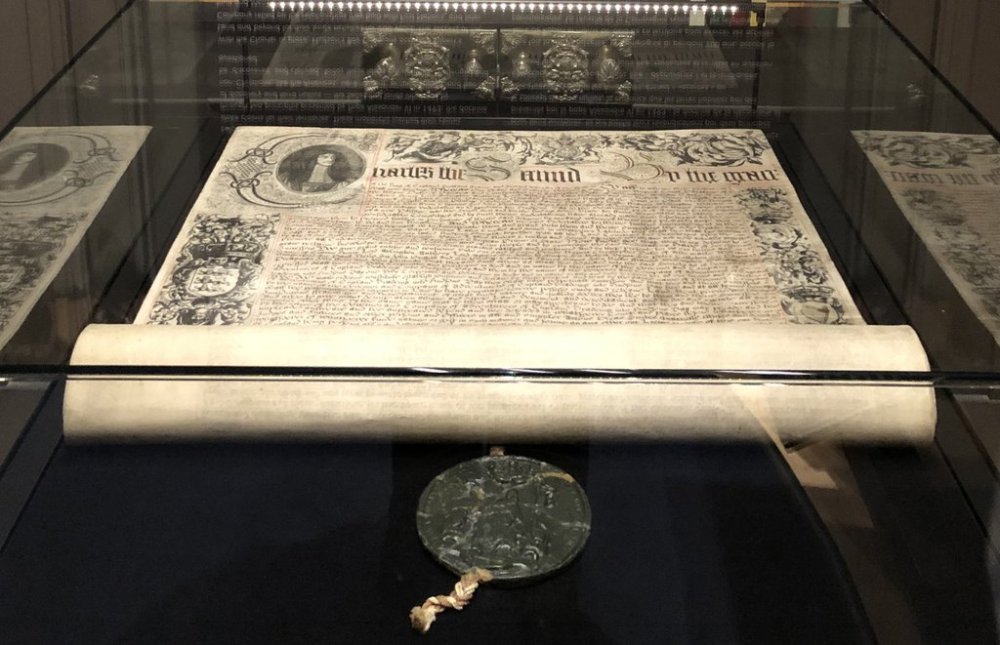
The charter is typically shown mostly unrolled, with the pages stacked on top of one another and featuring line after line of 17th century legalese. A thick border surrounding the first page shows King Charles II’s portrait and England’s coat of arms along with crowns and other ornate flourishes.
There is also its wax seal — once a semi-translucent green, now dark brown with age and wear — stamped with the Great Seal of England. Silk laces, which were used to keep the charter pages together and were typically appended to documents to denote their perpetuity, hang from the seal.
The seal is the most fragile part of the charter; some of the broken-off fragments are being stored in a separate bag.
It also has cracks, which Canadian Conservation Institute radiographs show have been repaired over the years with pins and nails. The charter itself has held up better, though wormwood was applied to parts of it at some point to make it more legible and the medicinal herb turned some of the words into illegible blotches, a 1998 article in the journal Archivaria said.
The article suggests the wormwood incident happened during the 304 years the charter lived in England, where HBC was first headquartered before shifting to Canada.
———
Prior to its move across the Atlantic, the artifact was enclosed in a series of iron chests kept at the company’s various British headquarters or records facilities at Scrivener’s Hall and Fenchurch Street, sometimes in the secretary’s office, said Kathleen Epp, keeper of the Hudson’s Bay Company Archives at the Archives of Manitoba.
Some have suggested the charter had a stay at Windsor Castle in an apartment belonging to Prince Rupert, HBC’s first governor, but Epp hasn’t turned up any definitive proof of this in the 1,500 linear metres worth of materials HBC donated to the Archives of Manitoba in 1994.
The Royal Collection Trust said it has found no evidence that the charter was ever held at Windsor Castle.
However, Epp is sure it was stowed away at Hexton Manor, a rural estate about an hour north of London, when England was on the cusp of the Second World War and the pressure was on to keep antiquities safe from bombing.
By 1946, records indicate it was back in London with HBC. Then in the mid 1960s, a mahogany cabinet with a glass front was made for it in anticipation of a visit from Queen Elizabeth II.
The charter made its way to Canada by plane on July 26, 1974, said Epp.
A waybill that travelled with the artifact from London’s Heathrow Airport to Toronto Pearson on Air Canada Flight 857 measured the charter as about 97 by 91 by 13 centimetres and weighing 25 kilograms, Epp said. It was then wrapped in brown paper and another waterproof layer for the trip.
The artifact was valued at £25,000 that year, which would equate to approximately £240,000 or about $442,000 these days. The flight cost HBC £63.48 and the charter was marked “RUSH RUSH RUSH!!!!! MUST RIDE. BOOKED DIRECT FLIGHT.”
When it arrived, it was kept under glass at a constant temperature in HBC’s boardroom, said the Archivaria article. Around 1997 a new, “more superior” display case was made for it.
It’s unclear what happened to the iron chests or the display case made for Queen Elizabeth’s visit in the 1960s. Epp only knows about the case because it was mentioned in a 1964 letter between the company’s U.K.-based archivist and the Manitoba Archives.
———
Caring for such a historic document is complex.
An artifact as monumental and fragile as the charter needs constant security, so it’s not stolen, dim lighting, so the ink doesn’t fade, and stable temperatures, so it doesn’t expand and contract, said Fay of the Manitoba Museum.
The seal can be damaged by even the slightest vibrations, so it needs extra padding during shipping, when it is also at risk of punctures, dents and abrasion, said Paul Marcon, a conservation engineer with the Canadian Conservation Institute.
The agency under the federal Heritage Department has conducted at least two examinations to document the state of preservation of the charter since 1997. It has also consulted on the charter’s transportation and display while at the Manitoba Museum.
When transporting any “heritage objects,” Marcon advises that the time of year should be taken into account so the item doesn’t get too cold, which could put it at risk for damage. He recommends conditions between 15 and 25 C or a “narrower range, if needed.”
Staff involved in the move also have to plan out the route carefully, select appropriate vehicles, control their speed and arrange for protective equipment to be on hand for its arrival, he said.
When an artifact makes it to its destination, the institute said display cases that protect against changes in humidity and temperature should be used.
The charter’s latest case was created in tandem with its 2020 exhibition. It displayed the charter on a slight incline because it’s too precious to be hung vertically anymore and had “all the modern bells and whistles” to help protect the charter, Fay said.
Every time the charter was moved, even if it was only an inch, she said staff had to wear gloves to ensure oils from their fingers didn’t transfer to the document. Regular reports were also completed to detail how the charter was responding to any changes in conditions and whether the seal was cracking further.
The museum was particularly well-suited to handle the charter while it was away from home because it has a 28,000-item trove HBC gave the institution in 1994.
Many of those items, including an early-twentieth century birchbark canoe and an 1871 flintlock trade gun made by J.E. Barnett & Sons for HBC, have sat in the HBC gallery where the charter was displayed during its pandemic visit.
The charter was lent to the museum because HBC wanted to exhibit the charter to celebrate the company’s 350th anniversary. Few people got to see it during the visit, which was extended because the COVID-19 pandemic kept museums temporarily closed or at limited attendance during the span of its trip.
———
Fay is excited for the charter’s return to Winnipeg, but a lot of work has to happen before it’s on exhibition.
Once the Thomson and Weston purchase closes, Asad Moten, a lawyer for the Attorney General of Canada, has said the Canadian Conservation Institute will assess the charter’s condition once more and advise on how it should travel.
A $5 million donation the Thomsons and Westons have pledged for its care and additional support the Desmarais and Hennick families have promised will help with any move.

How exactly the charter recipients divvy up that cash, exhibition time and duties related to the artifacts will be heavily influenced by a Thomson and Weston family-mandated consultation with Indigenous communities, subject matter experts, archival institutions and the public.
There’s no timeline for that consultation yet, so Fay said she would be “surprised if I get a call saying there’s a shipment (of the charter) waiting” anytime soon.
After all, the charter is centuries old. What’s a little more time?
“It’s not something you can just throw together really quickly,” she said. “This requires … careful consideration, so it’s not something we will rush into.”
This report by The Canadian Press was first published Dec. 12, 2025.