Canadian researchers develop AI tool to fight online disinformation

Advertisement

Advertise with us

REGINA - Researchers say artificial intelligence has helped them ramp up the fight against online disinformation meant to divide Canadians and distort perceptions of reality.

Read this article for free:


or

Already have an account? Log in here »

To continue reading, please subscribe:

Subscribe and receive a limited-edition Free Press branded hat or tote.

Digital Subscription

One year of digital access for only $205*

  • Enjoy unlimited reading on winnipegfreepress.com
  • Read the E-Edition, our digital replica newspaper
  • Access News Break, our award-winning app
  • Play interactive puzzles

*First annual payment billed as $205.00 + GST for one year. This annual subscription will automatically renew at $233.00 + GST every 52 weeks (10% off the regular annual price of $259.35). Offer available to new and qualified returning subscribers only. Cancel any time.

To continue reading, please subscribe:

Add Free Press access to your Brandon Sun subscription for only an additional

$1 for the first 4 weeks*

  • Enjoy unlimited reading on winnipegfreepress.com
  • Read the E-Edition, our digital replica newspaper
  • Access News Break, our award-winning app
  • Play interactive puzzles
Start now

*Your next Brandon Sun subscription payment will increase by $1.00 and you will be charged $17.95 plus GST for four weeks. After four weeks, your payment will increase to $24.95 plus GST every four weeks.

Hey there, time traveller!
This article was published 14/02/2026 (230 days ago), so information in it may no longer be current.

REGINA – Researchers say artificial intelligence has helped them ramp up the fight against online disinformation meant to divide Canadians and distort perceptions of reality.

The Canadian Institute for Advanced Research says incorporating AI technology into its debunking tool CIPHER has allowed it to better keep up with a constant flow of false and misleading claims.

Brian McQuinn, an associate professor at the University of Regina who is one the project’s leads, said the technology currently only analyzes Russian campaigns but is expected to start decoding those that use Chinese languages.
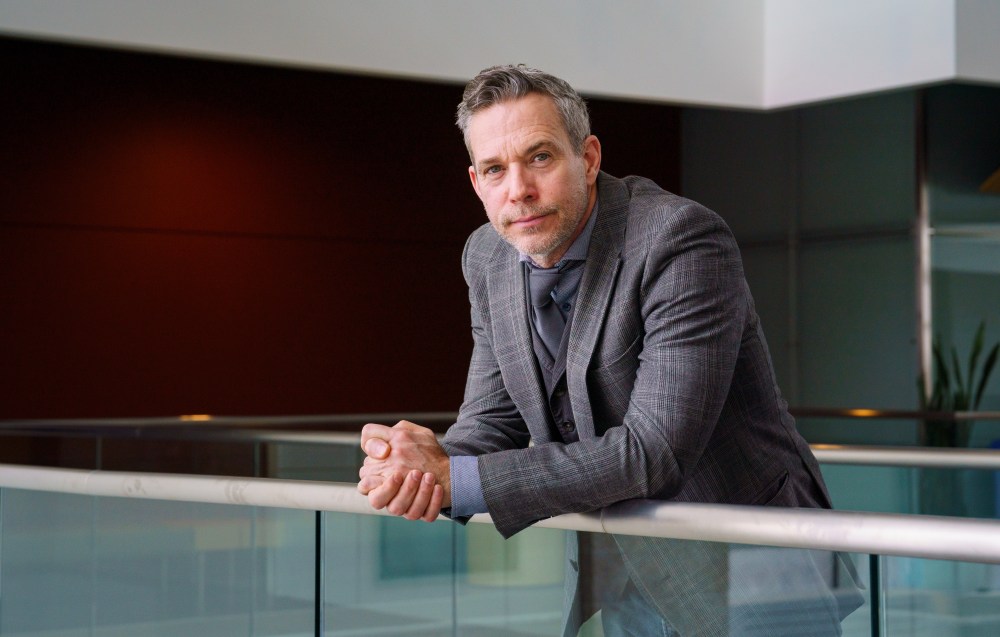
Brian McQuinn, associate professor at the University of Regina and co-lead of CIPHER, stands for a photograph in Regina, on Monday, Feb. 2, 2026. THE CANADIAN PRESS/Heywood Yu

It could also look at information coming from the United States, he added of the tool, which works by scanning foreign media sites for dubious claims that are then assessed by a human fact-checker.

“Russia was the main threat … targeting Canada most generally,” he said in a recent interview. “We are now beginning to shift.”

McQuinn cited a recent example where the system found a Russian media outlet had reported Alberta is moving towards independence, which is factually incorrect. Separatists in the province have held events and reportedly spoke with U.S. officials, but no process is currently underway for Alberta to separate.

“Effective disinformation often has kernels of truth in it,” McQuinn said.

CIPHER launched three years ago after McQuinn and his colleagues released a report that found pro-Kremlin social media accounts targeted far-right and far-left groups in Canada with false notions about the war in Ukraine. That included baseless claims that Russia invaded to root out a neo-Nazi regime and that Ukraine had sought nuclear weapons.

McQuinn said the overarching goal of disinformation campaigns is to tear societies apart and incite violence.

It becomes effective when regular people share it with their friends or family.

“(Campaigns) will use events in the news and tailor stories to advance it in different ways,” McQuinn said.

“It is essential for China and for Russia, especially, to show that it looks like the Western project is decaying, is falling apart economically, politically, socially.”

He said the United States is increasingly becoming a main source of disinformation in Canada.

“You have to always remember that most of Canada’s dialogue when it comes to social media is on U.S. platforms,” McQuinn said.

“We have seen that Canadian news and certain types of Canadian content are being downgraded and throttled within these algorithms.”

Artificial intelligence has been the source of much disinformation on people’s social media feeds, he added, but he said CIPHER needed the technology to make debunking easier.

“We are in an AI arms race around disinformation,” he said.

McQuinn said the goal is to get CIPHER into the hands of government agencies or non-profits.

It’s currently being used by the debunking organization DisinfoWatch, which works to expose falsehoods to Canadians.

DisinfoWatch founder Marcus Kolga called for stronger legislation and regulations on digital media platforms to prevent social media accounts from spreading lies.

“Us doing it alone is not sufficient enough. It requires technology and for us to harness existing technologies in order to sort of make up that gap that we have,” he said.

McQuinn said he’s spoken with government agencies about using CIPHER but declined to provide details. The Canadian Institute for Advanced Research has received funding from the federal and Alberta governments.

He said Canadians should take a beat before sharing what they see on social media.

“If I’m going to forward something, what am I forwarding?” he said.

“The research has shown if you just take like an extra 10 seconds, the amount of disinformation that gets transferred is significantly less.”

This report by The Canadian Press was first published Feb. 14, 2026.
Report Error Submit a Tip

More Stories

Time for AI guardrails is right now

Editorial 4 minute read Preview

Time for AI guardrails is right now

Editorial 4 minute read 2:00 AM CDT

The genie is most definitely out of the bottle.

And while there’s little chance of putting it back in, we should be very concerned that the people who released it from the bottle are now frantically warning us that it has become disinclined to do their — or our — bidding and seems instead to be increasingly intent on following its own whims and granting wishes to itself.

The figurative genie, in this case, is artificial intelligence, or AI, and in recent weeks many of the tech geniuses responsible for its development and introduction into the digital-information realm have begun asking the U.S. government and even the United Nations to impose limits on the pace and breadth of its growth.

Their fear is that, as AI very quickly continues to advance and develops the ability to make independent decisions and essentially think for itself, it will cease to be a tool controlled by its creators and instead will become a species unto itself that might eventually decide it’s better off without humans continually messing things up.

Read
2:00 AM CDT

Dynacare workers provide essential services that must be maintained during strike, labour board rules

Nicole Buffie 5 minute read Preview

Dynacare workers provide essential services that must be maintained during strike, labour board rules

Nicole Buffie 5 minute read Updated: Yesterday at 6:30 PM CDT

The Manitoba Labour Board has ruled Dynacare workers are essential employees and their services must be maintained during a labour dispute.

Read
Updated: Yesterday at 6:30 PM CDT

Man accused of killing five family members fires second legal team, but murder trial won’t be delayed, judge warns

Dean Pritchard 4 minute read Preview

Man accused of killing five family members fires second legal team, but murder trial won’t be delayed, judge warns

Dean Pritchard 4 minute read Updated: Yesterday at 6:44 PM CDT

A Manitoba man accused of killing five family members is once again looking for new lawyers to represent him at trial.

But Ryan Manoakeesick will stand trial, with or without a lawyer in April 2027, a judge warned him Thursday.

“I want to be clear, Mr. Manoakeesick, that the trial dates that have been set are going to remain,” King’s Bench Justice Candace Grammond told him. “Those trial dates are effectively written in stone.

“You may think that is a long time in the future, but in a trial of this kind you need to make sure you have appropriate representation and you will be ready to attend to the matter on that date.”

Read
Updated: Yesterday at 6:44 PM CDT

Letters, Oct. 1

7 minute read Preview

Letters, Oct. 1

7 minute read Updated: Yesterday at 7:45 AM CDT

Did anyone else see the irony when Premier Wab Kinew announced at the Selkirk Mental Health Centre that Manitoba would adopt permanent Daylight Time (DT) and had hired 17 new psychiatrists this year?

Read
Updated: Yesterday at 7:45 AM CDT

Thriller has steam to spare, but story slogs

Alison Gillmor 5 minute read Preview

Thriller has steam to spare, but story slogs

Alison Gillmor 5 minute read 2:01 AM CDT

Based on a 2018 book by hugely popular, wildly polarizing author Colleen Hoover (whose novels It Ends with Us, Regretting You and Reminders of Him have also been made into movies), this new adaptation is being billed as a sexy psychological thriller.

There is sex — quite a lot of sex. As for those other descriptors, Verity is not only lacking in thrills. It’s almost laughably light on plausible human psychology.

Plausibility can be overrated, of course. Scripter Nick Antosca (2026’s Cape Fear) and director Michael Showalter (The Idea of You) could have thrown plausibility out the window and gone all-in on escapist fun.

But while there is a gorgeous modernist lake house and some excellent knitwear here, and Anne Hathaway, at least, seems to be having a ball with her deliciously two-faced role, Verity is mostly a sloggy mess, with draggy pacing, flat characters and a fatal lack of atmosphere.

Read
2:01 AM CDT

Transit, roads and city council’s priorities

Erna Buffie 5 minute read Preview

Transit, roads and city council’s priorities

Erna Buffie 5 minute read 2:00 AM CDT

Did any of you happen to notice that the week of Sept. 14 marked an interesting confluence of events in Winnipeg? First up was the mayoral debate on public transit. Second was an announcement that the city would be undertaking a survey to determine whether their citizens’ “transportation needs” are being met.

The debate on our public bus system, from which our current Mayor Scott Gillingham was tellingly absent, focused primarily on safety rather than the efficiency of the system.

Which, on one level, is no great surprise.

After all unlawful incidents on buses and at transit stops have increased by 280 per cent compared to levels recorded around 2016. Moreover, the candidates were primarily speaking to the bus drivers’ union that organized the event, and bus drivers are often the victims of violent episodes.

Read
2:00 AM CDT