A group of Oscar winners set out to make the definitive AI documentary
Advertisement
Read this article for free:
or
Already have an account? Log in here »
To continue reading, please subscribe:

Digital Subscription
One year of digital access for only $205*
- Enjoy unlimited reading on winnipegfreepress.com
- Read the E-Edition, our digital replica newspaper
- Access News Break, our award-winning app
- Play interactive puzzles
*First annual payment billed as $205.00 + GST for one year. This annual subscription will automatically renew at $233.00 + GST every 52 weeks (10% off the regular annual price of $259.35). Offer available to new and qualified returning subscribers only. Cancel any time.
To continue reading, please subscribe:
Add Free Press access to your Brandon Sun subscription for only an additional
$1 for the first 4 weeks*
- Enjoy unlimited reading on winnipegfreepress.com
- Read the E-Edition, our digital replica newspaper
- Access News Break, our award-winning app
- Play interactive puzzles
*Your next Brandon Sun subscription payment will increase by $1.00 and you will be charged $17.95 plus GST for four weeks. After four weeks, your payment will increase to $24.95 plus GST every four weeks.
Read unlimited articles for free today:
or
Already have an account? Log in here »
Hey there, time traveller!
This article was published 24/03/2026 (199 days ago), so information in it may no longer be current.
The idea to make the “definitive” AI documentary was, admittedly, ambitious. But the timeline was downright absurd.
The filmmaking teams behind “Everything Everywhere All At Once” and “Navalny” started talking about a collaboration on the Oscars circuit, thinking perhaps they could finish something in a year. In reality, it would take “The AI Doc: Or How I Became an Apocaloptimist” almost three years for it to reach audiences. The film, co-directed by Daniel Roher and Charlie Tyrell, and co-produced by Daniel Kwan, attempts to zoom out from the daily headlines to give audiences a more evergreen glimpse of what is at stake for humanity as artificial intelligence rapidly evolves.
“The film is a journey of understanding that casts me as sort of a proxy for everyone, as a pea-brain regular person who’s trying to understand what the (expletive) is going on in the world,” Roher told The Associated Press earlier this year in an interview alongside Tyrell.
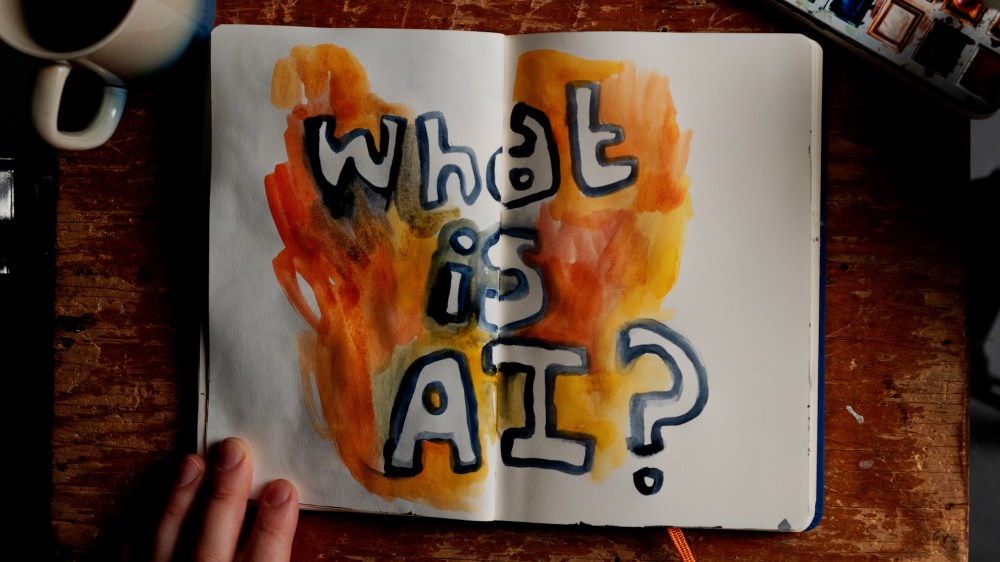
Their questions were straightforward: What is it? Why is it good? Why is it bad? And what do we need to know?
“And that simple task,” Roher said, “was (expletive) impossible. It was like making a film about outer space or China or the Bible. Like, fit that into 90 minutes.”
A Sisyphean task
“Impossible” was a sentiment shared by many who worked on the film, which opens in theaters Friday. Producer Diane Becker said it was the most challenging movie she’s ever made, a Sisyphean task where, “literally the minute we started making it, it was out of date.”
But they were emboldened by the urgency of the subject and the idea that what they were making might be not just a primer about an elusive subject, but a necessary, nonpartisan call to action. “The AI Doc” is about something bigger than AI Val Kilmer movies. For Center for Humane Technology co-founder Tristan Harris, it’s about fighting against an “antihuman future.”
“The only thing that would give humanity a shot for not ending in a dystopian or antihuman future would be for us to have collective clarity that we are heading towards that future,” Harris said. “My hope is that this film is kind of like ‘An Inconvenient Truth’ or ‘The Social Dilemma’ for AI.”
‘It takes a lot of humans to talk about AI’
Harris is just one of many voices in the film alongside the likes of OpenAI’s Sam Altman, Anthropic’s Daniela and Dario Amodei and Google DeepMind’s Demis Hassabis. In the end, more than 40 people encompassing a wide range of views and levels of expertise were interviewed on camera, resulting in some 3,300 pages of transcripts.
And it was a long journey to get those voices. Three weeks after the 2023 Oscar wins, Ted Tremper, a veteran producer who has worked on “The Daily Show,” sent over 80 emails asking leaders in the industry to talk. He got six responses. But through time, trust and many off-the-record conversations, those six people helped create a foundation that would eventually lead them to the CEOs. Tremper said the process was not unlike John Nash’s paper-and-red-string-covered office in “A Beautiful Mind.”
“It turns out, it takes a lot of humans to talk about AI,” Becker added.
And those are just the experts in front of the camera. Behind the scenes, there was also a big operation of people synthesizing the information they were receiving and figuring out a way to translate it cinematically. Tyrell said they decided on an anti-digital visual approach, using handmade things — from Roher’s notebook, where he is always drawing — to stop-motion animation.
So what is an apocaloptimist?
If you’re looking for a film that will convince or reassure you that artificial intelligence is all good or all bad, this is not it. You’ll hear bleak stories about generative AI blackmailing its programmers and doomsday scenarios of war and mass unemployment. You’ll also hear rose-colored predictions of a utopian future of medical advancements, creativity and freedom, and many things in between — like how there is more regulation over making a sandwich in New York then there is over AI and the development arms race.
The subtitle “or how I became” implies there will be a kind of tidy conclusion by the end of the film. Then you get to that pesky “apocaloptimist,” which has not yet been officially recognized by the AP Stylebook or defined by Merriam-Webster. But for Roher, it’s the key to the film.
“I am not an optimist and I do not believe this will be the apocalypse. I believe it is both at the same time and that’s critical,” Roher said. “What I take solace in is the idea that we still have agency over steering this thing towards the good and away from the bad. If we can walk this narrow path between the two and be very thoughtful and discerning, I think it will be OK.”
A catalyst for conversation and action
The film, Tremper said, assumes “zero knowledge of the subject matter” from audiences going into it. His 78-year-old dad, “who’s never owned a laptop in his life, watched it and understood it,” he said.

And the producers hope that people will make the choice to see it in a theater, or, at least with other people.
“It is entertaining in a theater. It’s cinematic in its own way. It’s not just 40 talking heads. You have an emotional ride with it,” Becker said. “And the best part about it is, the lights go up and you want to have conversation.”
Harris also wants people to see the movie “with your friends, with your church group, with your business.” But he has no financial stake in whether it succeeds or fails: He just wants people to have the knowledge.
“I honestly think if 99% of people on the planet were just to understand the basics of, like, what’s going on here, they would say, ‘That doesn’t sound good,’” Harris said.
“The film is meant to be a catalyst for a broader conversation, and for a movement that’s the size of humanity,” Harris added. “This one actually is a risk that we all face in the next single-digit number of years. It’s unlike climate change, it’s unlike specific political topics. This literally affects everyone, your well-being, your ability to put food on the table, your job, your livelihood, and I think everyone can get behind that.”