Martin J. Sherwin, Pulitzer-winning scholar, dead at 84

Advertisement

Advertise with us

NEW YORK (AP) — Martin J. Sherwin, a leading scholar of atomic weapons who in “A World Destroyed” challenged support for the U.S. bombing of Japan and spent more than two decades researching the pioneering physicist J. Robert Oppenheimer for the Pulitzer Prize-winning “American Prometheus,” has died.

Read this article for free:


or

Already have an account? Log in here »

To continue reading, please subscribe:

Subscribe and receive a limited-edition Free Press branded hat or tote.

Digital Subscription

One year of digital access for only $205*

  • Enjoy unlimited reading on winnipegfreepress.com
  • Read the E-Edition, our digital replica newspaper
  • Access News Break, our award-winning app
  • Play interactive puzzles

*First annual payment billed as $205.00 + GST for one year. This annual subscription will automatically renew at $233.00 + GST every 52 weeks (10% off the regular annual price of $259.35). Offer available to new and qualified returning subscribers only. Cancel any time.

To continue reading, please subscribe:

Add Free Press access to your Brandon Sun subscription for only an additional

$1 for the first 4 weeks*

  • Enjoy unlimited reading on winnipegfreepress.com
  • Read the E-Edition, our digital replica newspaper
  • Access News Break, our award-winning app
  • Play interactive puzzles
Start now

*Your next Brandon Sun subscription payment will increase by $1.00 and you will be charged $17.95 plus GST for four weeks. After four weeks, your payment will increase to $24.95 plus GST every four weeks.

Hey there, time traveller!
This article was published 09/10/2021 (1771 days ago), so information in it may no longer be current.

NEW YORK (AP) — Martin J. Sherwin, a leading scholar of atomic weapons who in “A World Destroyed” challenged support for the U.S. bombing of Japan and spent more than two decades researching the pioneering physicist J. Robert Oppenheimer for the Pulitzer Prize-winning “American Prometheus,” has died.

Sherwin died Wednesday at his home in Washington, D.C., according to his friend Andrew Hartman, a professor of history at Illinois State University. He was 84 and had been battling lung cancer. Kai Bird, a close friend and the co-author of “American Prometheus,” called him “probably the preeminent historian of the nuclear age.”

“When we started working on ‘American Prometheus’ he told me he had lots of research, but a few gaps,” Bird told The Associated Press on Saturday. “When I began going through all the materials I couldn’t find any gaps.”
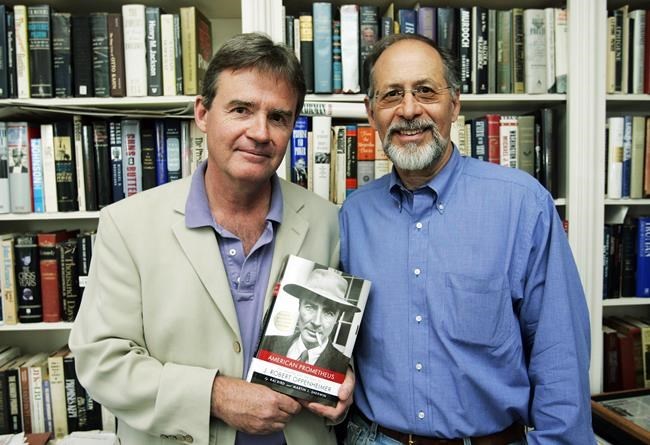
FILE - In this April 17, 2006, file photo, co-authors Kai Bird, left, and Martin J. Sherwin, right, hold a copy of the book they wrote
FILE - In this April 17, 2006, file photo, co-authors Kai Bird, left, and Martin J. Sherwin, right, hold a copy of the book they wrote "American Prometheus: The Triumph and Tragedy of J. Robert Oppenheimer," in Washington. Sherwin, a leading scholar of atomic weapons who in “A World Destroyed” challenged support for the U.S. bombing of Japan and spent more than two decades researching the pioneering physicist J. Robert Oppenheimer for the Pulitzer Prize-winning “American Prometheus,” has died at age 84. Sherwin died Wednesday, Oct. 6, 2021, at his home in Washington, D.C., according to his friend Andrew Hartman, a professor of history at Illinois State University. (AP Photo/Manuel Balce Ceneta, File)

Sherwin was a New York City native whose interest in nuclear research dated back to his undergraduate years at Dartmouth College, when he spent a summer working at a uranium mine out West. Sherwin’s ties to the arms race between the U.S. and the Soviet Union became frighteningly personal during the 1962 Cuban Missile Crisis,. He was a junior officer in the Navy and was told of plans to evacuate from their base in San Diego to a remote location in Baja California, Mexico.

“The rationale was to disperse military aircraft beyond the reach of Soviet missiles,” he wrote in “Gambling With Armageddon: Nuclear Roulette from Hiroshima to the Cuban Missile Crisis,” which came out last year. “Some junior officers — all of us bachelors — joked that the beaches of Baja ‘would be a delightful place to die.’”

He was best known for “American Prometheus,” published in 2005 and winner of the Pulitzer for biography. The book was widely praised as a comprehensive and invaluable study of the so-called “father of the atomic bomb” who later had his telephones tapped and his security clearance revoked during the McCarthy era of the 1950s as he advocated nuclear containment and opposed the development of the hydrogen bomb.

Sherwin began working on the book in the late 1970s with an hours-long horseback ride to the mountainside ranch in New Mexico where Oppenheimer once lived. He continued over the next two decades as he accumulated tens of thousands of pages of research, from FBI files to private correspondence to interviews with those who knew Oppenheimer. Bird, whom he had befriended in the 1990s and eventually brought in to help, joked that Sherwin had come down with “biographer’s disease,” the inability to know when it was time to stop researching and begin writing.

Pulitzer judges cited Sherwin and Bird for their “rich evocation of America at midcentury” and called “American Prometheus” a “new and compelling portrait of a brilliant, ambitious, complex and flawed man profoundly connected to its major events — the Depression, World War II and the Cold War.”

Sherwin was also a popular teacher and lecturer who taught at Princeton University, George Mason University and, for much of his career, Tufts University, where he founded the Nuclear Age History Center. At Princeton, he was an adviser to the author-journalist Eric Schlosser and mentored Katrina vanden Heuvel, now editorial director and publisher of the liberal weekly The Nation, for which Sherwin was a contributor.

Sherwin’s first book, “A World Destroyed: Hiroshima and Its Legacies,” came out in 1975 and was a Pulitzer finalist. The New York Times praised the book for its unprecedented scholarship on such questions as whether the U.S. needed nuclear weapons to defeat Japan in World War II (Sherwin contended President Truman’s decision to bomb Hiroshima and Nagasaki was based more on intimidating the Russians) and why the U.S. chose not to share its nuclear development with the Soviet Union when they were World War II allies.

In the mid-1990s, Sherwin was among the advisers for a planned Smithsonian exhibit about the 50th anniversary of the bombing of Japan that was canceled after veterans organizations and dozens of members of Congress objected to what they considered an anti-U.S. bias. Instead, the Smithsonian only displayed the Enola Gay, the plane from which the U.S. dropped a nuclear bomb on Hiroshima.
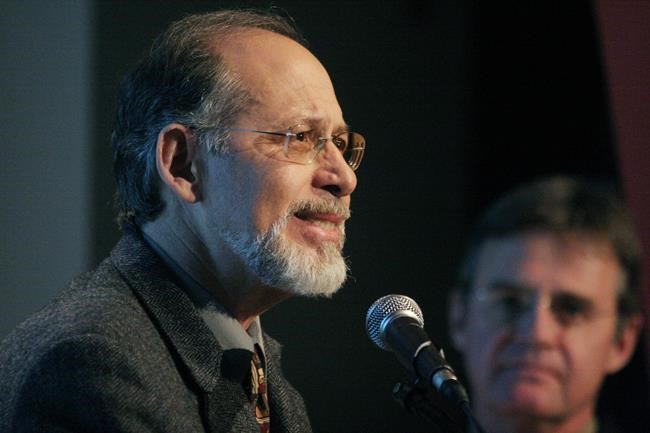
FILE - In this March 3, 2006, file photo, Martin J. Sherwin, left, speaks as Kai Bird stands by after Sherwin and Bird's
FILE - In this March 3, 2006, file photo, Martin J. Sherwin, left, speaks as Kai Bird stands by after Sherwin and Bird's "American Prometheus: The Triumph and Tragedy of J. Robert Oppenheimer" won the prize for biography at the NBCC awards ceremony in New York. Sherwin, a leading scholar of atomic weapons who in “A World Destroyed” challenged support for the U.S. bombing of Japan and spent more than two decades researching the pioneering physicist J. Robert Oppenheimer for the Pulitzer Prize-winning “American Prometheus,” has died at age 84. Sherwin died Wednesday, Oct. 6, 2021, at his home in Washington, D.C. (AP Photo/Tina Fineberg, File)

“In the United States, the collective memory of World War II sees the war as ‘our finest hour,’” he wrote in a 2003 edition of “A World Destroyed.”

“America without that image is unimaginable to most members of the generation that fought the war and to those in subsequent generations who have defined their view of the world and their political lives as a reflections of this image.”

According to Kai Bird, he and Sherwin had been working on a proposal for a new book even though he was badly weakened by his cancer treatment. Sherwin wanted to tell the extraordinary but true story of a crew of B-29 bombers who were captured off the coast of Japan at the end of World War II and saved from execution by an English-speaking Japanese commander who brought them to Hiroshima so they could see for themselves the devastation from the recently dropped atom bomb.

“He had been sitting on his story for a very long time, back to 1975 when he interviewed one of the B-29 crew members,” Bird said. “He was really excited about this, and I’m trying to see if I can turn this into a book proposal. On the day he died he was editing that proposal. Even as his body was giving out, he was still interested and his mind was alert.”

Report Error Submit a Tip

More Stories

Psychologist sentenced to house arrest after affair with patient

Dean Pritchard 4 minute read Updated: Yesterday at 5:31 PM CDT

A psychologist who didn’t disclose her sexual affair with a mental-health patient under her care when she testified on his behalf before the Criminal Code Review Board has been sentenced to 18 months house arrest.

Strike mandate for Dynacare workers

Free Press staff 2 minute read Preview

Strike mandate for Dynacare workers

Free Press staff 2 minute read Yesterday at 2:01 PM CDT

Nearly 350 laboratory technicians and technologists at Dynacare’s 22 laboratory and health services centres in Manitoba have voted in favour of a strike.

The Manitoba Association of Health Care Professionals, which represents the employees, said in a news release that 99 per cent of members who voted supported going on strike. A strike notice has not been served to the employer. If and when that occurs, the union is required to give two weeks’ notice.

The collective agreement between the union and Dynacare ended March 31. Negotiations between the parties began in February and they have been in mediation since July 15. They’ve been unable to reach a tentative agreement through mediation, and there are no further bargaining or mediation dates scheduled, the union said in a news release.

Dynacare became Manitoba’s only private outpatient provider for laboratory services in 2017, after purchasing competitor Unicity Labs. The union said Manitoba government records show Dynacare members completed more than 15 million laboratory tests in the 2024-25 fiscal year.

Read
Yesterday at 2:01 PM CDT

‘Disrespectful’: residents frustrated after Wyatt arrives hour late to committee meeting

Joyanne Pursaga 3 minute read Preview

‘Disrespectful’: residents frustrated after Wyatt arrives hour late to committee meeting

Joyanne Pursaga 3 minute read Updated: 1:00 PM CDT

Several Winnipeggers attending a city development hearing on Thursday expressed frustration that one councillor arrived about an hour late, delaying the matter from being heard.

Coun. Russ Wyatt, who continues to attend city hall while facing criminal charges, began participating in the 9:30 a.m. East Kildonan-Transcona community committee meeting at 10:35 a.m.

A resident who hoped to speak at the meeting about a development plan in south Transcona noted the tardiness led the committee to bump the topic down on its agenda, while dozens waited to speak on it.

Christina Pyra eventually opted to leave city hall instead of waiting for her turn to make a presentation, to avoid missing a work commitment.

Read
Updated: 1:00 PM CDT

Gillingham promises to help level playing field for local biz if re-elected

Joyanne Pursaga 3 minute read Preview

Gillingham promises to help level playing field for local biz if re-elected

Joyanne Pursaga 3 minute read 4:30 PM CDT

Scott Gillingham promises to take new steps to ensure local businesses can compete for the hundreds of millions of dollars in city contracts awarded each year, if re-elected as mayor.

The campaign promise follows the city’s controversial decision to replace longstanding Winnipeg restaurant Salisbury House with an American company at the city-owned Kildonan Park and Windsor Park golf courses. That contract for food and beverage service took effect April 1.

Gillingham acknowledged public opposition to the move is one of the reasons he’s revisiting the issue.

“As mayor, I want as many opportunities for local companies to benefit from work the city procures,” he said.

Read
4:30 PM CDT

Sea Bears staff a who’s who of hustlers in the hoops community

Joshua Frey-Sam 7 minute read Preview

Sea Bears staff a who’s who of hustlers in the hoops community

Joshua Frey-Sam 7 minute read 6:09 PM CDT

Ilarion Bonhomme was admittedly surprised when he got the call.

Not because he wasn’t confident in his ability to take the next step, but because he knew there were so many other qualified options.

On the other side of the line was newly minted Winnipeg Sea Bears head coach Mike Raimbault, offering the young coach a spot on his staff for this summer and Bonhomme a full-time opportunity to work with professionals.

“Surprised me, yes, because obviously he’s got such a huge coaching network and he had so much conversation with so many coaches,” Bonhomme said. “For him to kind of pick me to be part of it, yeah, I was surprised and, like I said, super excited.”

Read
6:09 PM CDT

It’s one thing to climb aboard rail-relocation train, quite another to pay for the ride

Dan Lett 5 minute read Preview

It’s one thing to climb aboard rail-relocation train, quite another to pay for the ride

Dan Lett 5 minute read Wednesday, Aug. 12, 2026

Anyone who wants a brighter, safer, healthier future for the city of Winnipeg should really want the renewed hopes of rail relocation to finally become reality. And the sooner, the better.

Premier Wab Kinew announced Wednesday the province was going to forge a plan to relocate the Canadian Pacific Kansas City central yards and many of other the lines that run through Winnipeg to a bypass that runs around the city.

This “plan to design a plan” strategy was devised by a task force headed up by former federal MP and cabinet minister Lloyd Axworthy, who in 2024 was given a two-year mandate to find the best way to rid the city of some or all of its rail infrastructure.

For the record, Kinew and Axworthy said a relocation would likely take 20 years to complete, which makes this week’s announcement an important statement of intent, but little more. The sobering reality is that this promising idea has been proposed by political leaders, and then abandoned, for decades.

Read
Wednesday, Aug. 12, 2026