People are strange
Amidst the blockbuster action, these comic-book mutants have something to say about embracing differences
Advertisement
Read this article for free:
or
Already have an account? Log in here »
To continue reading, please subscribe:

Digital Subscription
One year of digital access for only $205*
- Enjoy unlimited reading on winnipegfreepress.com
- Read the E-Edition, our digital replica newspaper
- Access News Break, our award-winning app
- Play interactive puzzles
*First annual payment billed as $205.00 + GST for one year. This annual subscription will automatically renew at $233.00 + GST every 52 weeks (10% off the regular annual price of $259.35). Offer available to new and qualified returning subscribers only. Cancel any time.
To continue reading, please subscribe:
Add Free Press access to your Brandon Sun subscription for only an additional
$1 for the first 4 weeks*
- Enjoy unlimited reading on winnipegfreepress.com
- Read the E-Edition, our digital replica newspaper
- Access News Break, our award-winning app
- Play interactive puzzles
*Your next Brandon Sun subscription payment will increase by $1.00 and you will be charged $17.95 plus GST for four weeks. After four weeks, your payment will increase to $24.95 plus GST every four weeks.
Read unlimited articles for free today:
or
Already have an account? Log in here »
Hey there, time traveller!
This article was published 03/06/2011 (5594 days ago), so information in it may no longer be current.
Believe it or not, the world wasn’t crying out for the X-Men backstory. Like most comic-book franchises to get a big-screen birthing, the appeal of an X-Men movie lay in the physical embodiment of the familiar characters — not a David Copperfield-styled biopic.
For instance, we all knew Wolverine — and we liked him — which made Hugh Jackman’s X-Men character an easy page-to-screen transition: He was well-defined, easy to understand and his special mutant power of fast-healing and super strength (combined with high-tech, weapons-grade metal implants) made him completely cinematic.
Professor X and Magneto may not have the same narrative sex appeal, given one is in a wheelchair and the other shaded under a prophylactic chapeau, but they are the two poles that hold the X-Men universe in position, and in this prequel, we find out how these former mutant allies became enemies.
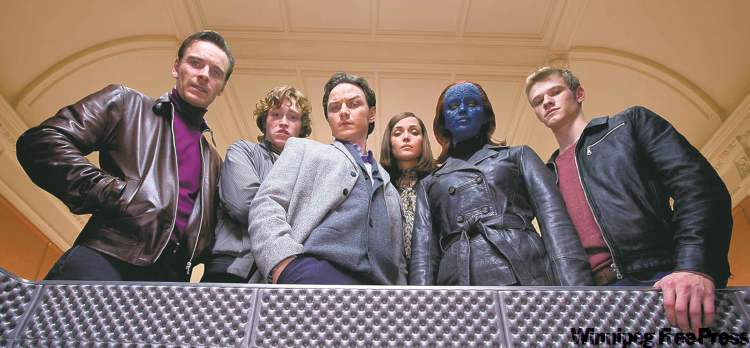
If you’re already held rapt by the premise, this movie is a must-see because, dramatically speaking, it’s probably got the biggest ambitions of any X-Men spectacle to date.
After all, it deals directly with the Holocaust, complete with scenes of concentration camps, people in striped clothing and cold-blooded killing.
Marrying systematic mass murder and comic-book sensibilities is a big challenge, but one director Matthew Vaughn (Kick-Ass, Layer Cake) handles with relative ease as he tapers the story down to two charismatic characters: Professor X and Magneto.
The most magnetic of the two is Erik Lehnsherr, which is where our story begins: Young Erik has just been separated from his family by Nazis when he demonstrates an unusual talent for bending metal. The show proves so compelling, he’s recruited for experiments by a creepy camp doctor named Shaw (Kevin Bacon).
The only problem for young Erik is his lack of control. He can’t command metal on a whim. He needs emotional urgency to access his mutant gift, which means the Nazis use his family to conjure emotional responses of the worst kind.
While Erik is being emotionally tortured by Shaw, young Charles Xavier (James McAvoy) is living quite comfortably on the English countryside in a mansion. Rich, privileged and well-educated, Charles is a blue-sky thinker who also has the curious ability to read minds. Charles always figured he was alone in the universe, but one day, a shape-shifter appears in his kitchen.
He can read her mind, and in an instant, Charles and Raven (later known as Mystique, played here by Jennifer Lawrence) become best friends and spiritual mutant siblings.
Flash forward to the height of the Cold War circa 1960. Charles has just graduated from university, where he was a clear winner with the ladies thanks to his opening line: “Hey gorgeous! That’s a groovy mutation you’ve got there…”
Erik (Michael Fassbender), meanwhile, has been hunting down Nazis, hoping to trap and kill his arch-enemy Shaw.
These two central mutants are on opposite tracks. One is focused on killing. The other is dedicated to teaching the world to embrace mutant differences. War versus peace, love versus hate, mutant versus human: it’s drama on an epic scale and Vaughn renders the players with a loving hand — and plenty of screen time.
McAvoy plays out the part of privileged hero with an almost Kennedy-esque persona — one that is both noble and just a tad scandalous at the same time. Fassbender (Inglourious Basterds) hands in such an emotionally driven performance, he may actually reduce the audience to tears — which is no small feat in a Hollywood action reel.

Lawrence’s role isn’t as big as those of the two men, but she proves her Oscar-nominated turn in Winter’s Bone was just the beginning of a flowering dramatic career as she carves out the conflicted heart of the turncoat Mystique.
Mystique is the symbolic core of First Class because she’s struggling with self-acceptance. Ostracized and alone as a result of her blue skin and yellow eyes, she’s learned self-loathing. She wants to be like everyone else. She wants to be “normal,” and that’s where this movie makes its most articulate points as it challenges our human propensity to judge all books by their cover.

Only Erik has the depth of experience to understand the importance, and the beauty, of individual difference. When he looks into Mystique’s yellow eyes, he sees someone worth loving for who she is — which makes Erik surprisingly attractive, despite his hate-on for just about everyone and everything.
X-Men: First Class handles all these themes with just enough gravitas to bring the emotional moments home, without sacrificing the kitsch appeal of a story about mutant superheroes and their connection to such historical events as the Bay of Pigs crisis.
That First Class also offers up a decent narrative about the importance of self-love, family bonding and friendship gives it extra dimension — even if the overall dramatic range only goes X to Z.
— Postmedia News