Thriller goes from great to grisly in second half
Eerie AI premise turns into generic bloodbath
Advertisement
Read this article for free:
or
Already have an account? Log in here »
To continue reading, please subscribe:

Digital Subscription
One year of digital access for only $205*
- Enjoy unlimited reading on winnipegfreepress.com
- Read the E-Edition, our digital replica newspaper
- Access News Break, our award-winning app
- Play interactive puzzles
*First annual payment billed as $205.00 + GST for one year. This annual subscription will automatically renew at $233.00 + GST every 52 weeks (10% off the regular annual price of $259.35). Offer available to new and qualified returning subscribers only. Cancel any time.
To continue reading, please subscribe:
Add Free Press access to your Brandon Sun subscription for only an additional
$1 for the first 4 weeks*
- Enjoy unlimited reading on winnipegfreepress.com
- Read the E-Edition, our digital replica newspaper
- Access News Break, our award-winning app
- Play interactive puzzles
*Your next Brandon Sun subscription payment will increase by $1.00 and you will be charged $17.95 plus GST for four weeks. After four weeks, your payment will increase to $24.95 plus GST every four weeks.
Read unlimited articles for free today:
or
Already have an account? Log in here »
Hey there, time traveller!
This article was published 02/09/2016 (3676 days ago), so information in it may no longer be current.
It wouldn’t be fair to compare father and son, but Ridley Scott’s progeny, Luke Scott, takes on some similar themes to his father’s work in his feature directorial debut, Morgan. In a story that contemplates the emotional boundaries and consequences of artificial intelligence, Seth W. Owen’s script landed on the 2014 Black List of Best Unproduced Screenplays, and in Scott, Morgan finds an appropriate marriage between material, filmmaker and, yes, family legacy.
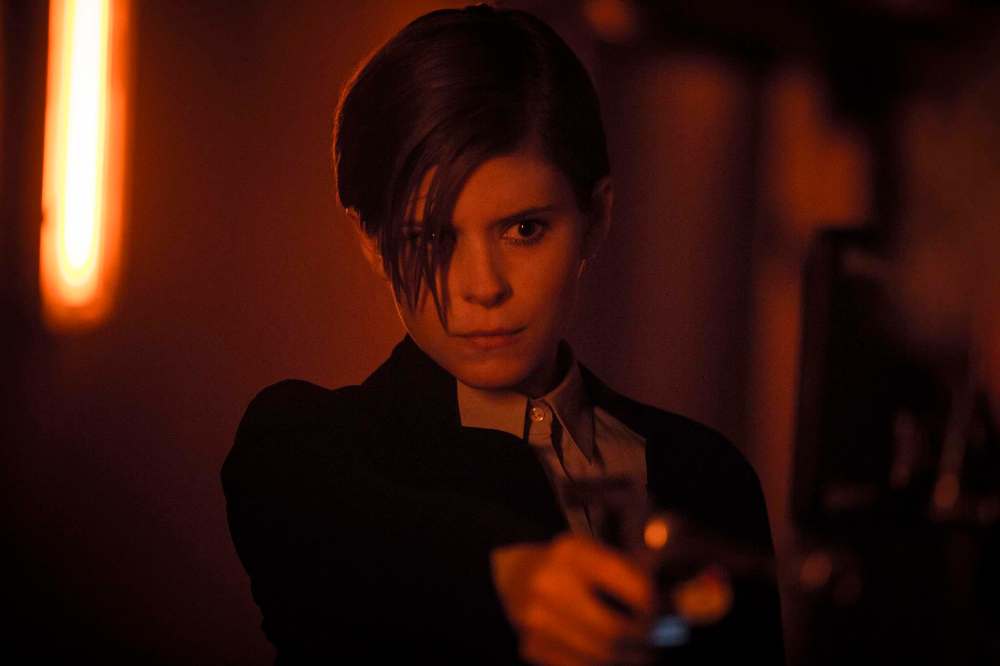
While Deckard was compelled by the state to hunt for replicants in Ridley Scott’s Blade Runner, in Morgan, artificial intelligence is a privatized affair. Lee Weathers (Kate Mara), a corporate fixer/troubleshooter, is dispatched to a remote wooded lab facility to check on the status of one of her company’s assets — a young girl known as Morgan (Anya Taylor-Joy) to her ad-hoc family of scientist caretakers.
In this iteration of experimental artificial intelligence, the focus is on developing emotion, and in this summer camp-like bubble, the scientists have bonded with the young girl of tremendous, nearly psychic ability, who is almost fully grown at age five. Nature walks and birthday parties are part of the routine — until Morgan loses her temper with Kathy (Jennifer Jason Leigh) and gouges her eye out. Lee’s job is to assess “it,” and decide on a course of action.
Her task is complicated by the close relationships between Morgan and the scientists — team leader Dr. Cheng (Michelle Yeoh), free-spirited behaviourist Amy (Rose Leslie), an idealistic geneticist (Toby Jones), their fastidious co-ordinator Ted (Michael Yare), and a couple of loving doctors, Darren (Chris Sullivan) and Brenda (Vinette Robinson). Some are unwilling to terminate her, despite the increasing levels of violence when provoked.
With dissent among the ranks, and murderous chaos breaking out, only Lee can take control of the situation. “This is what I do,” she tells nutritionist Skip (Boyd Holbrook), shouldering a shotgun and taking off after a Morgan gone rogue.
Morgan takes its place in the canon of awesome female-driven sci-fi such as Alien or T2. Neither Lee nor Morgan is clearly heroine or villain — Lee’s only attempting to do her job by preserving the asset, while Morgan, with a clearly developed sense of selfhood, is also attempting to preserve the asset: herself. The two tangle with a thudding, efficient violence, landing blows and drawing blood with nary a flinch. It’s a rather fascinating take on the possibilities and limits of artificial intelligence and artificial emotion, and brings up questions about the rights and autonomy of these creatures similar to the ones explored recently in Ex Machina.
The failure of Morgan is in its lack of restraint. The first half of the film is as tightly controlled as the lab facility, with small moments of foreshadowing planted expertly, if obviously. The second half descends into a violent bloodbath, and the twists in the story that lie just below the surface waiting to be discovered are spoken aloud, taken from theory to fact. But it’s far more fun when just a theory. Over-explanation takes a film from an eerie think piece to a banal sci-fi thriller; it robs you of the chance to trade post-film hypotheses.

That kind of ambiguity makes Blade Runner a classic; the lack of ambiguity means Morgan strays into a run-of-the-mill genre territory, despite its deeper ideas.
— Tribune News Service
MOVIE REVIEW
 Morgan
● Starring Kate Mara and Anya Taylor-Joy
● Grant Park, Polo Park, St. Vital
● 14A
● 92 minutes
★★★1/2 out of five
Advertisement Advertise With Us
Advertisement Advertise With Us