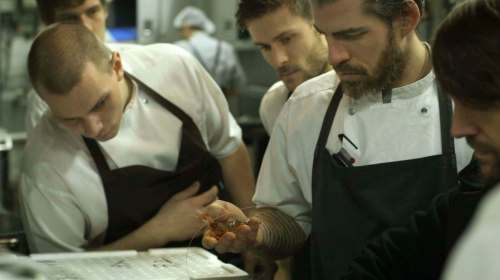
No Gordon Ramsay drama in this kitchen
Documentary gives an inside, in-depth look at high-level restaurant life

Advertisement
Read this article for free:
or
Already have an account? Log in here »
To continue reading, please subscribe:

Digital Subscription
One year of digital access for only $205*
- Enjoy unlimited reading on winnipegfreepress.com
- Read the E-Edition, our digital replica newspaper
- Access News Break, our award-winning app
- Play interactive puzzles
*First annual payment billed as $205.00 + GST for one year. This annual subscription will automatically renew at $233.00 + GST every 52 weeks (10% off the regular annual price of $259.35). Offer available to new and qualified returning subscribers only. Cancel any time.
To continue reading, please subscribe:
Add Free Press access to your Brandon Sun subscription for only an additional
$1 for the first 4 weeks*
- Enjoy unlimited reading on winnipegfreepress.com
- Read the E-Edition, our digital replica newspaper
- Access News Break, our award-winning app
- Play interactive puzzles
*Your next Brandon Sun subscription payment will increase by $1.00 and you will be charged $17.95 plus GST for four weeks. After four weeks, your payment will increase to $24.95 plus GST every four weeks.
Read unlimited articles for free today:
or
Already have an account? Log in here »
Hey there, time traveller!
This article was published 02/12/2016 (3589 days ago), so information in it may no longer be current.
René Redzepi, rock-star chef, owner of the Michelin-two-starred restaurant Noma, and crucial influence on the New Nordic food movement, is famous enough to have been featured in three documentaries, including Noma: My Perfect Storm, Noma at Boiling Point and now this Dutch-Japanese co-production (in English, mostly).
So what does the man behind one of the most renowned restaurants in the world do to stay fresh? He temporarily packs up his whole Copenhagen operation and heads to Tokyo’s Mandarin Oriental hotel to create an elaborate cross-cultural pop-up. This 2015 Japanese jaunt will involve 3,400 diners tasting a 14-course meal over a stretch of five stress-packed weeks.
Part gastro porn and part personality study, this fascinating, but strangely gruelling documentary is an insider look at high-level restaurant life. Dutch filmmaker Maurice Dekkers also ends up making a larger comment on creativity, perfection, inspiration and the unexpected value of failure.
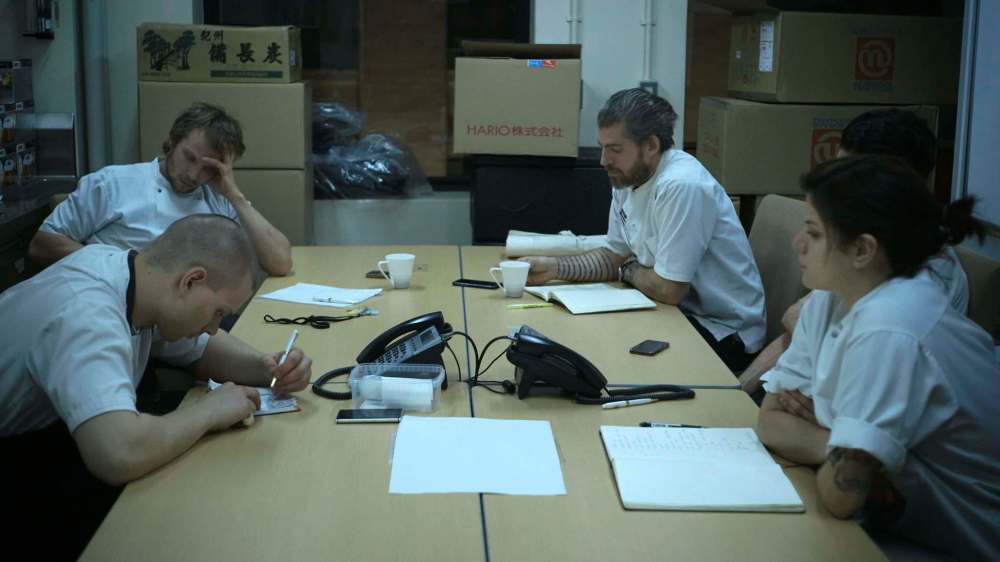
Dekkers starts with Noma’s opening day in Tokyo, then loops back to several months before. His quiet, observant camera tracks Redzepi and his team, with all their uncertainties, anxieties, futile detours and minor disasters, en route to opening day once again.
At the beginning of this culinary odyssey, the restless Redzepi sees it as a way to bust out of the daily grind. “Why not have fun with it?” asks the talky and charismatic chef.
The five-person team tasked with doing the advance work arrives in Japan and almost immediately realizes they’ve taken on a job that’s frequently the opposite of fun.
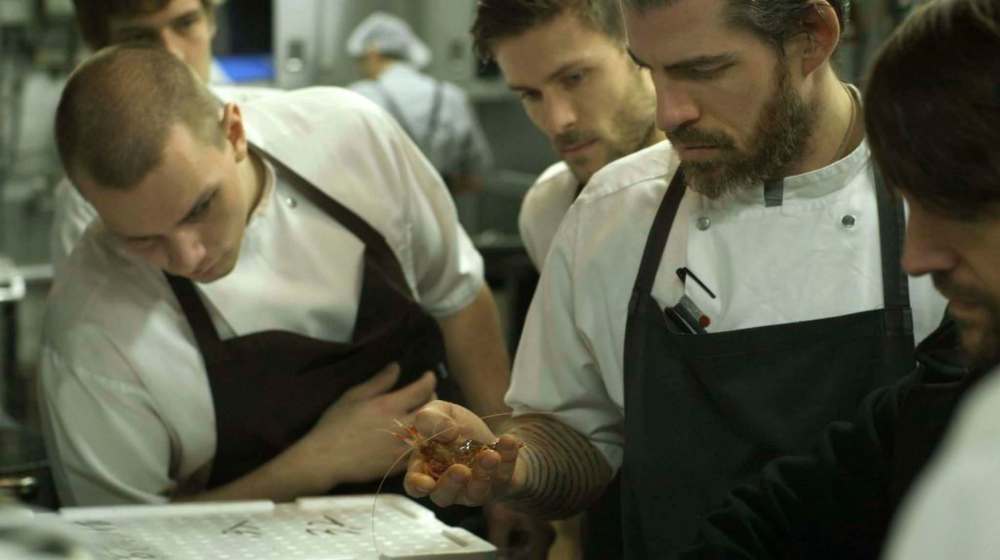
They need to maintain Noma’s impossible standards and global reputation while diving into unfamiliar traditions and ingredients in a strange subterranean kitchen, all on a tight timeline. (Also, the sex workers in Tokyo are totally different, complains one young chef. Talk about culture shock.)
This film is about food, of course, covering many of the staple ingredients of the foodie doc. This increasingly popular genre — which includes such titles as Jiro Dreams of Sushi, A Matter of Taste, Three Stars, Kings of Pastry and the Netflix series Chef’s Table — has become so recognizable that it’s been spoofed by Bill Hader and Fred Armisen in the satirical series Documentary Now!
And Ants on a Shrimp has moments that teeter on the cliff of satire. We watch kitchen hands using eye droppers and tweezers for the precision placement of tiny twigs and enigmatic foams and small insects. (Those titular “ants on a shrimp” are actual, not metaphorical.) A young up-and-comer demonstrates her prowess with a dish based on fish sperm emulsion.
A word of warning here for some viewers: You’ll also be watching the nitty-gritty of kitchen work, such as plucking ducks and scorching off the pin feathers, gutting tuna, decapitating snapping turtles and eating live langoustines.
Dekkers intercuts this front-line footage with a serious look at the creative process. Redzepi never yells — there are no Gordon Ramsay-style theatrics here.
Instead, he employs a polite-but-pointed form of the Socratic method to prod his chefs to do better.

Redzepi demands perfection, but also senses that perfection can become sterile and self-enclosed. This might be why he risks uprooting his restaurant and “free-falling into another culture,” as he puts it.
That might also be why his top chefs, characterized by good knife skills and sleeve tattoos, are more than anything united by a willingness to fail. “Our job is not to succeed but to fail — over and over and over again,” comments one of his team in a moment of gloomy Scandinavian resignation.
Ants on a Shrimp is an intense film and, for a food flick, it’s much more about the hard labour of cooking than the pure pleasure of dining. “Don’t let any frustration come out,” Redzepi tells his staff at one point. “Just let it eat you up from the inside.” It’s a joke, kind of.
alison.gillmor@freepress.mb.ca
Studying at the University of Winnipeg and later Toronto’s York University, Alison Gillmor planned to become an art historian. She ended up catching the journalism bug when she started as visual arts reviewer at the Winnipeg Free Press in 1992.
Our newsroom depends on a growing audience of readers to power our journalism. If you are not a paid reader, please consider becoming a subscriber.
Our newsroom depends on its audience of readers to power our journalism. Thank you for your support.
Movie review

Ants on a Shrimp
Featuring René Redzepi
Cinematheque
Subject to classification
88 minutes
Three and a half stars out of five
Other voices
If the title Ants on a Shrimp evokes the worst picnic ever, guess again.
— Gary Goldstein, Los Angeles Times
Mr. Redzepi is a restless soul, and Maurice Dekkers’s engaging Ants on a Shrimp follows him on an adventure that seems almost recklessly impulsive.
— Daniel M. Gold, New York Times
Falls short of a four-star cinematic experience.
— Doris Toumarkine, Film Journal International
Studying at the University of Winnipeg and later Toronto’s York University, Alison Gillmor planned to become an art historian. She ended up catching the journalism bug when she started as visual arts reviewer at the Winnipeg Free Press in 1992.
Our newsroom depends on a growing audience of readers to power our journalism. If you are not a paid reader, please consider becoming a subscriber.
Our newsroom depends on its audience of readers to power our journalism. Thank you for your support.
Advertisement Advertise With Us
Advertisement Advertise With Us