A revolution like no other
Epic Québécois film strikes a fine balance on difficult issues

Advertisement
Read this article for free:
or
Already have an account? Log in here »
To continue reading, please subscribe:

Digital Subscription
One year of digital access for only $205*
- Enjoy unlimited reading on winnipegfreepress.com
- Read the E-Edition, our digital replica newspaper
- Access News Break, our award-winning app
- Play interactive puzzles
*First annual payment billed as $205.00 + GST for one year. This annual subscription will automatically renew at $233.00 + GST every 52 weeks (10% off the regular annual price of $259.35). Offer available to new and qualified returning subscribers only. Cancel any time.
To continue reading, please subscribe:
Add Free Press access to your Brandon Sun subscription for only an additional
$1 for the first 4 weeks*
- Enjoy unlimited reading on winnipegfreepress.com
- Read the E-Edition, our digital replica newspaper
- Access News Break, our award-winning app
- Play interactive puzzles
*Your next Brandon Sun subscription payment will increase by $1.00 and you will be charged $17.95 plus GST for four weeks. After four weeks, your payment will increase to $24.95 plus GST every four weeks.
Read unlimited articles for free today:
or
Already have an account? Log in here »
Hey there, time traveller!
This article was published 17/03/2017 (3474 days ago), so information in it may no longer be current.
This beautiful, provocative, maddening, magnificently titled anarchist epic is both operatic and intimate, ambitious and ambivalent. With a walloping three-hour runtime, complete with a five-minute orchestral overture that plays to a dark screen, this Québécois film also pulls off a surprisingly delicate balance of tone, form and socio-sexual-political-emotional content.
Following four 20-somethings in the aftermath of the 2012 Quebec student protests as they transform from activists to terrorists, the film has been controversial, inciting walkouts at the Toronto International Film Festival, while also being named Best Canadian Film.
Directors Mathieu Denis and Simon Lavoie begin their hybrid narrative three years after the strikes and shutdowns of the so-called Maple Spring, when most students have been lured back to school by a temporary tuition freeze and the promise of normalcy.
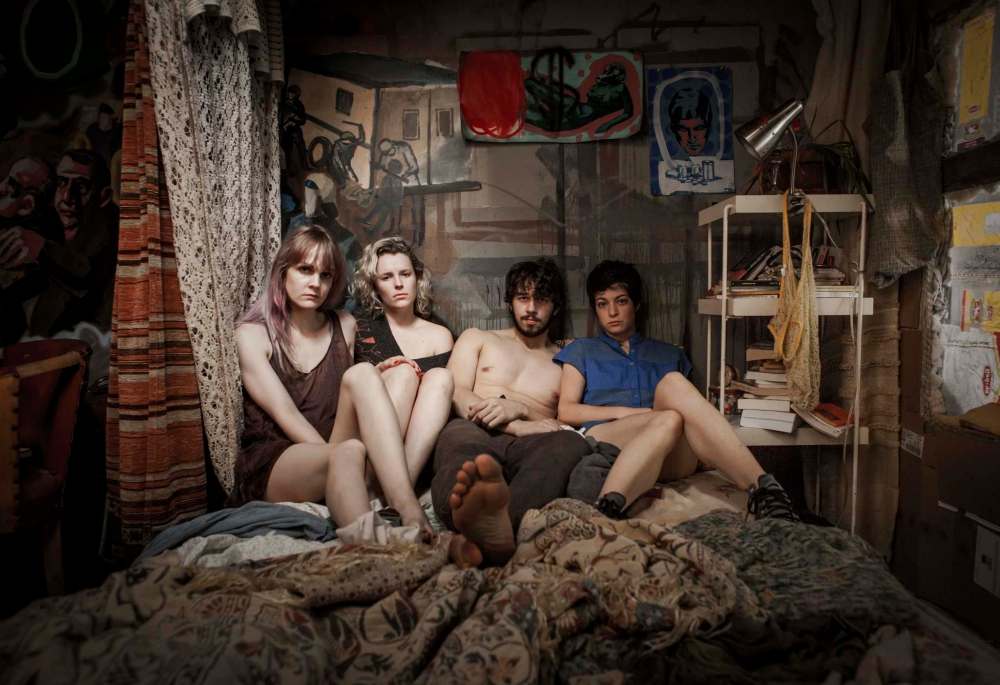
Giutizia (Charlotte Aubin), Tumulto (Laurent Bélanger), Ordine Nuovo (Emmanuelle Lussier-Martinez) and Klas Batalo (Gabrielle Tremblay) — these are their revolutionary noms de guerre — don’t want normalcy or compromise or anything else that smacks of bourgeois settling.
The quartet retreats to an old industrial garage, dumpster-diving for food and using Klas’s wages as a transgender sex worker to pay their meagre bills. Their political acts shift from billboard graffiti to urinating on the window of an upscale restaurant to setting off a smoke bomb in the Metro, before escalating toward outright violence.
Denis and Lavoie’s formal control is formidable. They use music and sound with sensitivity and intelligence. They have set their story in Montreal without allowing in even one picturesque view, offering instead underground tunnels, caged overhead walkways, strip malls, freeways and barren but bloated suburbs.
Lavoie and Denis employ a Godard-like mix of narrative, news footage and archival sequences — including footage of Justin Trudeau with what feels like satirical extreme close-ups on his hair. There are also stretches in which the characters act out — for each other and for us — heightened forms of dance, slam poetry and confrontational performance art.
The filmmakers’ attitude here can be hard to read. They seem to admire the characters’ sincerity, while simultaneously exposing their self-seriousness. They understand their characters’ rage and alienation and passionate purity, while casting a critical, even clinical eye at how those feelings are translated into the world.
Dramatic gestures and slogans such as, “Revolution begins when destiny avenges illustrious indigents,” also walk this tricky tonal line. The writings of Peter Kropotkin or Rosa Luxembourg, read aloud or written on walls between scenes, sound even more stilted and 19th-century in English translation. Stripped of their original context, they are at once inspiring and faintly ridiculous.
While talking constantly about society and its needs, the four revolutionaries become increasingly isolated and insular. (Pity the poor environmental activist who comes to their door and wants to talk about “saving the world,” one green space at a time.) They argue about the ideals of their movement and the means and ends of armed struggle, their bickering ultimately culminating in a literally naked act of Marxist self-criticism.
Viewers may start to question whether the characters’ absolute certainty is itself a form of confusion, whether their political commitment has tipped over into personal pathology.
Certainly, the revolutionary exhortation to “overthrow our fathers,” which is solemnly quoted at one point, is personal as well as political. Like so many revolutionaries, these kids come from privileged backgrounds, and we see a Freudian dynamic in Ordine Nuovo’s complicated contempt for her single mother, in Giutzia’s violent denunciation of her wealthy father as a baby boomer sell-out, in Klas’s encounter with a client who was once a revolutionary nationalist and is now interested only in his own comforts and desires.
These cross-generational scenes never resort to caricature. They are, in fact, the most nuanced and compassionate sequences in the film.
Audiences outside Quebec might miss the references to historical figures such as Lionel Groulx and Hubert Aquin and the layered allusions to the separatist movement. The angry despair of youth is universally recognizable, however, and it’s given depth and dimension with fierce performances, particularly from Tremblay, a transgender actor playing a transgender character.
After a difficult, occasionally infuriating, sometimes exhausting three hours, the film ends with an extreme act that is at once dramatic and unresolvable.
And here’s the final paradox: the characters in Those Who Make Revolution fret that Quebec has succumbed to political complacency and cultural fatigue, a notion contradicted ardently and eloquently by the film itself.
alison.gillmor@freepress.mb.ca
Studying at the University of Winnipeg and later Toronto’s York University, Alison Gillmor planned to become an art historian. She ended up catching the journalism bug when she started as visual arts reviewer at the Winnipeg Free Press in 1992.
Our newsroom depends on a growing audience of readers to power our journalism. If you are not a paid reader, please consider becoming a subscriber.
Our newsroom depends on its audience of readers to power our journalism. Thank you for your support.
Movie review

Those Who Make Revolution Halfway Only Dig Their Own Graves
Starring Charlotte Aubin, Laurent Bélanger, Emmanuelle Lussier-Martinez and Gabrielle Tremblay
● Cinematheque
● 18A ● 183 minutes
★★★★ out of five
[A] sprawling, vibrant, thought-provoking and thoroughly engaging film.
— Pat Donnelly, Montreal Gazette
Those Who Make Revolution Halfway Only Dig Their Own Graves unfurls with a bravado as outsized as its title.
— Scott Tobias, Variety
Studying at the University of Winnipeg and later Toronto’s York University, Alison Gillmor planned to become an art historian. She ended up catching the journalism bug when she started as visual arts reviewer at the Winnipeg Free Press in 1992.
Our newsroom depends on a growing audience of readers to power our journalism. If you are not a paid reader, please consider becoming a subscriber.
Our newsroom depends on its audience of readers to power our journalism. Thank you for your support.
Advertisement Advertise With Us
Advertisement Advertise With Us