Back to the ‘Burbs
Director Clooney takes a look at '50s life -- through the Coen brothers' prism

Advertisement
Read this article for free:
or
Already have an account? Log in here »
To continue reading, please subscribe:

Digital Subscription
One year of digital access for only $205*
- Enjoy unlimited reading on winnipegfreepress.com
- Read the E-Edition, our digital replica newspaper
- Access News Break, our award-winning app
- Play interactive puzzles
*First annual payment billed as $205.00 + GST for one year. This annual subscription will automatically renew at $233.00 + GST every 52 weeks (10% off the regular annual price of $259.35). Offer available to new and qualified returning subscribers only. Cancel any time.
To continue reading, please subscribe:
Add Free Press access to your Brandon Sun subscription for only an additional
$1 for the first 4 weeks*
- Enjoy unlimited reading on winnipegfreepress.com
- Read the E-Edition, our digital replica newspaper
- Access News Break, our award-winning app
- Play interactive puzzles
*Your next Brandon Sun subscription payment will increase by $1.00 and you will be charged $17.95 plus GST for four weeks. After four weeks, your payment will increase to $24.95 plus GST every four weeks.
Read unlimited articles for free today:
or
Already have an account? Log in here »
Hey there, time traveller!
This article was published 27/10/2017 (3260 days ago), so information in it may no longer be current.
As a man of doggedly liberal bent, George Clooney is a guy who likes to make a statement when he directs movies.
The Monuments Men posited that, even in the killing fields of wartime, art was worth saving. The Ides of March was about idealism struggling in the realm of dirty politics. Good Night and Good Luck was about journalism serving as a bulwark against authoritarian extremism in American life.
In his new film Suburbicon, Clooney had the opportunity to let his hair down and have stylistic fun with a long unproduced, three-decades-languishing script by Joel and Ethan Coen, featuring murder, treachery and kink in an unlikely setting of wholesome, white-picket-fence 1950s America.
That kind of story has its own subversive kick, as any fan of David Lynch’s Blue Velvet will tell you. But Clooney takes a heavy hand with it and adds an element of docu-drama that doesn’t… quite… fit.
The Suburbicon of the title is a forcefully wholesome suburban development intended to reflect the Eisenhower-era riches of middle-class life: prosperity, safety and community.
But when a black family moves in, the citizens are horrified at the violation of an unspoken “whites-only” understanding. Trying to make a home, the quiet, dignified black matriarch Mrs. Meyers (Karimah Westbrook) finds herself facing pushback from her white neighbours, who inexorably start to take on the characteristics of Ku Klux Klan terrorists.
Clooney and co-screenwriter Grant Heslov add this story to the Coens’ script as backdrop. In the foreground is bespectacled ‘50s dad Gardner (Matt Damon) whose backyard is adjacent to the Meyers’. Gardner’s attitude to the controversy is that it is mere distraction. He’s got other things on his plate. His paraplegic wife (Julianne Moore) resents him for the car accident that took away the use of her legs and necessitated live-in assistance from her twin sister Margaret (also Moore).
Gardner’s young son Nicky (Noah Jupe) quietly observes the tension, until one night, his dad wakes him up so that he can join the rest of the family in the clutches of a sinister pair of home invaders. Nicky — and the audience — may be mystified by the scary intrusion that ultimately claims the life of Nicky’s mom. And it’s not until a scene in a police lineup where we put two and two together regarding the true nature of the crime, putting Nicky in particular in imminent danger.

At times, it really feels like a Coen brothers effort, albeit one the bros might not have taken on since it bears too much similarity in plot and tone to Fargo. It has a dazzling cast of eccentric supporting players. (Oscar Isaac is a stand-out as a sleazy insurance investigator whose professional standards run akin to Fred MacMurray in Double Indemnity.) Its production values and musical score are top-notch.
It also feels weirdly timely. The film was shot around the same time Donald Trump was winning the White House, and it seems Clooney has deliberately fashioned a response to Trump’s slogan of Make America Great Again, suggesting this epoch of white-male dominance is precisely the “greatness” to which Trump and his minions ascribe. At the same time, its plot mirrors Trump’s playbook: Draw the attention of the populace with a race-baiting (take a knee, anyone?) and you might just get away with murder.
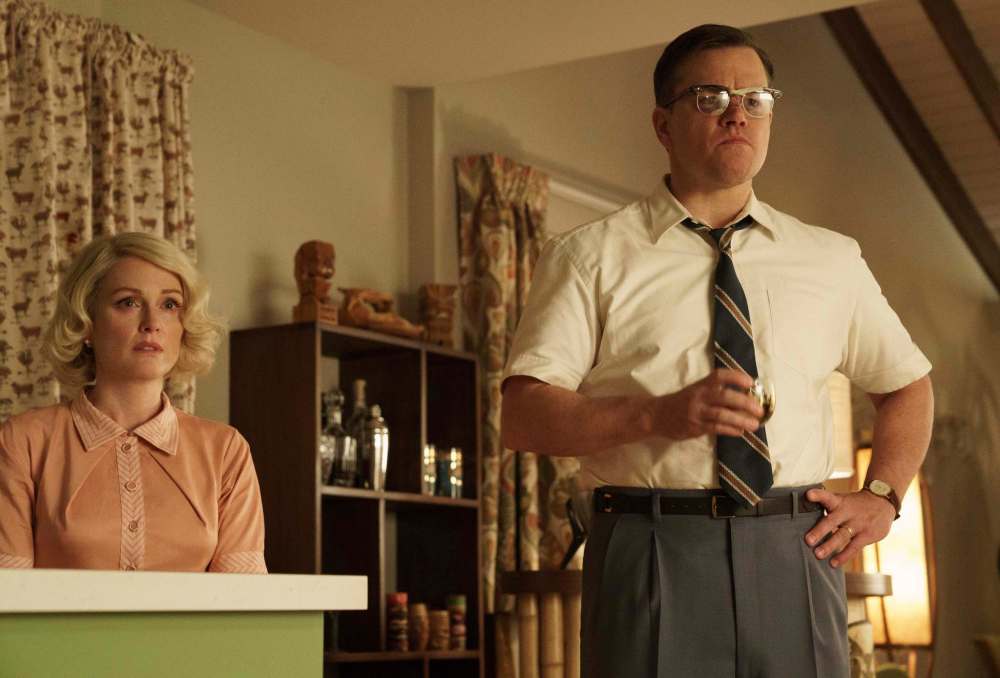
Still, the movie just doesn’t succeed in overcoming an incurable tonal rift between the serious story (in fact, the racial component was based on real events in Levittown, Pa. in 1957) and the Coens’ dark farce.
It’s frustrating. But good intentions do not a good movie make.
randall.king@freepress.mb.caTwitter: @FreepKing
Our newsroom depends on a growing audience of readers to power our journalism. If you are not a paid reader, please consider becoming a subscriber.
Our newsroom depends on its audience of readers to power our journalism. Thank you for your support.
Movie review
Suburbicon
● Starring Matt Damon and Julianne Moore
● McGillivray, Polo Park, St. Vital, Towne
● 14A
● 105 minutes
★★★ out of five
Other voices
In the grand scheme of Coen brothers’ scripts with nimwits making hugely bad decisions, Fargo exists on one brilliant end while Suburbicon lands with a hearty thud somewhere on the other side.
— Brian Truitt, USA Today
It wants to be both a cynical reimagining of To Kill A Mockingbird and a Coen Bros.’ black comedy.
— Scott Mendelson, Forbes
The filmmakers never let us forget how hip they are to humanity’s dark side, and their hyperawareness is more wearying than it is illuminating.
—Stephanie Zacharek, Time
It’s immensely stylish, darkly funny and has dialogue partly written by the Coen brothers, which never hurts.
— Brian Viner, Daily Mail
I laughed in many of the places where Suburbicon wants us to laugh, yet something feels ill-balanced from the get-go-like a carelessly mixed gin and tonic that you drink anyway, wincing at the bitter follow-through.
— Guy Lodge, Vanity Fair
Our newsroom depends on a growing audience of readers to power our journalism. If you are not a paid reader, please consider becoming a subscriber.
Our newsroom depends on its audience of readers to power our journalism. Thank you for your support.
Advertisement Advertise With Us
Advertisement Advertise With Us