Hard and soft Concrete documentary aided by filmmaker’s tender, affecting manner
Read this article for free:
or
Already have an account? Log in here »
To continue reading, please subscribe:

Digital Subscription
One year of digital access for only $205*
- Enjoy unlimited reading on winnipegfreepress.com
- Read the E-Edition, our digital replica newspaper
- Access News Break, our award-winning app
- Play interactive puzzles
*First annual payment billed as $205.00 + GST for one year. This annual subscription will automatically renew at $233.00 + GST every 52 weeks (10% off the regular annual price of $259.35). Offer available to new and qualified returning subscribers only. Cancel any time.
To continue reading, please subscribe:
Add Free Press access to your Brandon Sun subscription for only an additional
$1 for the first 4 weeks*
- Enjoy unlimited reading on winnipegfreepress.com
- Read the E-Edition, our digital replica newspaper
- Access News Break, our award-winning app
- Play interactive puzzles
*Your next Brandon Sun subscription payment will increase by $1.00 and you will be charged $17.95 plus GST for four weeks. After four weeks, your payment will increase to $24.95 plus GST every four weeks.
Read unlimited articles for free today:
or
Already have an account? Log in here »
The title sounds direct, straight-up and, well, concrete.
This is, however, a sweetly aimless, sneakily hilarious, completely unclassifiable documentary.
If you’re a real concrete wonk, you might end up frustrated. Yes, there will be some wild revelations about the world’s most common building material, but this is not exactly a comprehensive examination.
Magnolia Pictures The History of Concrete makes great use of director John Wilson’s strengths.
If you’re a John Wilson fan, on the other hand, you’ll find exactly what you want here. Known for his HBO series How To With John Wilson, the New York-based creator makes his move to the big screen with The History of Concrete, and that means more bizarro street footage, more funny business signs, and more encounters with weird and wonderful NYC randos.
Movie review
The History of Concrete
Directed by John Wilson
- Dave Barber Cinematheque, to Oct. 6
- 101 minutes, not rated
★★★★ out of five
Wilson has become known for his idiosyncratic explorations of such seemingly banal topics as how to track your package, how to find a public restroom, how to clean your ears and how to set up scaffolding. In his show, these subjects get title billing — and a certain amount of fascinating factual background — but mostly they act as jumping-off points for Wilson’s serendipitous journeys.
Making allusive connections, he takes niche subjects and opens them up to universal feelings of loss, loneliness, futility and hope. His true subject is the endless absurdity of the human condition.
In The History of Concrete, Wilson’s free associating starts with a cracked and leaking foundation in his Queens home. No longer able to take concrete for granted, he starts investigating its history, from Rome’s Pantheon (built in the second century and still magnificent) to today’s 3D-printed concrete buildings (already looking a little glitchy).
Magnolia Pictures John Wilson in a scene from The History of Concrete.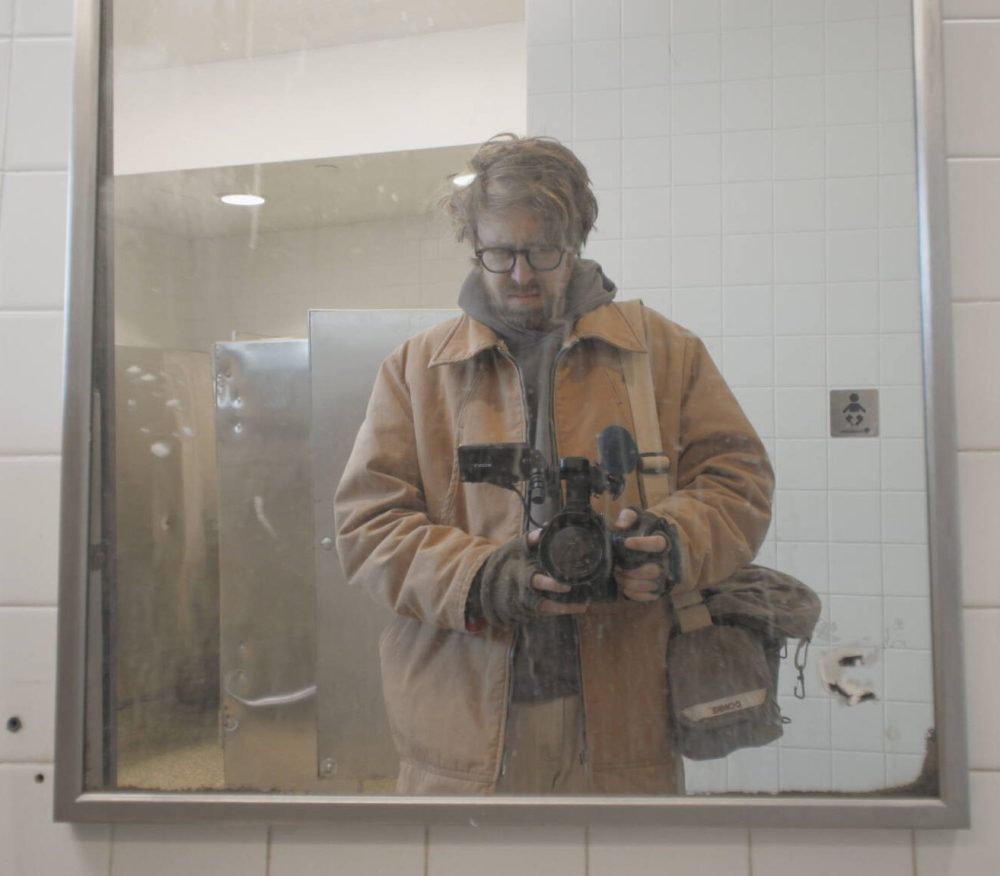
He introduces us to a guy whose business is removing chewing-gum deposits from concrete sidewalks. He takes a trip to Ohio to visit “the oldest concrete street in America.” He attends a concrete convention in Las Vegas. (Regular Wilson viewers know he’s quite the conventioneer.)
While at the convention, he signs a document saying he won’t depict concrete in a negative light. Post-convention, though, he does reference its doubled nature. Concrete has helped build our world but also extracts huge environmental costs. This, in turn, leads to a deeply New Yorky look at affordable housing, the NIMBY movement and the city’s (literally) crumbling concrete infrastructure.
Meanwhile, Wilson is wondering aloud about his own career, specifically the unlikeliness that this film — you know, the one you’re watching — will ever get made. (The Rehearsal’s Nathan Fielder is an executive producer, and, as with his hybrid work, it can be tricky to sort out what’s real and what might be set up.)
Other voices
I wasn’t enthusiastic about the show’s sense of faux-magpie messaging… The movie, by contrast, is rich in an authentic sense of discovery, not least because its titular subject, superficially banal, is also profoundly and strangely universal.
— Richard Brody, The New Yorker
Personal in outlook yet pluralist in content, “The History of Concrete” doubles as a history of his own perceptiveness. It roams from the sidewalk to the soul.
— Zachary Barnes, Wall Street Journal
The question was always: Could he sustain something like that in a longer format? The answer is a resounding [in John Wilson voice], “Um, well… yes.”
— David Fear, Rolling Stone
You’re left wondering how a movie about concrete could leave a lump in your throat. But that’s how Wilson works, making us see what we might not have otherwise.
— Alissa Wilkinson, New York Times
Feeling at loose ends after the end of his HBO series and looking for a new project, Wilson gets on Zoom meetings with colleagues, agents and executives, who tell him they need “sizzle.” They need something that adheres to a clear formula, something that can be boiled down to an elevator pitch.
Wilson dutifully attends a workshop on how to write Hallmark holiday movies, which seems to come down to aspirational interiors, emotional uplift and Christmas trees. The other marketable entertainment, his agent helpfully tells him, is the rockumentary, especially if it centres on a famous person whose career hits a high point just as they are engulfed by scandal and/or personal tragedy.
Of course, easily summed-up storylines are not Wilson’s strong suit, and — despite a brief scene involving Kim Kardashian — he’s comically bad at “sizzle.”
Instead, we get sidetracked into a 3,100-mile extreme marathon that requires running half-mile loops round and round a Queens high school for 52 days. This annual event, inaugurated by the late spiritual leader Sri Chinmoy, involves uneven and unforgiving sidewalk concrete and, hopefully, self-transcendence.
We get musings on the social theory of Guy Debord, the Buddhist idea of samsara and the burial place of Ettore Boiardi (or, as boomers knew him, Chef Boy-ar-dee). We get a poignant detour involving an aging bar-band rocker.
Maybe Wilson’s peregrinations go on too long. Possibly he struggles to connect all his disparate ideas. Wilson is a master of the 28-minute shortform piece, and he hasn’t fully adapted to feature-film length.
Still, we do get more of what Wilson is good at. He’s so profoundly interested in the world and so adorably awkward when he interacts with it. He has such tenderness toward his interview subjects, who need that tenderness, because they’re outcasts and eccentrics and enthusiasts.
All this makes for an affecting, oddball tone, and it means that a film packed with obscure little facts about concrete also happens to be a moving meditation on time and memory, death and decay.
arts@freepress.mb.ca

Studying at the University of Winnipeg and later Toronto’s York University, Alison Gillmor planned to become an art historian. She ended up catching the journalism bug when she started as visual arts reviewer at the Winnipeg Free Press in 1992.
Our newsroom depends on a growing audience of readers to power our journalism. If you are not a paid reader, please consider becoming a subscriber.
Our newsroom depends on its audience of readers to power our journalism. Thank you for your support.
Related Articles
Concrete doc befits brutalist Winnipeg