Pompeii movie an eruption of clichés
Destruction of ancient city a relief in sword-and-sandal epic

Advertisement
Read this article for free:
or
Already have an account? Log in here »
To continue reading, please subscribe:

Digital Subscription
One year of digital access for only $205*
- Enjoy unlimited reading on winnipegfreepress.com
- Read the E-Edition, our digital replica newspaper
- Access News Break, our award-winning app
- Play interactive puzzles
*First annual payment billed as $205.00 + GST for one year. This annual subscription will automatically renew at $233.00 + GST every 52 weeks (10% off the regular annual price of $259.35). Offer available to new and qualified returning subscribers only. Cancel any time.
To continue reading, please subscribe:
Add Free Press access to your Brandon Sun subscription for only an additional
$1 for the first 4 weeks*
- Enjoy unlimited reading on winnipegfreepress.com
- Read the E-Edition, our digital replica newspaper
- Access News Break, our award-winning app
- Play interactive puzzles
*Your next Brandon Sun subscription payment will increase by $1.00 and you will be charged $17.95 plus GST for four weeks. After four weeks, your payment will increase to $24.95 plus GST every four weeks.
Read unlimited articles for free today:
or
Already have an account? Log in here »
Hey there, time traveller!
This article was published 21/02/2014 (4599 days ago), so information in it may no longer be current.
The last time an Englishman made a movie set amid the romance, intrigue and devastation of the Roman city of Pompeii, circa AD 72, the result was the fleshy sex farce Up Pompeii (1971).
It was no masterpiece. But the memory of it makes one positively wistful when it is compared with the Sturm und Drang of this formulaic romance/gladiator/disaster movie.
Brit director Paul W. S. Anderson of the Resident Evil franchise presumably rose to the challenge of this Gladiator-meets-Titanic contrivance to take a breather from that franchise’s non-stop high-tech zombie gunfights.
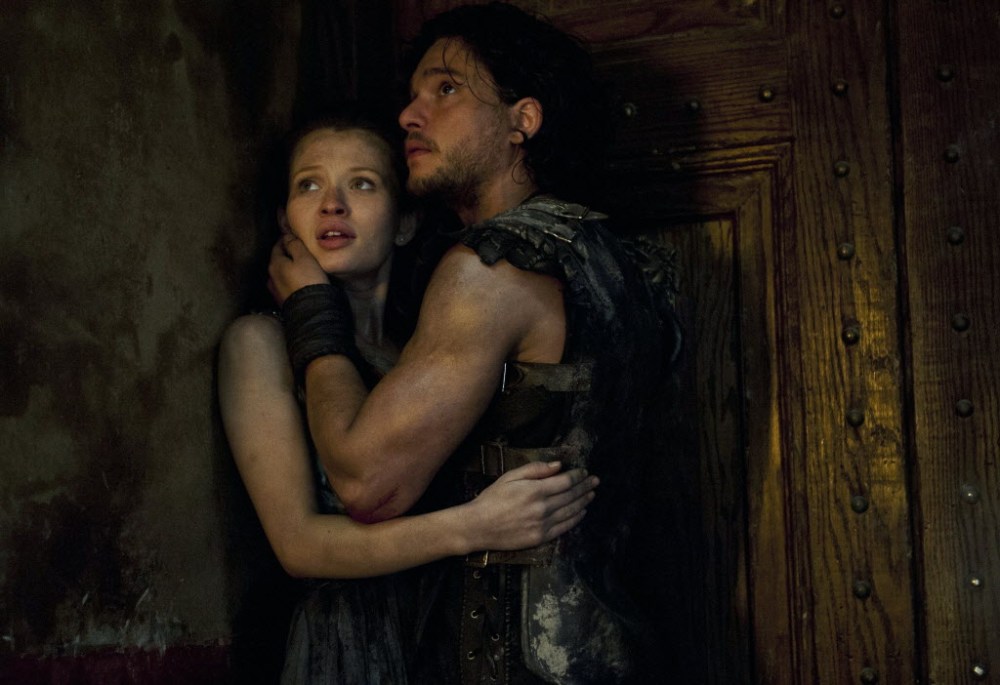
But the resulting film is low on substance, even as it mightily strives to combine a star-crossed romance, gladiatorial combat and fiery apocalyptic disaster.
Milo (Game of Thrones’ Kit Harington) is a Celt who, as a child, witnessed the death of his tribe at the hands of sadistic, marauding Roman general Corvus (Kiefer Sutherland). Years later, he has channelled his rage into gladiatorial skill, which brings him to Pompeii, coincident with the homecoming of Cassia (Emily Browning), the daughter of a senator returning from a fretful stay in Rome.
In this movie’s notion of “meeting cute,” Cassia’s heart is set aflutter when Milo steps up from a throng of slaves to kill her crippled horse with his bare hands.
Milo is designated to fight a battle to the death with Atticus (Adewale Akinnuoye-Agbaje), a slave who has been promised freedom upon his next victory. Cassia, meanwhile, is told by her father to make nice with the visiting, lecherous Gen. Corvus, the very reason she left Rome in the first place.
Sparks fly between the slave Milo and the winsome Cassia, but deadlier sparks are emanating from Mount Vesuvius, which is ominously rattling the pottery in Pompeii prior to what we know will be a devastating event.
The only suspense is not in what will happen, but which will happen first? Will Corvus despoil Cassia? Will Milo save her? Will Milo save himself and get long-awaited revenge on General Corvus?
Anderson and his sundry screenwriters employ the volcano as a deus ex machina that doesn’t necessarily favour its heroes. For a movie that borrows heavily from past Hollywood films — an arena battle re-enactment is lifted straight out of Ridley Scott’s Gladiator — the movie manages to avert a Hollywood ending.

But Anderson is not so nimble when it comes to avoiding cloying sentimentality and bad performances, especially from Sutherland, who delivers Corvus’s Black Bart dialogue in an English accent to underline his contempt for all things decent.
Much of Pompeii’s bombast might have been forgivable if it had been leavened with a bit of humour or dry comedy, especially given that ridiculous precedent from 1971.
After all, what movie couldn’t be improved by some campy double-entendre? Quoth Up Pompeii’s sissy serf Lurkio: “That ring was given to her by her fiancé when she was 18, and he jilted her, and she hasn’t had it off since!”
Now more than ever, Frankie Howerd, you are missed.
randall.king@freepress.mb.ca
Our newsroom depends on a growing audience of readers to power our journalism. If you are not a paid reader, please consider becoming a subscriber.
Our newsroom depends on its audience of readers to power our journalism. Thank you for your support.
Movie review
Pompeii
- Starring Kit Harington and Emily Browning
- McGillivray, McGillivray VIP, Polo Park, St. Vital, Towne.
- PG
- 105 minutes
- 2 stars out of five
Other voices
While hardly high art, Pompeii certainly recognizes what mass audiences want from a Game of Thrones-style sword-and-sandal saga, delivering especially high marks as either a sudsy indulgence for teenage girls or beefcake offering to gay men.
— Peter Debruge, Variety
God help me, it’s not half bad. Pity the studio figured it was a Paul W.S. Anderson picture and sort of gave up on it.
— Roger Moore, McClatchy-Tribune News Service
A kitschy apocalyptic peplum whose visual epiphanies — of which there are definitely a few — cannot outdo a B- (or C- or D-) grade scenario that will have lots of eyes rolling by the time the big stack finally blows.
— Jordan Mintzer, Hollywood Reporter
The eruption itself makes for some pyrotechnic thrills but the action and romance don’t produce many sparks.
— John Hazelton, Screen International
Our newsroom depends on a growing audience of readers to power our journalism. If you are not a paid reader, please consider becoming a subscriber.
Our newsroom depends on its audience of readers to power our journalism. Thank you for your support.
Advertisement Advertise With Us
Advertisement Advertise With Us
History
Updated on Friday, February 21, 2014 7:28 AM CST: Changes headline