New on DVD / VOD

Advertisement
Read this article for free:
or
Already have an account? Log in here »
To continue reading, please subscribe:

Digital Subscription
One year of digital access for only $205*
- Enjoy unlimited reading on winnipegfreepress.com
- Read the E-Edition, our digital replica newspaper
- Access News Break, our award-winning app
- Play interactive puzzles
*First annual payment billed as $205.00 + GST for one year. This annual subscription will automatically renew at $233.00 + GST every 52 weeks (10% off the regular annual price of $259.35). Offer available to new and qualified returning subscribers only. Cancel any time.
To continue reading, please subscribe:
Add Free Press access to your Brandon Sun subscription for only an additional
$1 for the first 4 weeks*
- Enjoy unlimited reading on winnipegfreepress.com
- Read the E-Edition, our digital replica newspaper
- Access News Break, our award-winning app
- Play interactive puzzles
*Your next Brandon Sun subscription payment will increase by $1.00 and you will be charged $17.95 plus GST for four weeks. After four weeks, your payment will increase to $24.95 plus GST every four weeks.
Read unlimited articles for free today:
or
Already have an account? Log in here »
Hey there, time traveller!
This article was published 18/02/2016 (3876 days ago), so information in it may no longer be current.
Trumbo
The saving grace of Jay Roach’s Trumbo is a character worthy of a full-blown biopic. Screenwriter Dalton Trumbo, enthusiastically played by Bryan Cranston, was prickly, intellectually vigorous and very talented. He backed his convictions with action — or, in the case of his encounters with the House Un-American Activities Committee (HUAC), his bold refusal to co-operate with the inquiry by naming names of associates in the Communist party.
Trumbo’s stand makes him a target of both political opportunists and the viperish, power-mad gossip columnist Hedda Hopper (Helen Mirren may not be the best casting, but she clearly is enjoying herself).

Trumbo doesn’t even get a break from his fellow targets. In a priceless scene between Trumbo and fellow Commie screenwriter Arlen Hird (a fictional amalgamation of several screenwriters played by a hangdog Louis C.K.), Hird says he doesn’t trust Trumbo because he is rich.
“The radical and the rich guy make a perfect combination,” Trumbo counters. “The radical may fight with the purity of Jesus, but the rich guy wins with the cunning of Satan.”
That strategy actually works for Trumbo when he is released from prison and finds himself unemployable due to the blacklist. He enlists his family, especially his saintly wife (Diane Lane) and firebrand daughter (Elle Fanning), to help supply scripts written under assumed names for opportunistic producer Frank King (a hilariously nettlesome John Goodman). Ironically, those alter egos win Trumbo Academy Awards for the screenplays of The Brave One and Roman Holiday.
Trumbo screenwriter John McNamara may not be an Oscar contender, but he injects a lot of wit in the dialogue. He also doesn’t stint on the story’s undeniable dishy pleasures, casting the icon John Wayne in an ugly light, celebrating the ballsy heroism of Kirk Douglas (Dean O’Gorman) for breaking the blacklist by putting Trumbo’s name in the credits for Spartacus, and fairly portraying the quandary of Edward G. Robinson (Michael Stuhlbarg), who first defended Trumbo, but ultimately cracked under the pressure of the HUAC.
Yes, Trumbo is guilty of a Hollywood-centric prejudice in its depiction of the Communist witch hunt, but with extenuating circumstances Trumbo himself would have respected: it’s very entertaining. ★★★1/2
Black Mass
We know the story of James (Whitey) Bulger is the stuff of a classic mobster movie because it has already inspired one very good mobster movie: Martin Scorsese’s The Departed (2006), with Jack Nicholson inhabiting the kingpin role with his characteristically fiendish élan.
But where that story was a mashup of true Boston crime and the 2002 Hong Kong undercover thriller Infernal Affairs, Black Mass hews closer to the true facts of Bulger’s career, replete with crime, family, power, corruption, loyalty and treachery.
At its centre is an unholy alliance between Bulger (Johnny Depp) and FBI agent John Connolly (Joel Edgerton), a South Boston guy from the neighbourhood. When the FBI makes a mission out of toppling the Italian organized crime network in the city, Connolly suggests making an ally out of Bulger, turning him into an informant who will surreptitiously trip up the Mafia’s foothold in Boston.
Connolly, desperate to make it work, exacts a promise out of Bulger that he at least won’t kill anybody.
Bulger doesn’t exactly keep that promise, but the devil’s bargain serves both men. Bulger secures a place for himself as an unassailable crime lord. And with his successful prosecution of the Mafia elements, Connolly’s star starts to rise within the agency.
Director Scott Cooper makes a few smart moves, such as filming in many of the South Boston locations where the real story went down. But the film will only live and breathe if the star captures the imagination with a big performance of equal parts charisma and menace.
You know, like Jack Nicholson.
Unfortunately, Depp’s performance simply doesn’t find purchase in credibility: all cosmetics, no foundation. That’s exacerbated by stunt-casting Benedict Cumberbatch as Whitey’s senator brother Billy Bulger. In their scenes, it’s impossible to detect a whiff of history between them.
The usually excellent Aussie actor Edgerton is the third bit of miscasting, laying on Connolly’s arrogance with a trowel.
There is some excellent acting in here, mind you, almost all in the tiny roles, especially Peter Sarsgaard as a coke-addled small-timer and Juno Temple as a prostitute, both of whom get in Bulger’s bad books with predictable results. ★★1/2
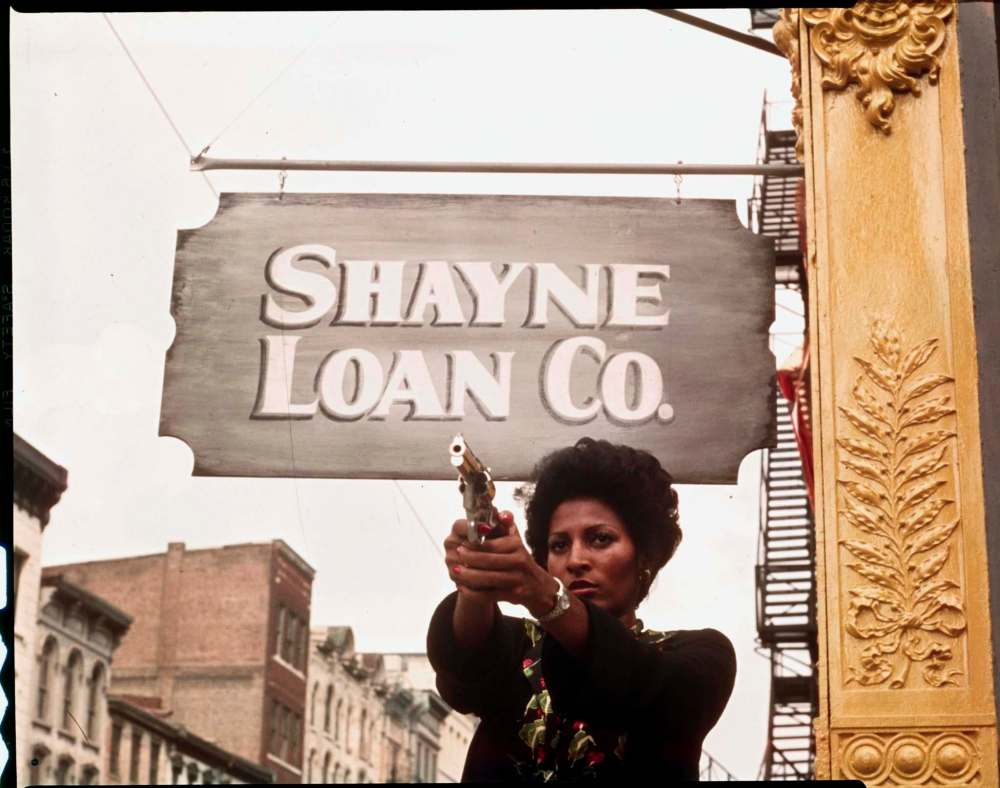
Sheba, Baby
When Quentin Tarantino cast Pam Grier in the title role of Jackie Brown in 1997, the director was famously inspired by Grier’s blaxploitation movies of the ’70s, especially Coffy (1973) and Foxy Brown (1974).
The 1975 film Sheba, Baby is often mentioned in the same breath as those two American International Pictures-produced predecessors.
The plotline is certainly similar: Grier is Sheba Shayne, a Chicago private eye called to her hometown of Louisville, Ky., to assist her dad, a loan-company owner targeted by some shady hoodlums. Much ass is kicked.

But as the new Arrow Video Blu-ray edition of the film demonstrates, Sheba, Baby is not really in the same league as its predecessors. A doc on the DVD featuring an interview with producer David Sheldon sheds some light on why.
Asked to come up with a project that would fulfil Grier’s three-picture obligation to AIP, Sheldon and director William Girdler essentially pulled an all-nighter coming up with a script that would meet the requirements of AIP’s none-too-finicky honcho Samuel Z. Arkoff.
More blame may be heaped on Girdler, a point-and-shoot director who tends to waste lots of footage of people walking and cars driving in an effort to pad the running time. Looking at Grier’s performance, one gets the impression Girdler was loath to ask for a second take when one might have been required. Coffy/Foxy Brown director Jack Hill looks like a genius by comparison.
Worst of all, the film is PG, meaning that while the action components are there, the sex-and-violence quotient of the typical Grier movie is way down. Sheba, Baby may be the only Grier movies of the ’70s that is — gasp — boring. ★★
randall.king@freepress.mb.ca @FreepKing
Our newsroom depends on a growing audience of readers to power our journalism. If you are not a paid reader, please consider becoming a subscriber.
Our newsroom depends on its audience of readers to power our journalism. Thank you for your support.
Our newsroom depends on a growing audience of readers to power our journalism. If you are not a paid reader, please consider becoming a subscriber.
Our newsroom depends on its audience of readers to power our journalism. Thank you for your support.
Advertisement Advertise With Us
Advertisement Advertise With Us