New on DVD / VOD

Advertisement
Read this article for free:
or
Already have an account? Log in here »
To continue reading, please subscribe:

Digital Subscription
One year of digital access for only $205*
- Enjoy unlimited reading on winnipegfreepress.com
- Read the E-Edition, our digital replica newspaper
- Access News Break, our award-winning app
- Play interactive puzzles
*First annual payment billed as $205.00 + GST for one year. This annual subscription will automatically renew at $233.00 + GST every 52 weeks (10% off the regular annual price of $259.35). Offer available to new and qualified returning subscribers only. Cancel any time.
To continue reading, please subscribe:
Add Free Press access to your Brandon Sun subscription for only an additional
$1 for the first 4 weeks*
- Enjoy unlimited reading on winnipegfreepress.com
- Read the E-Edition, our digital replica newspaper
- Access News Break, our award-winning app
- Play interactive puzzles
*Your next Brandon Sun subscription payment will increase by $1.00 and you will be charged $17.95 plus GST for four weeks. After four weeks, your payment will increase to $24.95 plus GST every four weeks.
Read unlimited articles for free today:
or
Already have an account? Log in here »
Hey there, time traveller!
This article was published 28/04/2016 (3744 days ago), so information in it may no longer be current.
● Krampus
This Christmas-themed horror movie should not distract from the fact writer-director Michael Dougherty has made this kind of seasonal offering before. His first feature was a very good Halloween thriller, Trick ’r’ Treat, a film that established his quirky gothic esthetic, especially in the fiendish character of a child maniac with a pumpkin for a head.
Think of Dougherty as a Tim Burton who isn’t especially interested in softening the horror elements for the kiddies.
Naturally, Dougherty would be drawn to the mythical character of Krampus, a figure out of Alpine German-Austrian lore, the “shadow of Saint Nicholas” who comes to punish bad kids at Christmastime, instead of rewarding good kids.
This film establishes its satiric tone right at the start with an opening credits montage of yuletide shoppers trampling and beating up on each other in the search for pre-Christmas bargains. We soon focus on the family of young Max (Emjay Anthony). His mom Sarah (Toni Collette) and dad Tom (Adam Scott) are preparing for the annual holiday invasion by the family of Sarah’s sister, Linda (Allison Tolman), including her obnoxious husband Howard (David Koechner) and their mostly malevolent offspring.
A successful attempt to humiliate Max by his cousins compels Max to rip up his letter to Santa and declare: “I hate Christmas!” That simple act ushers in a hellish blizzard that effectively cuts off the family from their neighbours, in addition to cutting off the power and the heat in the house. A large horned-and-hoofed presence soon makes itself manifest, and only Max’s German grandmother Omi (Krista Stadler) knows his identity: Krampus.
“He and his helpers did not come to give, but to take,” she warns Max.
What follows is a pretty conventional siege-type horror as Krampus and his minions — in the form of conventional Christmas elves, snowmen, gingerbread cookies and even angels — descend on Max’s suburban abode; Dougherty eschews graphic gore in favour of these disturbing monster creations.
It works on a satiric level, suggesting what unfettered capitalism has done to the spirit of peace on earth and goodwill towards men. It doesn’t work evoking real terror, but the film is primarily a dark comedy, eliciting some grim chuckles. ★★★
● Drunk Stoned Brilliant Dead: The Story of the National Lampoon
Netflix is currently producing a film biopic of National Lampoon co-founder Doug Kenney titled A Futile and Stupid Gesture (the title borrows a quote from Animal House). Consider this doc as deep background, the story of the magazine that really defined late-20th-century comedy, encompassing everything from Ghostbusters toSaturday Night Live, SCTV to Ferris Bueller.
National Lampoon was a raucous, subversive and often tasteless humour magazine that, issue after issue, hit the ’70s right in the zeitgeist. It became a satiric powerhouse around 1972, a counter-culture counter-punch to the era of the Vietnam war and the Nixon presidency. By today’s standards, it was insanely offensive. It made jokes about the Holocaust, rape, drugs, racism and homosexuality.
It was a publication of its time, but its influence was far-reaching. This doc by Douglas Tirola at least makes that point, emphasizing the mag’s origins and its two creative founders: Kenney and Henry Beard. In particular, Kenney comes under the microscope as a comedy genius who succumbed to druggie excess in the ’80s, joining the premature death parade with funny-angry writer-editor Michael O’Donaghue, writer-director John (Home Alone) Hughes (who wrote filthy stories in the magazine before becoming a respected Hollywood player) and John Belushi, who worked on NL’s radio shows before being absorbed into the nascent comedy machine that wasSNL. None of those guys made it out of comedy alive.
The film stands as an invaluable look at a largely forgotten comedy institution. But it falls maddeningly short of being definitive. Given the chance to interview writer Anne Beatts, who left the magazine to join the writing staff ofSNL, Tirola doesn’t think to ask about the magazine’s decidedly sexist content. He also doesn’t think to ask libertarian Republican P.J. O’Rourke about the magazine’s political sea change under his editorial tenure. ★★★
● Son of Saul
Many films have explored the topic of the genocide carried out by the Nazis during the Second World War. But few films have dared to drop viewers smack into the centre of that horror, keeping them there for the duration of the film’s running time.
Hungarian director László Nemes takes that gamble, training his camera almost exclusively on a single character over the course of a couple of desperate days.
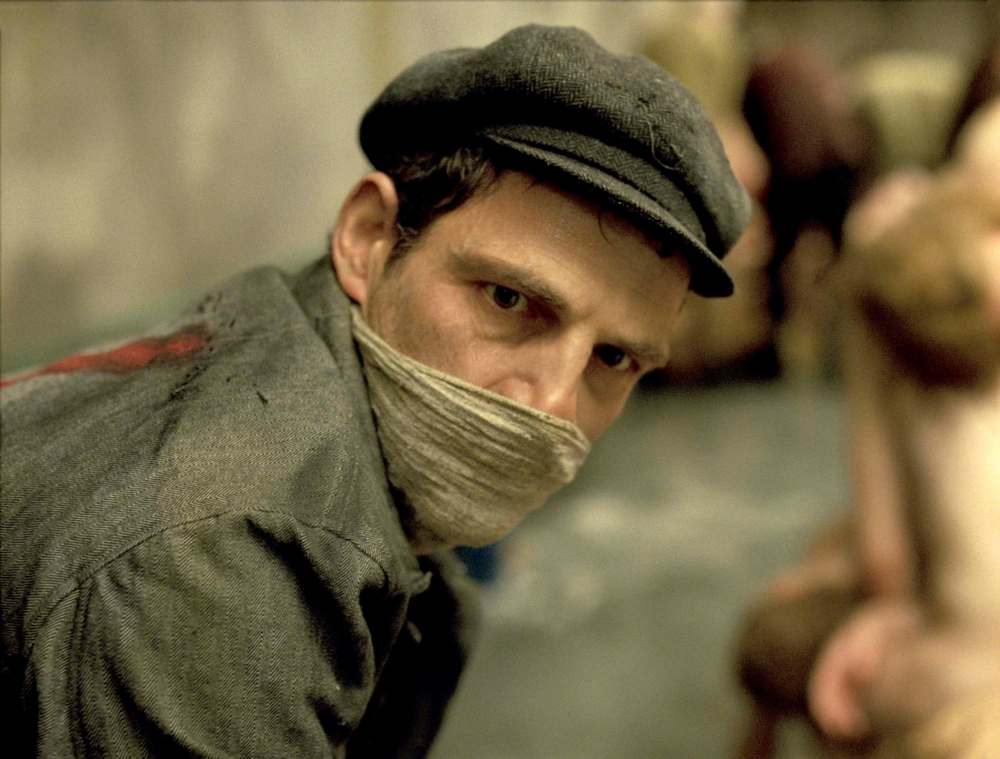
Adding to the challenge to audiences, Nemes’s protagonist, Hungarian prisoner Saul Ausländer (Géza Röhrig), is slow to register as a sympathetic character. In the Auschwitz-Birkenau concentration camp, Saul is a “Sonderkommando,” a Jew spared from the gas chambers in exchange for his willingness to work for the Nazis.
This job, as we see in the film’s harrowing first segment, includes shepherding new arrivals from railway boxcars to the facility’s “showers,” never betraying the fact that the room to which they’re being led is a gas chamber. When we meet Saul, he shows no more emotion than one would expect from a feral animal in carrying out these grim assignments. He bounces from task to task with his face set in an almost pugnacious determination, even as he is removing the bodies from the gas chambers and scrubbing the floors to dispose of evidence that might alert the next crowd of victims.
But a crack shows in his veneer when he encounters an unconscious boy whom the gas chamber has failed to kill. The boy is duly suffocated by a doctor working in the facility. But Saul refuses to abandon the corpse to the Nazi’s coal-fuelled furnaces. In fact, he plans to give the child a proper Jewish burial in the face of overwhelming odds. Among the camp’s incoming prisoners, he tries to find a rabbi who will attend the burial and say Kaddish, the mourner’s prayer.
Nemes, making an unprecedented feature debut, may be just as confounding as his hero with his refusal to frame the Holocaust as a big cinematic spectacle. His camera is intimately focused on Saul throughout the film.
This results in what would appear to be an accurate depiction of the death camps, where the inmates speak a baffling array of different languages (the film is mostly Hungarian with English subtitles), and an underground black market exists where members of the Sonderkommando trade in purloined jewelry with accommodating guards for trivial favours. Nemes’s subjective approach also means the attendant horrors of Saul’s existence — the bodies, the fires, the executions — are either out of focus or off-camera, suggesting Saul’s own psychological removal from the horrors of his existence. Esthetically, this choice constitutes a small mercy.

But it certainly doesn’t diminish the power of the story. The enigma of the child’s identity never overshadows the mystery of how such monstrous evil could exist in the first place. ★★★★
Twitter: @FreepKing
Our newsroom depends on a growing audience of readers to power our journalism. If you are not a paid reader, please consider becoming a subscriber.
Our newsroom depends on its audience of readers to power our journalism. Thank you for your support.
MTS VIDEO ON DEMAND MOVIES
1. The Revenant
2. Daddy’s Home
3. Sisters (HD)
4. The Hunger Games: Mockingjay Part 2
5. The Hateful Eight
6. Alvin and the Chipmunks: The Road Chip
7. The Big Short
8. The Forest
9. Concussion
10. In the Heart of the Sea
— Week ending April 24
Our newsroom depends on a growing audience of readers to power our journalism. If you are not a paid reader, please consider becoming a subscriber.
Our newsroom depends on its audience of readers to power our journalism. Thank you for your support.
Advertisement Advertise With Us
Advertisement Advertise With Us