Neil Young’s message to his mom
Iconic singer digs up his roots in a tiny 1947 Voice-o-Graph recording booth
Advertisement
Read this article for free:
or
Already have an account? Log in here »
To continue reading, please subscribe:

Digital Subscription
One year of digital access for only $205*
- Enjoy unlimited reading on winnipegfreepress.com
- Read the E-Edition, our digital replica newspaper
- Access News Break, our award-winning app
- Play interactive puzzles
*First annual payment billed as $205.00 + GST for one year. This annual subscription will automatically renew at $233.00 + GST every 52 weeks (10% off the regular annual price of $259.35). Offer available to new and qualified returning subscribers only. Cancel any time.
To continue reading, please subscribe:
Add Free Press access to your Brandon Sun subscription for only an additional
$1 for the first 4 weeks*
- Enjoy unlimited reading on winnipegfreepress.com
- Read the E-Edition, our digital replica newspaper
- Access News Break, our award-winning app
- Play interactive puzzles
*Your next Brandon Sun subscription payment will increase by $1.00 and you will be charged $17.95 plus GST for four weeks. After four weeks, your payment will increase to $24.95 plus GST every four weeks.
Read unlimited articles for free today:
or
Already have an account? Log in here »
Hey there, time traveller!
This article was published 18/05/2014 (4481 days ago), so information in it may no longer be current.
LOS ANGELES — Critics, be warned: Whatever you might want to say about the way Neil Young sings the work of Bob Dylan, Willie Nelson, Gordon Lightfoot and several other songwriters on his intimate and idiosyncratic new album, A Letter Home, don’t call them covers.
“I don’t like to think of them as cover tunes,” Young said by phone from New York recently before making an appearance on The Tonight Show Starring Jimmy Fallon with his Letter Home co-conspirator, Jack White.
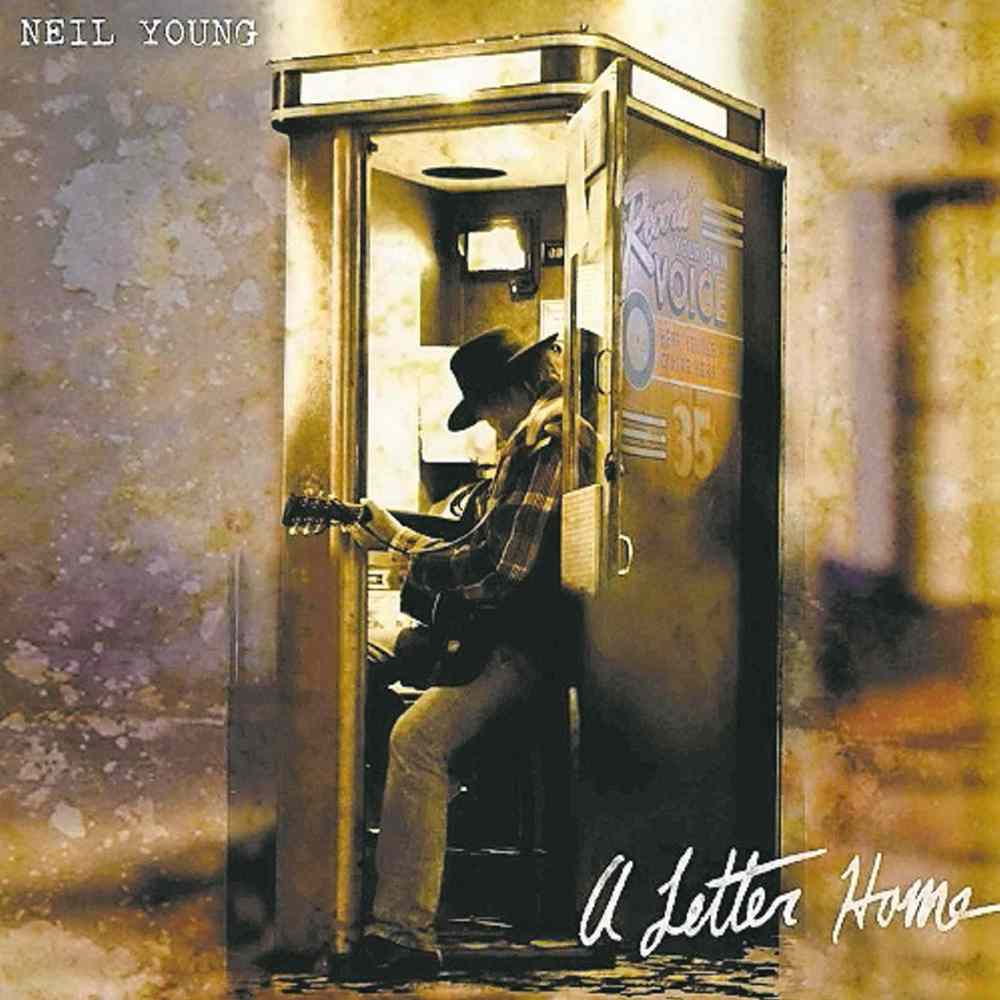
“Calling them ‘cover versions’ shows very little depth on the part of the reviewer,” he said. “These songs are the roots of who I am musically.”
A Letter Home, due May 27, represents another in a long line of intriguing tributaries explored on Young’s mercurial career. What began last year as simple curiosity when Young noticed people walking in off the streets of Nashville to use a vintage recording booth in Jack White’s Third Man Records complex quickly turned into a full-blown immersion in bygone recording technology.
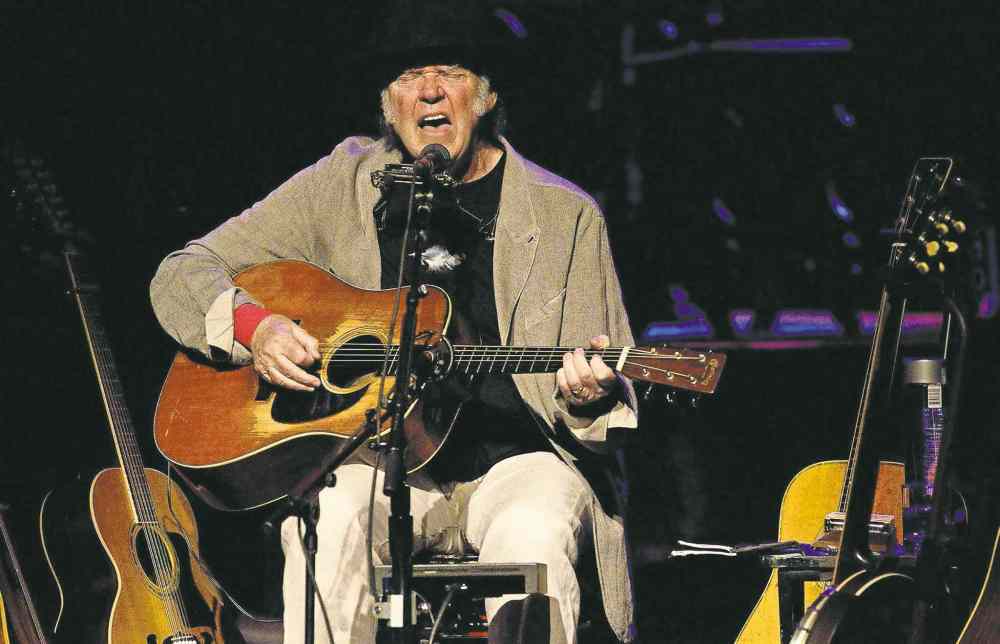
Originally, the 1947 Voice-o-Graph booth was an audio counterpart to photo booths that allow passersby to grab quick portraits of themselves. The original price of 35 cents per recording is still visible on the booth, which White restored to nearly original condition.
“They’d come in and sing a song,” said Young, 68. “I thought, ‘This is cool. Look at these people — everybody’s making records.’ I said to Jack, ‘I could probably make an album in this thing.’ He said, ‘Really?’ “
Young took about three months thinking about songs he could perform solo — a format he’s often employed over his nearly half-century career. Thinking small was a necessity of the booth, which measures less than a metre wide and just over a metre deep. Two songs that featured White backing Young on piano required some old-fashioned American ingenuity: They shoved a piano up against the booth and left the door open so the microphone inside could pick it up.
“It’s all about sitting down and playing a song and doing the whole thing,” Young said. “There’s no production; it’s just a performance. It’s about the essence of the songs. We planned it out, and after three days we’d done them all.”
While most of Young’s selections were from the 1960s and early ’70s — Dylan’s Girl From the North Country, Lightfoot’s Early Morning Rain and If You Could Read My Mind, Nelson’s Crazy — he looks as far forward as 1980 for a second Nelson contribution, On the Road Again, a song that nonetheless encapsulated Young’s life when he was just getting his career off the ground decades ago: “The life I love is making music with my friends/I can’t wait to get on the road again.”
Nelson’s long been a close friend of Young’s, sharing status as co-founders (along with rocker John Mellencamp) of the annual Farm Aid benefit shows in support of family farmers. And Lightfoot was something of a role model for Young, demonstrating that it was possible for Canadian musicians to establish solid careers south of their border.
“He’s a master,” Young said. “I love Gordy’s songs. Both of the songs of his I did on the record are very touching and very emotional to me.”
Young sticks to Lightfoot’s original version of If You Could Read My Mind, a song the composer has modified in recent years, changing a line that blames the other person for a breakup — “If you’ll read between the lines/You’ll see that I’m just trying to understand/The feelings that you lack.” These days, Lightfoot sings about “the feelings that we lack.”
“I think I sing the original version,” Young said of the modification. “The original is just so intense. He obviously matured. I didn’t.”
As much as Young thought he was familiar with songs he’d long treasured, there was a learning process.
“I know all kinds of songs that Bob (Dylan) sings, but I just had to do that one,” he said of Girl From the North Country, which first appeared on the 1963 album The Freewheelin’ Bob Dylan, released when Young was 17. “I’d never done it before. When I started playing it, I realized I don’t know this song at all. I don’t know the changes, I don’t know how to play it.
“With Bob’s masterful songwriting, the chords are all sideways,” he said. “It sounds like simple stuff — it’s only got three chords, but I’m working my ass off trying to figure out when they arrive.
“I love my version,” he said modestly. “That one’s got changes that are just irrational. Yet the song just bobbles along. It’s a great sympathetic character Bob created, the way he treats his love. It’s really beautiful — the respect that he shows” to the woman in the song.
In one of the album’s most paradoxical performances, he starts whistling at the end of Bert Jansch’s grim Needle of Death, which inspired at least two of Young’s own songs: The Needle and the Damage Done and Ambulance Blues.
“That’s the blues for you,” Young said with a laugh. “It’s just a happy-go-lucky song about someone killing themselves. You can’t describe the way these songs are just so magical. I didn’t know what I was gonna do, and that seemed to make a lot of sense. I’m just gonna whistle and walk out of here. There’s nothing more I can do.”
The framing device for the project — an introduction in which Young talks to his mother — also arose out of an off-the-cuff comment White made while they were working up the songs.
“Somewhere in there, Jack started to say, ‘They used to send messages out on these things instead of people writing letters. It would go to your friend, your family, or a lover. You’d send one of these to people and they’d save them forever, because you’d be hearing someone’s real voice.’ He kept saying that — ‘People used to send messages with these.’ “
So Young recorded his message to his mother, Rassy Young, who raised him largely as a single mom after his father, celebrated Canadian sportswriter Scott Young, left the family. “Hi, Mom!” he says in a child-like voice, adding the suggestion that “I really think you ought to start talking to Daddy again.”
“It was spontaneous,” Young said.
The basic recordings, as transferred to discs, have the surface noise and scratchy sounds of aged vinyl.
A Letter Home is being issued in three versions: a “standard version” (identified as Young’s preferred take) that captures the sound of the Voice-o-Graph discs on CD, 12-inch vinyl LP and six vinyl singles included in the deluxe box set. A version is also available for Young’s forthcoming audiophile-quality, digital music system, Pono.
“There’s no vinyl sound on that one because it never went to vinyl,” Young said.
Additionally, because Young was in Nashville working on a long-gestating documentary about his LincVolt electric car, his film crew captured most of the recording sessions for a DVD, another instalment in Young’s ongoing documentation of his career.

That A Letter Home is the second album of other people’s songs he’s released in the last two years — after Americana in 2012 — prompted a question posed in Young’s 2012 autobiography, Waging Heavy Peace: Whether his songwriting muse would still be with him after he gave up smoking pot. “I’ll have to get back to you on that,” he wrote at the time.
Now, however, Young said, “I’m writing new songs, and they’re really good, I feel. So I think everything’s fine.”
— Los Angeles Times