When Winnipeg rocked
Booming music scene made burgh one cool place to be young
Advertisement
Read this article for free:
or
Already have an account? Log in here »
To continue reading, please subscribe:

Digital Subscription
One year of digital access for only $205*
- Enjoy unlimited reading on winnipegfreepress.com
- Read the E-Edition, our digital replica newspaper
- Access News Break, our award-winning app
- Play interactive puzzles
*First annual payment billed as $205.00 + GST for one year. This annual subscription will automatically renew at $233.00 + GST every 52 weeks (10% off the regular annual price of $259.35). Offer available to new and qualified returning subscribers only. Cancel any time.
To continue reading, please subscribe:
Add Free Press access to your Brandon Sun subscription for only an additional
$1 for the first 4 weeks*
- Enjoy unlimited reading on winnipegfreepress.com
- Read the E-Edition, our digital replica newspaper
- Access News Break, our award-winning app
- Play interactive puzzles
*Your next Brandon Sun subscription payment will increase by $1.00 and you will be charged $17.95 plus GST for four weeks. After four weeks, your payment will increase to $24.95 plus GST every four weeks.
Read unlimited articles for free today:
or
Already have an account? Log in here »
Hey there, time traveller!
This article was published 09/11/2014 (4328 days ago), so information in it may no longer be current.
Neil Young said in a recent interview with CBC radio that “Winnipeg was the rock ‘n’ roll capital of Canada, as far as I was concerned.”
Few can argue with him. If you were a teenager here in the 1960s, you know Winnipeg was one of the most exciting places on Earth. Young’s latest book, Special Deluxe: A Memoir of Life & Cars, includes several warm and wonderful anecdotes about the local music scene back then and his role in it. It truly was a magical time.
“Winnipeg in the ’60s was like that movie That Thing You Do, only multiplied by a thousand,” says Randy Bachman of the Guess Who and Bachman-Turner Overdrive. “It was so exciting and alive with music.”
Even before Shakin’ All Over, the 1965 smash hit by the Guess Who, tuned the rest of Canada into what was happening in Winnipeg, a thriving rock scene was already well in motion. Beginning in the mid-1950s, community clubs in neighbourhoods throughout the city were the catalysts for the rock ‘n’ roll teen explosion.
“It was a time when everyone wanted to dance, so the community clubs were always packed,” notes the Quid’s Colin Palmer.
Community club canteen dances offered live music at a grassroots level and became the proving ground for every budding young musician.
“If anyone ever asked me when the best times were in music, for me it was back in those early days in the community clubs,” says Fred Turner of BTO, who cut his teeth in early bands such as Roy Miki and the Downbeats on the community club circuit.
“The first real gig I ever played was at Orioles Community Club. I played for a soft drink and a chocolate bar,” said Turner. “The band all plugged into one amplifier. No one could hear themselves, so you would have to kick guys in the ankles to get them to change chords.”
Burton Cummings, whose North End teenage band became a popular community club attraction before he found fame with the Guess Who, said, “The Deveron days were some of the happiest and most memorable of my entire life.”
“The drinking age was still 21 then and drugs hadn’t really hit the street yet, so the real buzz for everyone was the music. The music was the high. Lord Roberts, Crescentwood, Pirates, Woodhaven, Silver Heights, Chalmers, West End and dozens of other community clubs hosted dances every weekend. I think the Deverons played every weekend over a two-year period,” he said. “We were all still living at home, not having to take any risks in life yet, but having this incredible adulation and success while still in our teens.”
Glenn MacRae of the Crescendos says, “Champlain Community Club was a magic place to play.”
“So was Mapes (Maple Leaf Community Club). They seemed livelier, and the kids had more fun.”
It was Crescentwood Community Club dances that first introduced yours truly to live rock ‘n’ roll, and girls, vying with Randy Michalikow for attention and maybe a dance with Susan Dempsey or Janet Brown. The evenings always began with boys seated on one side of the hall and girls on the others. All it took was one bold young man to approach a girl to dance and the floodgates opened. And if you were lucky, you might receive a kiss at the end of the night. Innocent times, indeed.
On Feb. 1, 1963, Neil Young’s the Squires made their debut at Riverview Community Club in Fort Rouge, drawing a small but enthusiastic crowd of teens. They received $5 for their efforts — one dollar each, with a dollar left for gas. The four band members were elated.
“I always liked playing Crescentwood Community Club,” says Squires guitarist Allan Bates. “A lot of tough guys were around there, but that was OK because they were our buddies.”
Ron Simenik of the Vaqueros recalls, “You played from eight o’clock until one in the morning, with a couple of 15-minute breaks for a few Cokes.”
“We didn’t feel the necessity to stop,” adds Neil Young. “All the bands just enjoyed playing there so much, and the kids loved it. It was really a fun time. There was always big lineups and always good crowds at the community clubs.”
The Fifth’s Richard Gwizdak recalls one memorable night.
“We played Charleswood Community Club, and the ceiling started to come down. Kids were dancing and stomping their feet, and pieces of the ceiling started falling on us as we played,” he said. “But we kept on playing.”
The two local rock ‘n’ roll radio stations, CKY and CKRC (joined a few years later by CFRW), played a major role in igniting the music scene. disc jockeys such as Doc Steen, Daryl B, Boyd Kozak, Ron Legge, Jim Paulson, PJ the DJ (Peter Jackson), Dino Corrie and Jim Christie were local celebrities in their own right. Getting one of them to DJ your dance guaranteed a crowd.
“For three or four years, there wasn’t a Friday or Saturday night that I wasn’t out at the community clubs,” recalled Doc Steen. “I enjoyed working with all the bands.”
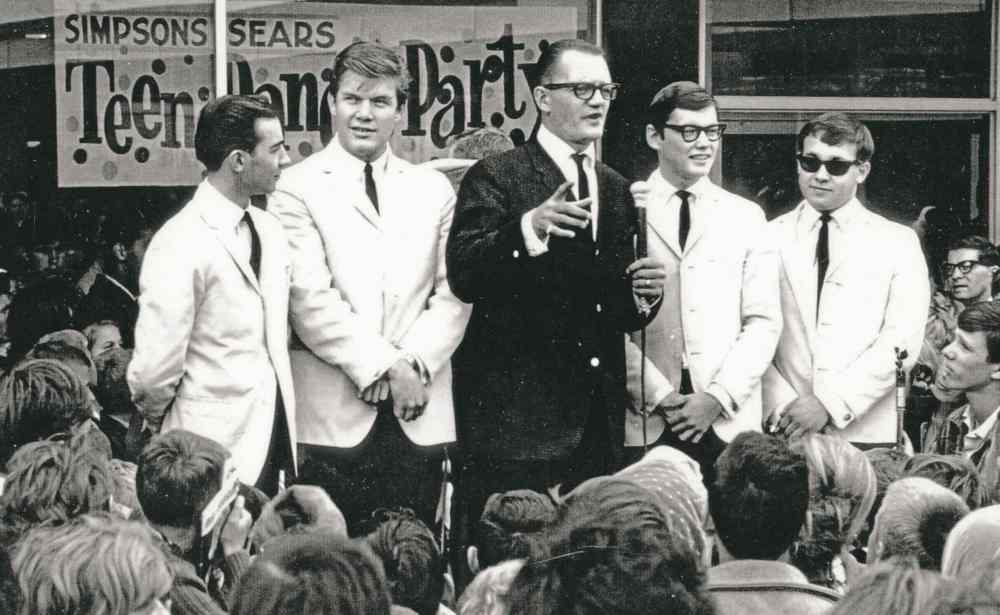
Similarly, Teen Dance Party host Bob Burns was as big a draw as the bands, bringing the Pepsi Pack dancers to your community club to demonstrate all the latest moves and shakes. Teens by the hundreds lined up each Saturday morning for a chance to show off their dance skills on the popular CJAY TV show.
“Everybody watched it, whether they admitted it or not,” says Joey Gregorash. “Guys watched it because there were chicks on the show, or to learn the new dances to try out later that night at the community clubs.”
Saturdays for teens also meant walking the Portage Avenue strip, visiting the clothing and music shops between Eaton’s and the Bay, ending up at the Bay’s sixth-floor Paddlewheel Restaurant, where bands and fans met.
“Me and my two best friends would stroll in, sit down and scout out who was there,” remembers Patti Ireland. “There was always a who’s who of band guys. I once saw Burton Cummings sitting there, but I was too shy to go over and say anything to him.”
‘Kids were dancing and stomping their feet, and pieces of the ceiling started falling on us as we played’
Local businesses jumped on the rock ‘n’ roll bandwagon, hiring bands to play at their establishments. Movie theatres — including the Rialto with its Sunday Shindigs, the Odeon and the Metropolitan — featured live bands between features.
A Champ’s Kentucky Fried Chicken outlet on Henderson Highway had bands playing on their roof. Car dealerships hired bands to play on their lots. Eaton’s and the Bay tried to outdo each other with Eaton’s A Go Go and Piccadilly A Go Go at the Bay. Simpsons-Sears, Clarks and Topps department stores, and even the Red River Exhibition with its Teen Fair, also used live music to draw in teens.
The most aggressive and successful local business to tap into the burgeoning teen market was Monarch Wear, owned by the Steinberg family. (I went all through high school with Lawrie Steinberg, never realizing the cool jeans I sported were made by his family.) Through marketing directed at youth and a connection with local bands, MW’s Tee Jays and later Tee Kays (“Jay is out; Kay is in”), the jeans became de rigueur for teens.
“Those jeans were as tight as you could get,” laughs former Monarch Wear salesman Peter Thiessen. “That’s the way the kids liked it. If you farted, you blew them apart.”
Both the Jury and Satan & the D-Men mentioned Tee Kays on their recordings and were rewarded with Monarch Wear gear. The company also hired 15-year-old singer Lucille Emond as Miss Tee Kay to model the jeans.
“They just shuffled me from event to event each week,” Lucille recalls.
Her picture appeared everywhere, making her a local celebrity. “All of this was going on and I was still in school.”
The antithesis of the innocent community club dances were the many teen nightclubs throughout the city. The Cellar, J’s Discotheque (formerly the Rainbow Dance Gardens, it boasted a mirror ball and the city’s largest dance floor), Hungry I (the old Penguin Dance Studio), the Twilight Zone on St. Mary’s Road, the North End’s Proteen, Pink Panther (in a former Transcona bowling alley), Beat Retreat and Transcona’s Den all featured live rock music, some all week long, in a more intimate setting.
Located down a back lane, the Cellar had a notorious reputation.
“Just going down that back lane was an experience,” recalls Glenn MacRae, “like something you’d see on The Naked City. It felt exciting, seedy, forbidden. It was pitch black and smoky inside. The walls were even painted black, with a mesh chain-link ceiling with pipes hanging down. It was dark and dingy, with no decorations.”
“All those clubs had that air of danger about them,” notes Janet Brett. “You never knew what might happen. So you got music and the thrill of the unknown at the same time. That, along with the fact that most of us were relatively young and naive, made them so exciting.”
The arrival of the British Invasion led by the Beatles fuelled more bands and even more excitement.
“The British Invasion gave all the bands more options and infinitely more styles to emulate,” says Cummings. “I recall making a list of the bands in Winnipeg that I knew about one day at St. John’s High School, and to the best of my knowledge they numbered almost 200, an astounding number.”
Once Chad Allan and the Expressions, a.k.a. the Guess Who, scored a nation-wide hit single with Shakin’ All Over, Winnipeg bands were suddenly being offered recording contracts. It was a Liverpool-like feeding frenzy to catch the next big thing coming from this out-of-the-way city. The Shondels, Luvin’ Kind, Jury, Eternals, Deverons, and Fifth all released records on national labels, while others, including the Mongrels (with Joey Gregorash), Gettysbyrg Address, Quid, Satan & the D-Men, Pink Plumm (featuring Fred Turner) and Squires recorded for local labels such as Eagle, V, TCP and Franklin. That Jungle Sun, Crazy Things, Funny Day, Another Man, Until You Do and Blue is the Night still conjure up memories of community club dances.

“One thing you have to remember,” says Cummings. “It was a tremendously exciting time for the kids who weren’t in bands, so for some of us who were right in the centre of that whole scene as musicians, the energy in the air was such that you could almost cut it with a knife. A fabulous social/musical explosion took place in Winnipeg, and I am convinced that it was the best place in the Canada to be young at that time.”
Neil Young would agree.
For more information and photos of Winnipeg bands, go to manitobamusicmuseum.com.
Related Articles
Neil Young: Still rocking at 70
Advertisement Advertise With Us
Advertisement Advertise With Us