King of strings
The path to Irish harp success includes a new stop: a workshop in Transcona
Advertisement
Read this article for free:
or
Already have an account? Log in here »
To continue reading, please subscribe:

Digital Subscription
One year of digital access for only $205*
- Enjoy unlimited reading on winnipegfreepress.com
- Read the E-Edition, our digital replica newspaper
- Access News Break, our award-winning app
- Play interactive puzzles
*First annual payment billed as $205.00 + GST for one year. This annual subscription will automatically renew at $233.00 + GST every 52 weeks (10% off the regular annual price of $259.35). Offer available to new and qualified returning subscribers only. Cancel any time.
To continue reading, please subscribe:
Add Free Press access to your Brandon Sun subscription for only an additional
$1 for the first 4 weeks*
- Enjoy unlimited reading on winnipegfreepress.com
- Read the E-Edition, our digital replica newspaper
- Access News Break, our award-winning app
- Play interactive puzzles
*Your next Brandon Sun subscription payment will increase by $1.00 and you will be charged $17.95 plus GST for four weeks. After four weeks, your payment will increase to $24.95 plus GST every four weeks.
Read unlimited articles for free today:
or
Already have an account? Log in here »
Hey there, time traveller!
This article was published 07/05/2016 (3731 days ago), so information in it may no longer be current.
‘Luck is where preparation meets opportunity,” said Larry Fisher, loosely quoting Roman philosopher Seneca the Younger.
Twelve years ago, Fisher was introduced to Michael Rooney, an Irish composer and harpist who was in Winnipeg for an Irish music festival.
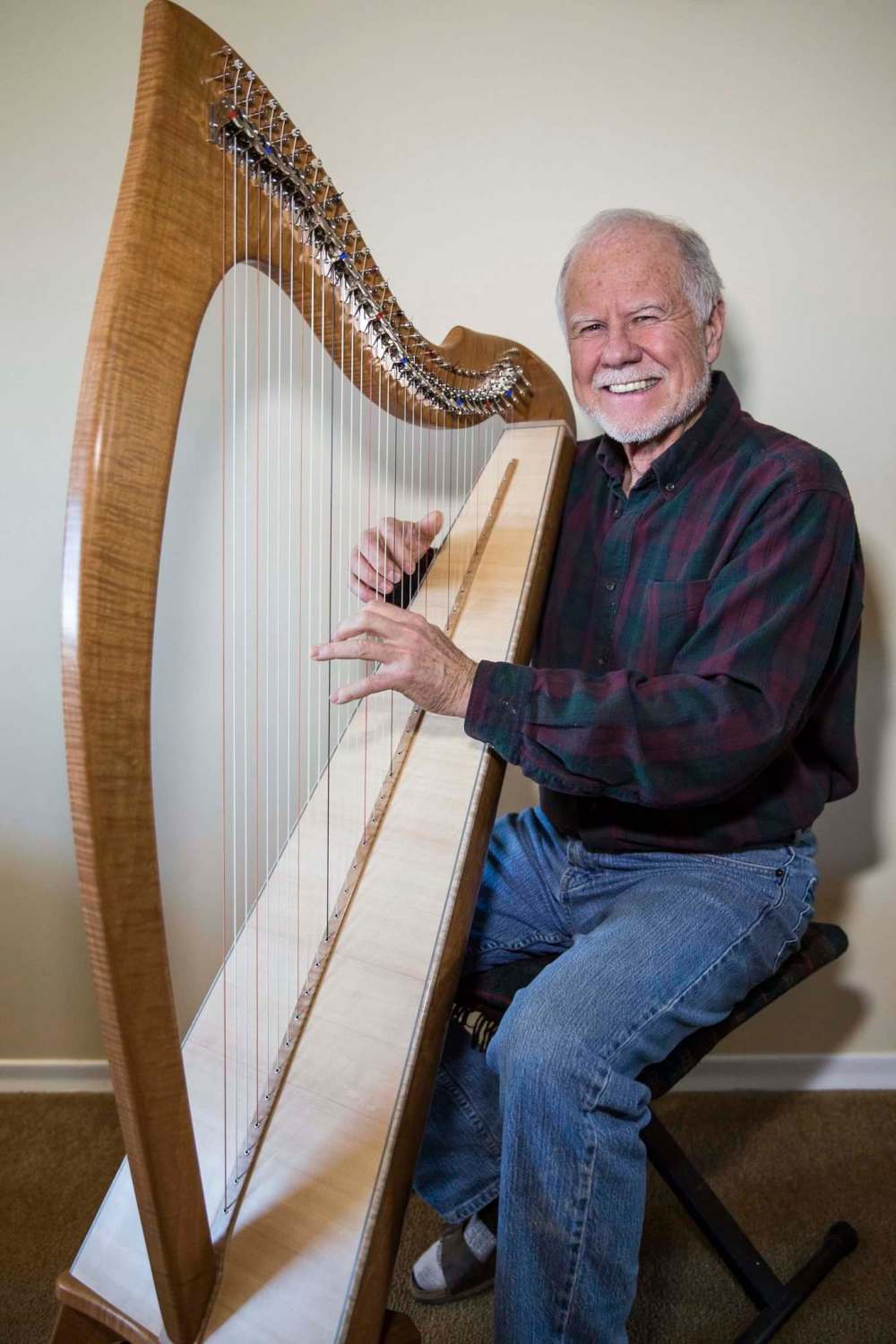
Since 2000, Fisher had been building and selling Celtic harps under the banner Larry Fisher Harps. But because he had pretty much saturated the Canadian market, his sales were at a virtual stand-still. During their tête-à-tête, Rooney suggested Fisher try selling his harps in Ireland, instead.
“He said the top two craftsmen there were having health problems and because of that, the wait for high-quality, custom-made harps like mine was in the three-to-four-year range,” Fisher said. “He told me I was doing really nice work, but if I could build my harps to Irish specifications — back then, mine were more North American Celtic — there would be tremendous opportunity for me.”
For the next year, Fisher worked closely with Irish-born musicians, including Rooney, figuring out exactly what they were after. When he finally came up with his definitive version, he packed a few prototypes in his minivan and drove to North Carolina and West Virginia to demonstrate them at a pair of harp festivals that routinely drew the most accomplished players on the planet.
When Fisher got back to Winnipeg, he had enough orders to keep him busy for the next year.
“I took that as a sign. The world had spoken to me and had said, ‘Larry, we want you to build the best harps in the world and we want you to do it right here in Winnipeg.’ I’m not saying I’m there yet but for the last 12 years, that’s been my goal.”
A U.S. army brat, Fisher was born in Montgomery, Ala., and schooled in California, Hawaii and Japan. He enrolled at the University of Nevada, Las Vegas in 1965 — by then, his father had been transferred to nearby Nellis Air Force Base — but because he wasn’t taking enough credit hours, he was drafted into the military three years later.
Fisher was stationed at Fort Hood, Texas, where he was trained to operate an assault helicopter. By the time he received his orders to head to Vietnam, however, he was decidedly anti-war.
“There was a coffee house off-base that played folk music I used to go to as often as I could,” Fisher recalled. “The guys running it were a couple of hippies from California and one night I mentioned to them I was supposed to leave for Vietnam in a couple of weeks and was freaking out because I wanted no part of (the Vietnam War).”
The proprietors told Fisher their café was the start of a so-called “Underground Railroad.” They mentioned they had been helping dissident soldiers “get out” for weeks. After asking what his options were, Fisher was given a choice of four destinations — Mexico, Sweden, France or Canada. A few days later, he was on a Greyhound bus bound for Vancouver.
Fisher spent his first summer in B.C. doing odd jobs such as painting houses and laying concrete. By chance, he met and fell in love with a woman from Winnipeg. The pair spent much of 1970 hitchhiking around the province.
“We saw the Rockies, Vancouver Island, the Gulf Islands… then we found out we were going to have a baby and decided to come out here where her family was living,” Fisher said, noting it was mid-December when their train pulled into the Canadian Pacific Railway station on Higgins Avenue.
“I’d never experienced that kind of cold in my life. I froze my ass off taking a bus from downtown to her parents’ place in Transcona, all the while wondering, ‘What the hell are we doing here?’”
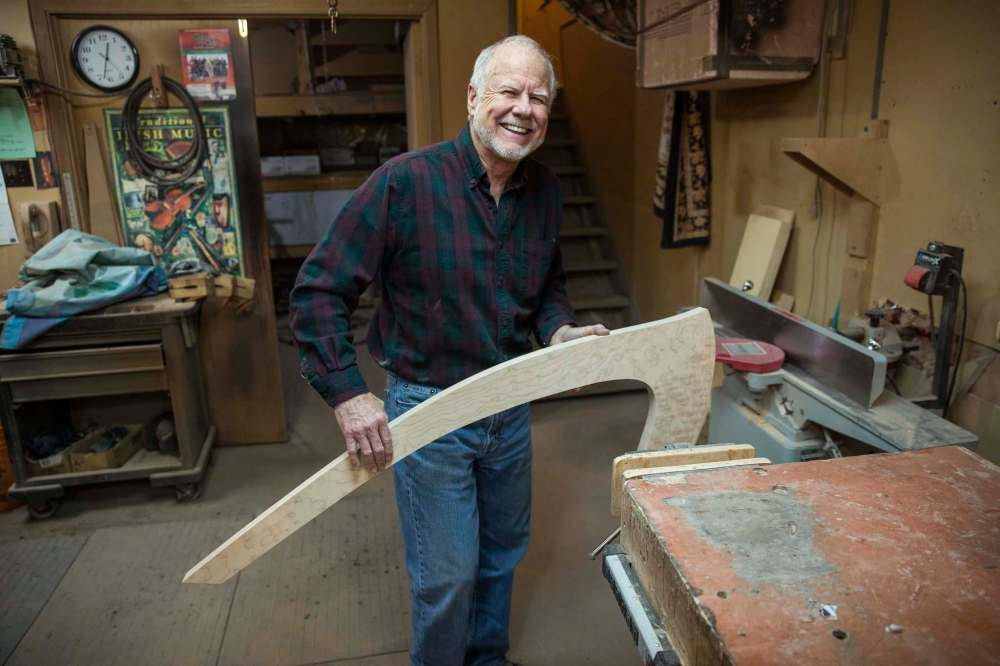
Winnipeg obviously agreed with Fisher; even though his marriage ended seven years later, he decided to make the city his permanent home. (Fisher was one of 100,000 Americans pardoned by president Jimmy Carter in 1977 for evading the war. Though his father “basically disowned” him when he left for Canada, the elder Fisher shook his son’s hand before he died in 1999 and said, “Larry, I didn’t agree with what you did but now that time has passed, I’ve seen the error of U.S. foreign policy.”)
Fisher, 69, had always been interested in music. Like many people from his generation, he took up guitar in 1964 after hearing the Fab Four warble “I want to hold your hand…” on the radio.
But his light-bulb moment, career-wise, didn’t occur until 1977, when he hooked up with Dennis Waring, a musician, luthier and author of a number of books about instrument-making.
At first, Fisher, a graphic designer by day, was content to sit in with Waring and his chums, performing folk tunes made famous by the likes of the Clancy Brothers, the Kingston Trio and Bob Dylan. Soon, though, he got the itch to construct his own wooden instruments. With Waring’s assistance, he began crafting banjos, dulcimers and French-Canadian spoons.
His focus switched to Celtic harps after he heard one played at the Winnipeg Folk Festival and fell in love with its look and sound. (Before founding Larry Fisher Harps in 2000, Fisher ran Prairie Woodworks. That is, when he wasn’t busy staging a one-man minstrel show for Lord Gort’s Medieval Feast at the Viscount Gort Hotel, or presenting music-appreciation shows in schools across Canada and the U.S.)
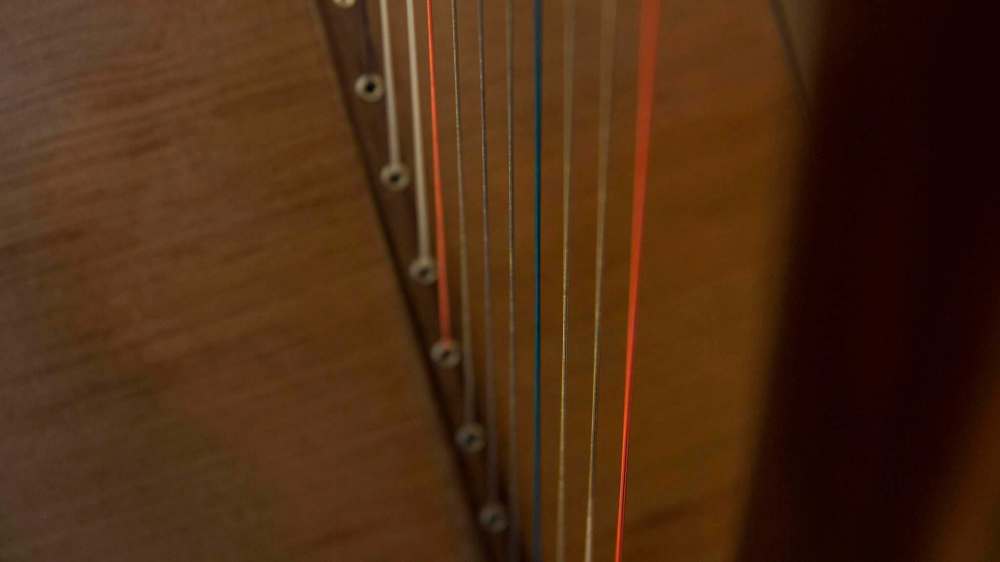
Fisher, who performs in weekly, Sunday afternoon jam sessions at Shannon’s Irish Pub, sells two styles of harp — Éireann, which means “of, or from, Ireland,” and Keltia. After deciding which one they are interested in — they differ in terms of size, tone and string tension, Fisher explained — customers are asked what type of wood they prefer.
Let’s just say the grandfather of two isn’t shopping for lumber at Home Depot.
“I try to offer some of the most beautiful woods in the world that, with the exception of Hawaiian Koa, I order from a timber company in Oregon,” he said, touring a visitor around his neat-as-a-pin workshop. “People can choose from quilted maple, Port Orford white cedar, Engelmann spruce… one of the harps I’m making right now will have a soundboard made out of Oregon Claro walnut and trim done with Indonesian rosewood. After I’m done I’ll put a dark, coffee-coloured stain on it and it will be absolutely stunning.”
Fisher’s price tags aren’t for the faint of heart. His finished products — he makes 22 harps a year, on average, and each one takes approximately two weeks to build — generally top out at just over $7,000. Factor in another $2,000 for shipping and duty on overseas sales, and sometimes it’s cheaper for customers to travel to Winnipeg to pick their instruments up themselves.
“I’ve had people fly to Winnipeg from as far as Scotland and Ireland, who then pop over to my place in a cab from whatever downtown hotel they’re staying at,” said Fisher, who is taking orders for June 2017. “In most cases, they get a holiday and get to meet the maker for less than it would have cost to box and ship it.”
A couple of months ago, a man dressed in jeans, a hardhat and work boots showed up at Fisher’s front door, holding out a wad of $100 bills. It turned out the person was from County Monaghan, Ireland and was in Winnipeg as part of an Irish construction crew hired to work on the Women’s Hospital. “This is from Frank in Castleblaney,” he told Fisher as he handed him the money, referring to a mate of his back home who had ordered a harp for his daughter, and wanted to make sure the down payment was delivered in person.
In August, Fisher plans to attend an Irish music festival at Ennis, County Clare, called the Fleadh Cheoil na hEireann. If history repeats itself, Fisher will again be seated in the audience like a proud parent, watching his “babies” take home trophy after trophy.
“The last Fleadh I attended was in Cavan Town in 2012,” Fisher said. “I would say that during the harp competitions there — especially among the 15-to-18-year-olds and 18-plus competitions — about 75 per cent of the medal winners were playing my harps.
“You can’t really ask for better advertising than that.”
david.sanderson@freepress.mb.ca
Dave Sanderson was born in Regina but please, don’t hold that against him.
Our newsroom depends on a growing audience of readers to power our journalism. If you are not a paid reader, please consider becoming a subscriber.
Our newsroom depends on its audience of readers to power our journalism. Thank you for your support.