Songs in the key of love
Duo’s musical project brings popular music to bear on ideas of colonization and reconciliation

Advertisement
Read this article for free:
or
Already have an account? Log in here »
To continue reading, please subscribe:

Digital Subscription
One year of digital access for only $205*
- Enjoy unlimited reading on winnipegfreepress.com
- Read the E-Edition, our digital replica newspaper
- Access News Break, our award-winning app
- Play interactive puzzles
*First annual payment billed as $205.00 + GST for one year. This annual subscription will automatically renew at $233.00 + GST every 52 weeks (10% off the regular annual price of $259.35). Offer available to new and qualified returning subscribers only. Cancel any time.
To continue reading, please subscribe:
Add Free Press access to your Brandon Sun subscription for only an additional
$1 for the first 4 weeks*
- Enjoy unlimited reading on winnipegfreepress.com
- Read the E-Edition, our digital replica newspaper
- Access News Break, our award-winning app
- Play interactive puzzles
*Your next Brandon Sun subscription payment will increase by $1.00 and you will be charged $17.95 plus GST for four weeks. After four weeks, your payment will increase to $24.95 plus GST every four weeks.
Read unlimited articles for free today:
or
Already have an account? Log in here »
Hey there, time traveller!
This article was published 27/09/2022 (1479 days ago), so information in it may no longer be current.
Peter Morin and Jimmie Kilpatrick used to go to church together.
It wasn’t in a cathedral, with wooden pews and stained glass. It was at a bar in Brandon called the Double Decker, and the hymns they sang were written by Cat Stevens, Tina Turner or Cher.
“We called it the church of karaoke,” says Kilpatrick, a Brandon-based artist who’s performed solo as Shotgun Jimmie and in groups such as Shotgun and Jaybird. “Thursday night at the Double Decker, I guess you could say we gathered for mass.”
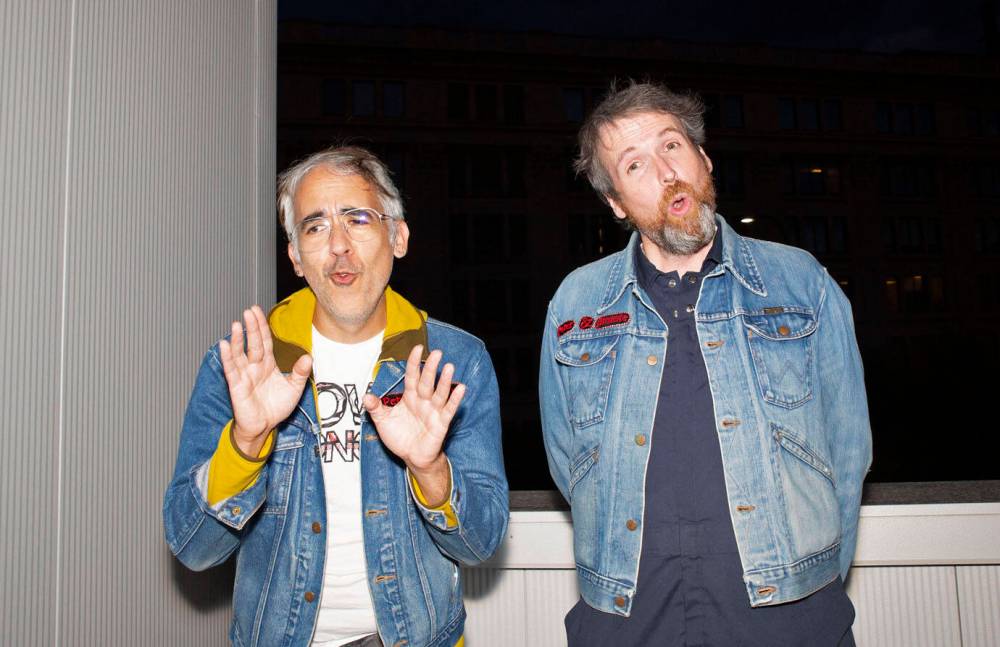
Huimin (Daisy) Wu photo
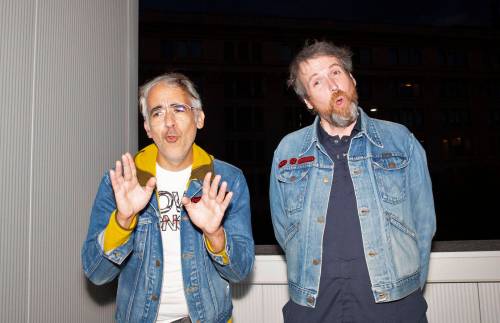
Peter Morin, left, and Jimmie Kilpatrick have made an album using karaoke to critique colonization and get people singing the same tune.
Though they laugh about it, Kilpatrick and Morin, a performance artist and a program director at the Ontario College of Art and Design, take karaoke very seriously. It’s an artform in itself, elevating music to communal experience, transforming average people into headliners and a dingy bar into a concert hall.
“Everybody brought such beautiful, strange and wide-ranging tastes. And sometimes at karaoke, people don’t clap,” says Morin, who is of Tahltan Nation heritage. “But at the church, everybody stopped, clapped, acknowledged and screamed along, and if you somehow lost the melody, even though the words are right in front of you, the whole bar had your back.”
Throughout Morin’s career, he has routinely used pop music as a method to critique and articulate his feelings about Canada, colonialism, and the impact it’s had on his Indigenous mind and body. He and Kilpatrick once sang Buffy Sainte-Marie’s Not the Loving Kind to a wheat field for six hours, in an attempt to free the land and reclaim it.
Pop music in a shifted context can tell a completely different story, Morin says. Songs about ex-lovers can become songs about territory, friendship, home and generational grief.
So Morin and Kilpatrick combined that part of Morin’s serious artistic practice with their shared recreational passion for karaoke.
The result is a double album called Love Songs to End Colonization, with Morin and Kilpatrick singing on one LP and a backing karaoke track on the other.
The tracklist contains nine songs that at first glance are not at all about colonization, such as Stevens’ The First Cut is the Deepest, Turner’s What’s Love Got to Do With It, Conway Twitty’s Hello Darlin’, and AC/DC’s Who Made Who. But in listening to them through Morin and Kilpatrick’s prism, the listener is forced to affix new narratives to the music, to think about their own lives and do a little bit of guesswork as to why each song was chosen.
There is also the added layer of communal performance central to karaoke, which echoes the notion that reconciliation is not an individual act, but a collective one.
That was on display at a few performances since the album’s August release, including at the recent Prairie Art Book Fair at Winnipeg’s Plug In Institute of Contemporary Art, where Kilpatrick and Morin coaxed the audience to sing along. The album is available for purchase at the Portage Avenue gallery.

“When they sing along with me, or when they offer their own voice, they amplify the original intentions of finding a space for multiple bodies to be OK inside the colonization that is inherent to this place now known as Canada,” says Morin.
Tomas Jonsson, who produced the project, is the curator of performance and moving image at Regina’s Dunlop Art Gallery, and says the album manages to shift expectations and understandings of pop music.
“One thing someone who bought the record said was, ‘I’ll never listen to another pop song without asking myself if it might on some subliminal level be a decolonial love song.”
It’s all about how it’s heard and how it’s sung, even if it’s woefully off-key. How it sounds is not the point.
ben.waldman@winnipegfreepress.com
Ben Waldman is a National Newspaper Award-nominated reporter on the Arts & Life desk at the Free Press. Born and raised in Winnipeg, Ben completed three internships with the Free Press while earning his degree at Ryerson University’s (now Toronto Metropolitan University’s) School of Journalism before joining the newsroom full-time in 2019. Read more about Ben.
Every piece of reporting Ben produces is reviewed by an editing team before it is posted online or published in print — part of the Free Press‘s tradition, since 1872, of producing reliable independent journalism. Read more about Free Press’s history and mandate, and learn how our newsroom operates.
Our newsroom depends on a growing audience of readers to power our journalism. If you are not a paid reader, please consider becoming a subscriber.
Our newsroom depends on its audience of readers to power our journalism. Thank you for your support.
Ben Waldman is a National Newspaper Award-nominated reporter on the Arts & Life desk at the Free Press. Born and raised in Winnipeg, Ben completed three internships with the Free Press while earning his degree at Ryerson University’s (now Toronto Metropolitan University’s) School of Journalism before joining the newsroom full-time in 2019. Read more about Ben.
Every piece of reporting Ben produces is reviewed by an editing team before it is posted online or published in print — part of the Free Press‘s tradition, since 1872, of producing reliable independent journalism. Read more about Free Press’s history and mandate, and learn how our newsroom operates.
Our newsroom depends on a growing audience of readers to power our journalism. If you are not a paid reader, please consider becoming a subscriber.
Our newsroom depends on its audience of readers to power our journalism. Thank you for your support.
Advertisement Advertise With Us
Advertisement Advertise With Us