With help from AI, Randy Travis got his voice back. Here’s how his first song post-stroke came to be

Advertisement

Advertise with us

With some help from artificial intelligence, country music star Randy Travis, celebrated for his timeless hits like “Forever and Ever, Amen” and “I Told You So," has his voice back.

Read this article for free:


or

Already have an account? Log in here »

To continue reading, please subscribe:

Subscribe and receive a limited-edition Free Press branded hat or tote.

Digital Subscription

One year of digital access for only $205*

  • Enjoy unlimited reading on winnipegfreepress.com
  • Read the E-Edition, our digital replica newspaper
  • Access News Break, our award-winning app
  • Play interactive puzzles

*First annual payment billed as $205.00 + GST for one year. This annual subscription will automatically renew at $233.00 + GST every 52 weeks (10% off the regular annual price of $259.35). Offer available to new and qualified returning subscribers only. Cancel any time.

To continue reading, please subscribe:

Add Free Press access to your Brandon Sun subscription for only an additional

$1 for the first 4 weeks*

  • Enjoy unlimited reading on winnipegfreepress.com
  • Read the E-Edition, our digital replica newspaper
  • Access News Break, our award-winning app
  • Play interactive puzzles
Start now

*Your next Brandon Sun subscription payment will increase by $1.00 and you will be charged $17.95 plus GST for four weeks. After four weeks, your payment will increase to $24.95 plus GST every four weeks.

Hey there, time traveller!
This article was published 06/05/2024 (889 days ago), so information in it may no longer be current.

With some help from artificial intelligence, country music star Randy Travis, celebrated for his timeless hits like “Forever and Ever, Amen” and “I Told You So,” has his voice back.

In July 2013, Travis was hospitalized with viral cardiomyopathy, a virus that attacks the heart, and later suffered a stroke. The Country Music Hall of Famer had to relearn how to walk, spell and read in the years that followed. A condition called aphasia limits his ability to speak — it’s why his wife Mary Travis assists him in interviews. It’s also why he hasn’t released new music in over a decade, until now.

“Where That Came From,” which released Friday, is a rich acoustic ballad amplified by Travis’ immediately recognizable, soulful vocal tone.
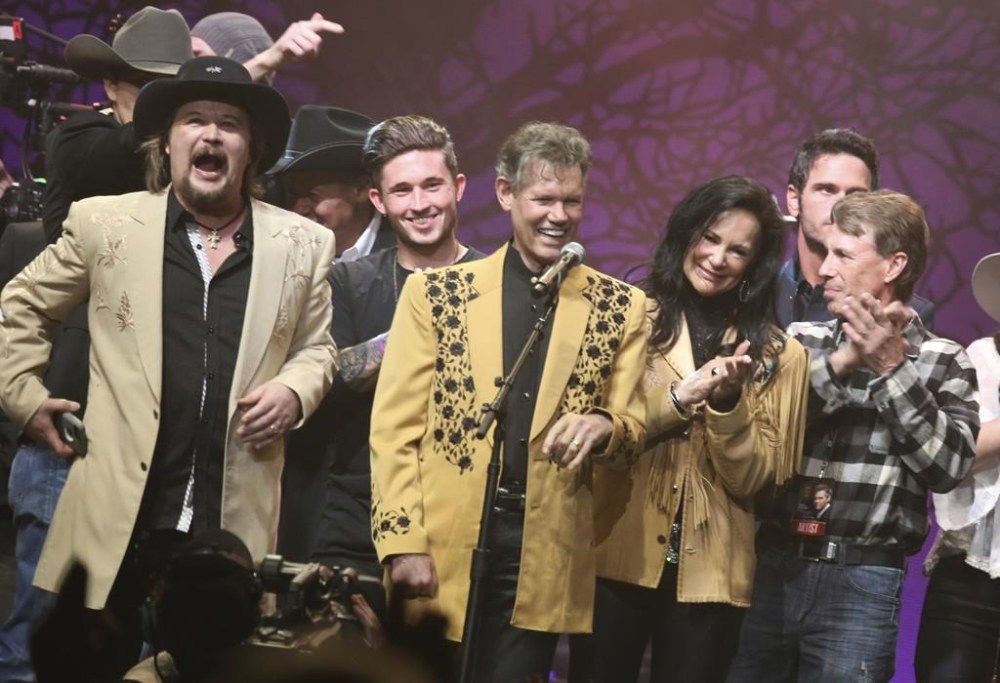
FILE - Travis Tritt, left, Randy Travis, center left, Mary Travis, center right, and Ricky Traywick, right, appear on stage at the
FILE - Travis Tritt, left, Randy Travis, center left, Mary Travis, center right, and Ricky Traywick, right, appear on stage at the "1 Night. 1 Place. 1 Time.: A Heroes and Friends Tribute to Randy Travis" on Feb. 8, 2017 in Nashville, Tenn. (Photo by Laura Roberts/Invision/AP, File)

Cris Lacy, Warner Music Nashville co-president, approached Randy and Mary Travis and asked: “’What if we could take Randy’s voice and recreate it using AI?,'” Mary Travis told The Associated Press over Zoom last week, Randy smiling in agreement right next to her. “Well, we were all over that, so we were so excited.”

“All I ever wanted since the day of a stroke was to hear that voice again.”

Lacy tapped developers in London to create a proprietary AI model to begin the process. The result was two models: One with 12 vocal stems (or song samples), and another with 42 stems collected across Travis’ career — from 1985 to 2013, says Kyle Lehning, Travis’ longtime producer. Lacy and Lehning chose to use “Where That Came From,” a song written by Scotty Emerick and John Scott Sherrill that Lehning co-produced and held on to for years. He believed it could best articulate the humanity of Travis’ idiosyncratic vocal style.

“I never even thought about another song,” Lehning said.

Once he input the demo vocal (sung by James Dupree) into the AI models, “it took about five minutes to analyze,” says Lehning. “I really wish somebody had been here with a camera because I was the first person to hear it. And it was stunning, to me, how good it was sort of right off the bat. It’s hard to put an equation around it, but it was probably 70, 75% what you hear now.”

“There were certain aspects of it that were not authentic to Randy’s performance,” he said, so he began to edit and build on the recording with engineer Casey Wood, who also worked closely with Travis over a few decades.

The pair cherrypicked from the two models, and made alterations to things like vibrato speed, or slowing and relaxing phrases. “Randy is a laid-back singer,” Lehning says. “Randy, in my opinion, had an old soul quality to his voice. That’s one of the things that made him unique, but also, somehow familiar.”

His vocal performance on “Where That Came From” had to reflect that fact.

“We were able to just improve on it,” Lehning says of the AI recording. “It was emotional, and it’s still emotional.”

Mary Travis says the “human element,” and “the people that are involved” in this project, separate it from more nefarious uses of AI in music.

“Randy, I remember watching him when he first heard the song after it was completed. It was beautiful because at first, he was surprised, and then he was very pensive, and he was listening and studying,” she said. “And then he put his head down and his eyes were a little watery. I think he went through every emotion there was, in those three minutes of just hearing his voice again.”

Lacy agrees. “The beauty of this is, you know, we’re doing it with a voice that the world knows and has heard and has been comforted by,” she says.

“But I think, just on human terms, it’s a very real need. And it’s a big loss when you lose the voice of someone that you were connected to, and the ability to have it back is a beautiful gift.”

They also hope that this song will work to educate people on the good that AI can do — not the fraudulent activities that so frequently make headlines. “We’re hoping that maybe we can set a standard,” Mary Travis says, where credit is given where credit is due — and artists have control over their voice and work.

Last month, over 200 artists signed an open letter submitted by the Artist Rights Alliance non-profit, calling on artificial intelligence tech companies, developers, platforms, digital music services and platforms to stop using AI “to infringe upon and devalue the rights of human artists.” Artists who co-signed included Stevie Wonder, Miranda Lambert, Billie Eilish, Nicki Minaj, Peter Frampton, Katy Perry, Smokey Robinson and J Balvin.

So, now that “Where That Came From” is here, will there be more original Randy Travis songs in the future?

“There may be others,” says Mary Travis. “We’ll see where this goes. This is such a foreign territory. There’s likely more on the horizon.”

“We do have other tracks,” says Lacy, but Warner Music is being as selective. “This isn’t a stunt, and it’s not a parlor trick,” she added. “It was important to have a song worthy of him.”

___

This story has been updated to correct one instance of the song title “Where That Came From,” instead of “What That Came From.”

Report Error Submit a Tip

More Stories

Today’s horoscope

Georgia Nicols 4 minute read Preview

Today’s horoscope

Georgia Nicols 4 minute read Yesterday at 2:00 AM CDT

MOON ALERT: Avoid shopping (except food and gas) and important decisions until after 10:45 a.m. After that, the moon moves from Libra into Scorpio.

ARIES (March 21-April 19)

You have a choice. You can either get embroiled in disputes about shared property, debt, insurance issues or inheritances; or instead, relax and have a playful day featuring sporting events, social outings and fun activities with kids.

TAURUS (April 20-May 20)

Read
Yesterday at 2:00 AM CDT

Hurricane Simon pounds resorts and vulnerable towns along Mexico’s Pacific coast

Fernando Llano And Martin Silva, The Associated Press 5 minute read Preview

Hurricane Simon pounds resorts and vulnerable towns along Mexico’s Pacific coast

Fernando Llano And Martin Silva, The Associated Press 5 minute read Updated: 2:38 AM CDT

PUERTO VALLARTA, Mexico (AP) — Hurricane Simon pounded Mexico’s Pacific coast as a Category 3 storm on Sunday, its eye remaining just offshore as its most powerful winds and rain slammed people living between the Sierra Madre and the ocean.

The hurricane's center swirled parallel to the coast, closing in on the Puerto Vallarta area, where its most damaging winds and rain were expected to hit around midnight and continue through Monday morning. Its maximum sustained winds weakened late Sunday to 115 mph (185 kph), according to the U.S. National Hurricane Center in Miami, but it was still expected to remain a dangerous hurricane.

That’s not good news for people in and around Puerto Vallarta, a popular tourist destination in the state of Jalisco. Just inland and uphill from the resort areas, many Mexicans live in communities where housing might not stand up to the storm.

By late Sunday, Simon's eye was moving northwest about 45 miles (75 kilometers) south of Cabo Corrientes at about 5 mph (7 kph). A senior hurricane center specialist, Philippe Papin, said this westernmost tip of mainland Mexico is the area most likely to get a direct hit from the system. Cabo Corrientes is at the southern tip of Bahia de Banderas, the wide bay where Puerto Vallarta looks out to the Pacific.

Read
Updated: 2:38 AM CDT

A Life's Story: Writer built bridges with genuine curiosity, compassion for diversity of religious practices

Janine LeGal 6 minute read Preview

A Life's Story: Writer built bridges with genuine curiosity, compassion for diversity of religious practices

Janine LeGal 6 minute read Saturday, Oct. 10, 2026

Brenda Suderman knew how to make people feel comfortable. For a journalist, that character trait is a real strength, and it made people trust and appreciate her.

Whether covering musicals, worship spaces, the effects of pandemic shutdowns, death rituals and practices of different traditions, the discovery of the burial of 2,284 infants in unmarked graves, or any other of the countless topics she wrote about in her four- decade career, Suderman did it with genuine interest and care.

Born and raised in Winkler, Suderman grew up on a farm. Much of her childhood was spent in gardens and sugar beet fields.

Baptized at 16, she became a member of the Winkler Bergthaler Mennonite Church. The restrictions against women at the time contributed to planting the seeds of Suderman’s feminist perspective.

Read
Saturday, Oct. 10, 2026

With help from AI, Randy Travis got his voice back. Here’s how his first song post-stroke came to be

Maria Sherman, The Associated Press 5 minute read Preview

With help from AI, Randy Travis got his voice back. Here’s how his first song post-stroke came to be

Maria Sherman, The Associated Press 5 minute read Tuesday, May. 7, 2024

With some help from artificial intelligence, country music star Randy Travis, celebrated for his timeless hits like “Forever and Ever, Amen” and “I Told You So,” has his voice back. In July 2013, Travis was hospitalized with viral cardiomyopathy, a virus that attacks the heart, and later suffered a stroke. The Country Music Hall of Famer had to relearn how to walk, spell and read in the years that followed. A condition called aphasia limits his ability to speak — it’s why his wife Mary Travis assists him in interviews. It’s also why he hasn’t released new music in over […]

Read
Tuesday, May. 7, 2024

What's open, what's closed, what's up on Thanksgiving

Free Press staff 3 minute read Preview

What's open, what's closed, what's up on Thanksgiving

Free Press staff 3 minute read Friday, Oct. 9, 2026

Here's a round-up of things to do and hours of business for services on Thanksgiving Day 2026.

Read
Friday, Oct. 9, 2026

Manitoba e-scooter legislation changes set to impose speed limit, age restrictions, sidewalk ban

Matthew Frank 5 minute read Preview

Manitoba e-scooter legislation changes set to impose speed limit, age restrictions, sidewalk ban

Matthew Frank 5 minute read Updated: Yesterday at 5:14 PM CDT

People riding e-scooters and other personal electric vehicles in Manitoba will have to strap on a helmet, stay off sidewalks and follow new age limits once new provincial rules for the devices take effect next year.

The vehicles, which also include electric skateboards, hoverboards and unicycles, will fall under The Highway Traffic Act starting in 2027, according to the province’s website. E-bikes are excluded from the new rules, according to the province’s frequently-asked-questions page.

All riders must be at least 16 years old and wear properly fitting helmets — that goes for passengers, too, the province said.

The proposed new legislation sets a speed limit of 25 km/h and would prohibit personal electric vehicles from sidewalks unless signs specifically allow sidewalk use. Riders would be using shared paths or roads with speed limits of 50 km/hr or less. They won’t be allowed to operate the vehicles under the influence of alcohol or drugs and they must use hand signals and obey traffic signs.

Read
Updated: Yesterday at 5:14 PM CDT