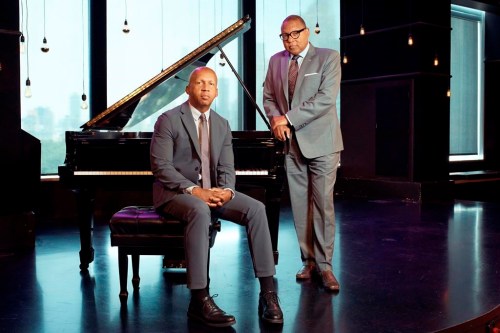
Jazz, justice and Juneteenth: Wynton Marsalis and Bryan Stevenson join forces to honor Black protest
Advertisement
Read this article for free:
or
Already have an account? Log in here »
To continue reading, please subscribe:

Digital Subscription
One year of digital access for only $205*
- Enjoy unlimited reading on winnipegfreepress.com
- Read the E-Edition, our digital replica newspaper
- Access News Break, our award-winning app
- Play interactive puzzles
*First annual payment billed as $205.00 + GST for one year. This annual subscription will automatically renew at $233.00 + GST every 52 weeks (10% off the regular annual price of $259.35). Offer available to new and qualified returning subscribers only. Cancel any time.
To continue reading, please subscribe:
Add Free Press access to your Brandon Sun subscription for only an additional
$1 for the first 4 weeks*
- Enjoy unlimited reading on winnipegfreepress.com
- Read the E-Edition, our digital replica newspaper
- Access News Break, our award-winning app
- Play interactive puzzles
*Your next Brandon Sun subscription payment will increase by $1.00 and you will be charged $17.95 plus GST for four weeks. After four weeks, your payment will increase to $24.95 plus GST every four weeks.
Read unlimited articles for free today:
or
Already have an account? Log in here »
Hey there, time traveller!
This article was published 18/06/2024 (846 days ago), so information in it may no longer be current.
NEW YORK (AP) — Black music traditions such as jazz are central to celebrations of Juneteenth, says civil rights lawyer and jazz pianist Bryan Stevenson.
That’s why he and Pulitzer Prize-winning jazz artist Wynton Marsalis have debuted “Freedom, Justice and Hope,” a live performance album of historic jazz records created to protest racial injustice, in time for this year’s celebrations.
Along with a new arrangement of saxophonist John Coltrane’s “Alabama,” which pays homage to the four Black girls killed when the Ku Klux Klan bombed Birmingham’s 16th Street Baptist Church in 1963, the project includes original compositions by up-and-coming bassist Endea Owens and trumpeter Josh Evans.
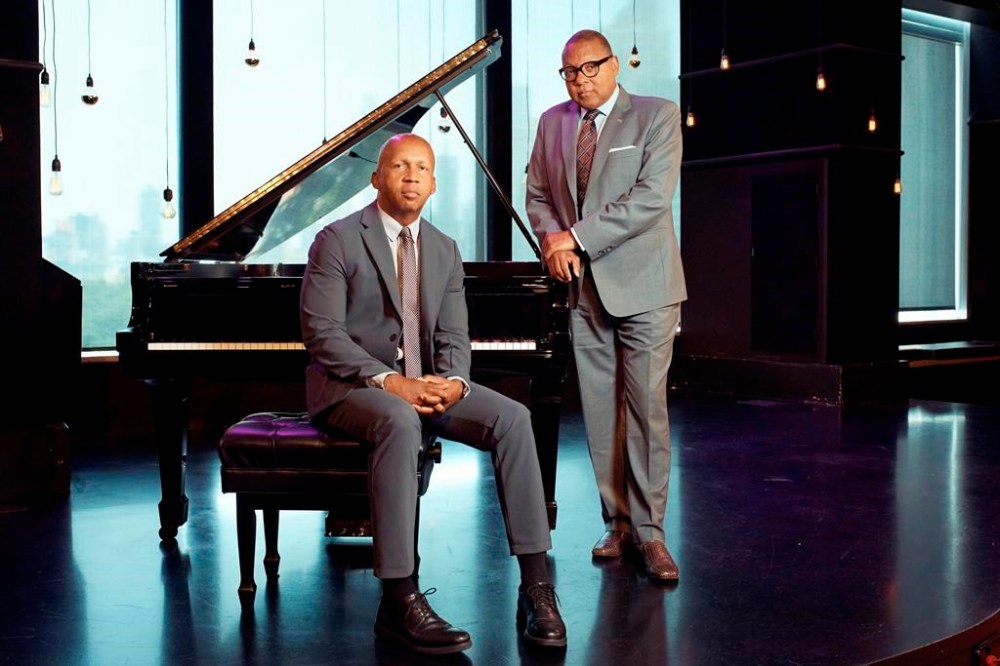
The album, released under Blue Engine Records, features the orchestra of Jazz at Lincoln Center, where Marsalis is the artistic and managing director. It is now streaming on digital platforms.
Its release comes ahead of this summer’s 10-year marking of the death of Michael Brown, a Black teenager fatally shot by police in Ferguson, Missouri, that set off a wave of Black Lives Matter protests. When “Freedom, Justice and Hope” was recorded three years ago, in 2021, the nation was reeling from another flashpoint — the murder of George Floyd by a police officer in Minneapolis.
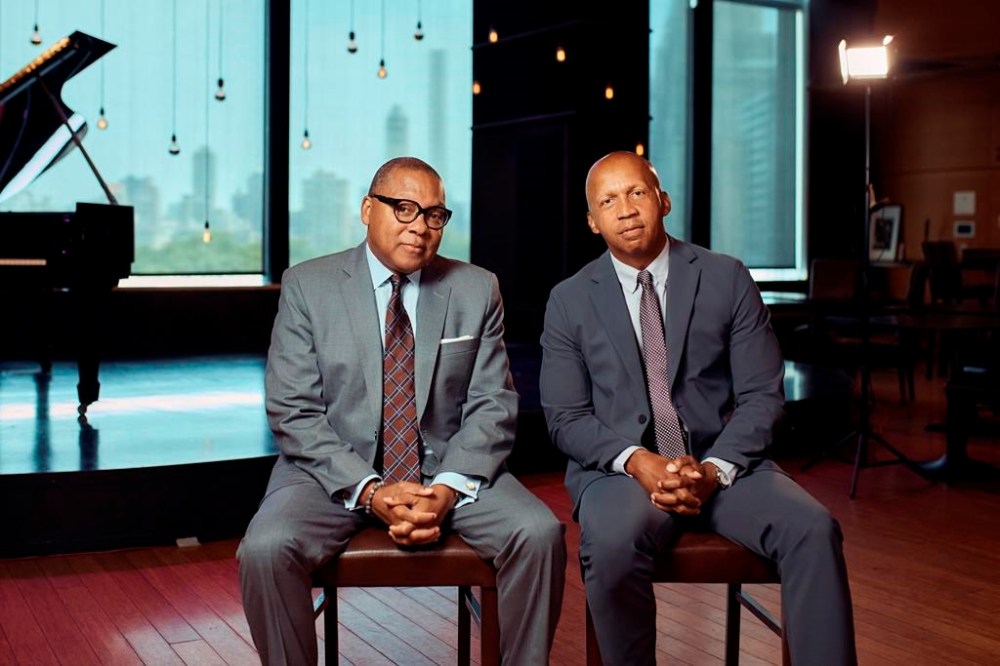
“To take some of the great jazz works of the 20th century and integrate them with the narrative about the long struggle for social justice in this country is just a dream come true,” said Stevenson, who founded the Equal Justice Initiative, a criminal justice reform and racial justice nonprofit based in Montgomery, Alabama.
The history of jazz and musicianship in Black American protest is deeper than many people realize, said Marsalis, the legendary trumpeter who delivers stirring melodies throughout the album. Stevenson accompanies on piano and interweaves spoken reflections on disenfranchisement, racial injustice and the activism that ignited in response.
“Jazz, itself, was a counterstatement to minstrelsy,” said Marsalis, referring to a form of entertainment popularized in the 20th century that included white actors with blackened faces performing racist depictions of African Americans.
“Jazz still has that same impact,” he said. “People show up, they can play, they’re serious about what they do. They will discuss issues and be for real about it, and they don’t feel the need to denigrate themselves.”
Derived from ragtime and blues, cultivated in turn-of-the-century New Orleans, and rising to prominence during the Harlem Renaissance, the genre is a crossroads where music meets the march for justice. Some historians even consider jazz singer Billie Holiday’s 1939 rendition of “Strange Fruit,” an anti-lynching poem by Abel Meeropol, one of the catalysts of the Civil Rights Movement.
“I think jazz as an art form needs to be understood as a protest against these narratives that Black people are somehow incapable,” Stevenson said. “The extraordinary thing that jazz musicians did was that they took Western music, did things to these art forms that others have been playing for centuries, and added things that dazzled and inspired.”
“They did it with a kind of dignity and intentionality of rebutting this false narrative of racial hierarchy,” he said.
It’s in that spirit that Owens’ buoyant “Ida’s Crusade” chronicles journalist Ida B. Wells-Barnett’s lifelong fight against lynching and wrongful imprisonment. “Elaine,” by Evans, takes inspiration from the 1919 massacre in Arkansas that claimed the lives of several hundred Black Americans.
With Marsalis and Stevenson, the Jazz at Lincoln Center Orchestra performs new arrangements of “Honeysuckle Rose,” originally composed by Fats Waller in 1929; “We Shall Overcome,” the Civil Rights Movement refrain from 1947; and “Freedom Suite,” originally composed by Sonny Rollins in 1958.
Aside from Stevenson’s monologues, the songs on “Freedom, Justice and Hope,” the songs are completely instrumental, with no vocals.
Jazz’s reliance on instrumental leads has led some to stereotype it as dated, irrelevant and less connected to social justice than vocally driven rap and hip-hop — think Public Enemy’s “Fight the Power,” N.W.A’s “F(asterisk)(asterisk)(asterisk) Tha Police,” and Kendrick Lamar’s “Alright.” But musicians, scholars and activists alike urge listeners to recognize and champion the political messages communicated through the music’s emotional depth.
“Sometimes there are no words to express the joy and the blues that we feel,” said Reiland Rabaka, the founding director of the Center for African and African American Studies at the University of Colorado Boulder.
“And sometimes those trumpets, those saxophones, those guitars, those pianos — they can say it better than our words can say it,” said Rabaka, who has written extensively about hip-hop and Black Power, women’s liberation and civil rights songs.
The improvisational elements of jazz can be traced to the Middle Passage from Africa to the Americas, where slaves shackled to the bottoms of ships invented songs, according to Rabaka. Improv was also found in the Juba and juke dances common in various parts of the southern United States, including New Orleans’ Congo Square, where slave auctions were held.
Improvisation can be likened to the resourcefulness of Black Americans who, using what little they had, forged lives for themselves after gaining freedom from the agricultural environments they were confined to.
For Marsalis and Stevenson, the Juneteenth release of an album recorded three years ago is symbolic. June 19th, or Juneteenth, is the day in 1865 when the last enslaved people in Galveston, Texas, were informed of their freedom — more than two years after the Emancipation Proclamation had granted it to them.
“Enslaved people learned to love in the midst of sorrow, and that’s an extraordinary thing to achieve,” Stevenson said. “That is the part of Juneteenth that I hope we can begin celebrating. Not just emancipation, but this whole legacy. … I think music plays a central role in that.”

Echoing his collaborator, Marsalis said he hoped to inspire people to look at the challenges ahead, instead of continuing to fight the old battles.
“I like Juneteenth, symbolically, because many times people, anywhere they are in the world, don’t know they’re free,” he said. “From a national standpoint, the nation needs to view Juneteenth in the context of the national struggles we still have.
“We still are fighting that conflict, now on another battlefield. Nobody told people, ‘Hey, this was over a long time ago.’ Let’s be present,” Marsalis said.
___
Doan-Nguyen and Morrison are members of AP’s Race and Ethnicity team.