Latest Marple mystery mostly marvellous
Advertisement
Read this article for free:
or
Already have an account? Log in here »
To continue reading, please subscribe:

Digital Subscription
One year of digital access for only $205*
- Enjoy unlimited reading on winnipegfreepress.com
- Read the E-Edition, our digital replica newspaper
- Access News Break, our award-winning app
- Play interactive puzzles
*First annual payment billed as $205.00 + GST for one year. This annual subscription will automatically renew at $233.00 + GST every 52 weeks (10% off the regular annual price of $259.35). Offer available to new and qualified returning subscribers only. Cancel any time.
To continue reading, please subscribe:
Add Free Press access to your Brandon Sun subscription for only an additional
$1 for the first 4 weeks*
- Enjoy unlimited reading on winnipegfreepress.com
- Read the E-Edition, our digital replica newspaper
- Access News Break, our award-winning app
- Play interactive puzzles
*Your next Brandon Sun subscription payment will increase by $1.00 and you will be charged $17.95 plus GST for four weeks. After four weeks, your payment will increase to $24.95 plus GST every four weeks.
Read unlimited articles for free today:
or
Already have an account? Log in here »
Hey there, time traveller!
This article was published 05/07/2009 (6268 days ago), so information in it may no longer be current.
Dame Agatha Christie remains the gold standard of mystery writers, not only for her productivity — the woman wrote 80 detective novels — but also for her permanence. One could argue that Sherlock Holmes is the most universally famous detective, but Arthur Conan Doyle had but one iconic offspring while Christie had two — Hercule Poirot and Miss Jane Marple.
Poirot is probably the best known — there are more than twice as many Poirot novels — but Miss Marple is the best loved. Also the most influential. Poirot, like Holmes, was an actual detective, whereas Miss Marple was an aged spinster living in the seemingly tranquil village of St. Mary Mead. It is Miss Marple who introduced the notion that detecting is more about understanding human behaviour than about analyzing evidence or knowing far too much about the various soils of London. It is Miss Marple who introduced the revolutionary notion that people are essentially the same wherever one goes; while it is sad to believe the worst of people, it is also often the truth.
In other words, everybody lies.
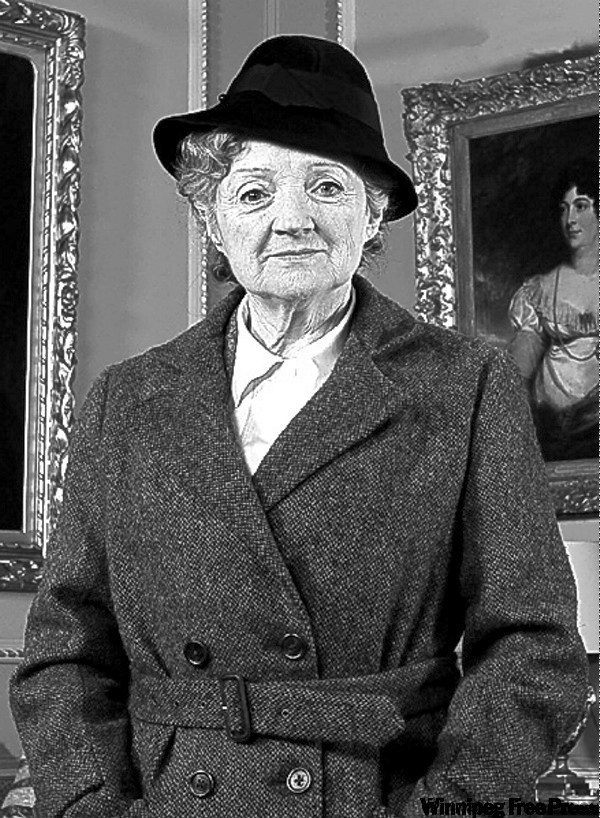
Poirot and Miss Marple’s latest TV incarnations are on PBS’s Six by Agatha, which began in June on Masterpiece Mystery! with two Poirot mysteries.
In tonight’s instalment, replacing Geraldine McEwan, the star of 12 previous Marple mysteries, is Julia McKenzie (Notes on a Scandal), a more solidly tweedy than feathery presence. Stout of shoe and clear of eye, her Miss Marple less given than the original to couching her observations in self-deprecation but equally fond of knitting, eavesdropping and mining idle conversation for nuggets of vital information.
In A Pocket Full of Rye, a rich and not particularly nice man is poisoned. There is, of course, a country house full of suspects and, quickly, more victims. It isn’t until the housemaid Gladys winds up dead that Miss Marple shows up to explain, among other things, the grains of rye that were found in the dead man’s pockets.
She trained Gladys, don’t you see, and feels responsible for the poor girl, who has no other family. Miss Marple is quickly ensconced in the house, endears herself to the local inspector (Matthew Macfadyen) and is thus made privy to the entire investigation.
The acting is marvellous. As prodigal son Lance, Rupert Graves is handsome and human, and Macfadyen provides a perfect stoic recipient of Miss Marple’s shocking revelations. McKenzie is delightful to watch, if a bit direct for the purist; her most Marple-like feature is her piercing blue eyes, which she uses to great effect. A bit disappointing is the loss of the idea that nothing happens in the halls of power that doesn’t also happen, in the smallest village.
Miss Marple solved most of her mysteries by drawing upon experiences she had with grocers who drank or maids who succumbed to the local heir. But none of that is in evidence here, which may cause an aficionado to feel something is missing.
— Los Angeles Times
TV PREVIEW
A Pocket Full of Rye
PBS
Sunday at 8 p.m. on 24; 9 p.m. on 3