Filmmaker went underground in Putin’s Russia to profile LGBT athletes during Olympics

Advertisement
Read this article for free:
or
Already have an account? Log in here »
To continue reading, please subscribe:

Digital Subscription
One year of digital access for only $205*
- Enjoy unlimited reading on winnipegfreepress.com
- Read the E-Edition, our digital replica newspaper
- Access News Break, our award-winning app
- Play interactive puzzles
*First annual payment billed as $205.00 + GST for one year. This annual subscription will automatically renew at $233.00 + GST every 52 weeks (10% off the regular annual price of $259.35). Offer available to new and qualified returning subscribers only. Cancel any time.
To continue reading, please subscribe:
Add Free Press access to your Brandon Sun subscription for only an additional
$1 for the first 4 weeks*
- Enjoy unlimited reading on winnipegfreepress.com
- Read the E-Edition, our digital replica newspaper
- Access News Break, our award-winning app
- Play interactive puzzles
*Your next Brandon Sun subscription payment will increase by $1.00 and you will be charged $17.95 plus GST for four weeks. After four weeks, your payment will increase to $24.95 plus GST every four weeks.
Read unlimited articles for free today:
or
Already have an account? Log in here »
Hey there, time traveller!
This article was published 22/06/2015 (4080 days ago), so information in it may no longer be current.
The 2014 Olympic Winter Games in Sochi, Russia, had all the high-stakes drama sports fans expect when the best athletes in the world congregate to compete.
But the event had an underlying parallel tension that had more to do with Russia’s draconian laws forbidding the country’s LGBT citizens to engage in “propaganda of nontraditional sexual relations” to minors.
The Vladimir Putin-approved dictate essentially forbids at-risk teens from learning about their sexuality. That, coupled with state-sanctioned brutality toward LGBT activists, created a crisis of conscience for gay athletes, whether they were competing or, in the case of high-profile figure skater Johnny Weir, commentating at the Games.
.jpg?w=1000)
Winnipeg filmmaker Noam Gonick found himself smack in the middle of the situation when his friend, producer Laura Michalchyshyn, asked him to go to Sochi and direct a documentary on the subject. The project gave Gonick access to older gay athletes such as U.S. gold-medallist diver Greg Louganis, tennis great Billie Jean King and Canadian gold-medal-winning swimmer Mark Tewksbury, as well as young Olympians, including snowboarders Belle Brockhoff of Australia and Simona Meiler of Switzerland, speedskaters Anastasia Bucsis of Canada and Blake Skjellerup of New Zealand, and four-time gold-medal-winning hockey player Charline Labonté of Canada.
The resulting film is a mainstream, “G-rated” departure for Gonick, whose previous films (Hey, Happy!, Stryker) have tended towards more seditious content.
Gonick spoke to the Free Press about making the film.
Free Press: How did this come to you?
Noam Gonick: I was staying with Laura Michalchyshyn (who produced Gonick’s Hey, Happy! and the Guy Maddin doc Waiting for Twilight) because she’s the best host in New York City and she’s got the most comfortable couch in town. This project was percolating and she just said: ‘Why don’t you direct it?’ And within a month, I was in a cab with a camera in my hand saying: ‘Take me to the United Nations.’ The whole film from idea to première took 11 months.
FP: Were you obliged to stay under the radar while you were filming in Russia?
NG: We tried to stay low-profile and there was a little cloak-and-dagger involved because, just by making the film, we were flouting the anti-propaganda laws. We met (17-year-old Sochi gay activist) Vlad and took him to people he could tell his story to, people who could give him succour. And that is what the law is trying to prohibit, allowing young people to come out and deal with their sexuality. Bringing him to meet Billie Jean King and Johnny Weir and tell his story was against the law.
And we knew we were breaking the law by doing that. But by going into Russia, I knew that we were doing a pro-gay propaganda film for Russian youth, so as a result, our radar was out for people who were really victims of the law. We were hunting those people down while we were hunting Olympic athletes.
FP: In the film, the New Yorker’s David Remnick calls the state’s attitude to LGBT issues “primitive.” Did you have a sense of time warp in Sochi?
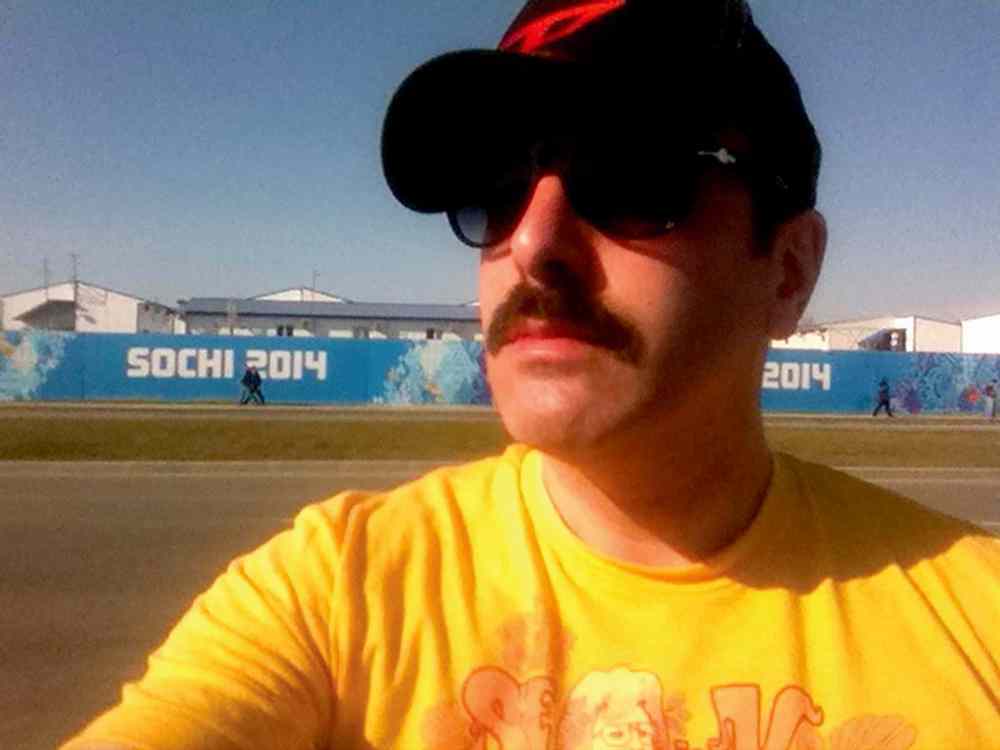
NG: I did, because I’m old enough to remember Gay Pride in Winnipeg being protested by zany people with signs, not all that long ago. The gay scene had an illicitness to it that is something that we’ve lost in this age of gay marriage.
FP: Did you ever feel in danger yourself?
NG: There was one moment when the police’s German shepherds were sniffing around, I felt like I might get arrested. But I have a certain amount of love towards Russia. I took the title of the film to heart. I went into the country feeling like I was embracing the culture and history and I wasn’t going to allow myself to be too spooked. That allowed me to walk through Olympic Park without full accreditation and do the documentary and not feel particularly scared.
FP: During the lead-up to Sochi, Johnny Weir was a flashpoint for the controversy. In this film, he is an executive producer in addition to being a natural star. What can you say about his the roles he played in both capacities?
NG: As a subject, he was totally fearless and willing to put himself on the record as representing this generation that is scared of activists and didn’t really understand the steps that were taken to get the gay community where it is today, vis-a-vis activism. But he wasn’t afraid to go out there and say: ‘I’m just me and I’m only looking out for No. 1.’ He was completely fearless and he gave me incredible material to work with. He showed all his facets and was very unguarded.
In terms of being the executive producer, the deal was: The (EPIX) network that funded the film in the States needed that kind of sports celebrity power in order to justify their investment. So it was our idea to bring Johnny on and that’s how the film got made.
FP: He’s pretty hilarious, on top of everything else. (Early in the film, Weir describes himself as being gay from birth: “I came out of my mother with jazz hands.”)
NG: There were so many incredible moments that ended up on the cutting-room floor because, at the end of the day, it’s a human-rights documentary and it has to be serious and have a certain amount of gravitas. But every time we filmed with him, I was just doubled over laughing.
What you see in the film? He went way further than that. He’s just a genius to work with. At one point, you see him just starting to speak Russian out of the blue and that’s all self-taught.
FP: The film is getting a prime-time berth on CBC, which means there’s a lot of eyes on it, which automatically is a departure from your more provocative past films.

NG: The film has been promoted and advertised during the Stanley Cup (playoffs) on the CBC, so this is a different audience for me and a more accessible film. It was a learning curve for me, for sure. I had very, very loving and firm producers and an editor and it’s a very collaborative thing, so we ended up making something your kids can watch.
To Russia With Love will have a special free screening at the Bonnie & John Buhler Hall in the Canadian Museum of Human Rights on Wednesday at 7 p.m. with Gonick and producer Laura Michalchyshyn in attendance.
randall.king@freepress.mb.ca
Our newsroom depends on a growing audience of readers to power our journalism. If you are not a paid reader, please consider becoming a subscriber.
Our newsroom depends on its audience of readers to power our journalism. Thank you for your support.
Event preview
To Russia With Love
Directed by Noam Gonick
Wednesday, Canadian Museum for Human Rights, 7 p.m.
Thursday, CBC, 8 p.m.
Our newsroom depends on a growing audience of readers to power our journalism. If you are not a paid reader, please consider becoming a subscriber.
Our newsroom depends on its audience of readers to power our journalism. Thank you for your support.
Advertisement Advertise With Us
Advertisement Advertise With Us
History
Updated on Monday, June 22, 2015 8:20 AM CDT: Replaces photo, changes headline, fixes cutlines