Uncoventional actress finds stardom on Handmaid’s Tale
The Handmaid's Tale reveals the unconventional beauty and acting excellence of Elisabeth Moss

Advertisement
Read this article for free:
or
Already have an account? Log in here »
To continue reading, please subscribe:

Digital Subscription
One year of digital access for only $205*
- Enjoy unlimited reading on winnipegfreepress.com
- Read the E-Edition, our digital replica newspaper
- Access News Break, our award-winning app
- Play interactive puzzles
*First annual payment billed as $205.00 + GST for one year. This annual subscription will automatically renew at $233.00 + GST every 52 weeks (10% off the regular annual price of $259.35). Offer available to new and qualified returning subscribers only. Cancel any time.
To continue reading, please subscribe:
Add Free Press access to your Brandon Sun subscription for only an additional
$1 for the first 4 weeks*
- Enjoy unlimited reading on winnipegfreepress.com
- Read the E-Edition, our digital replica newspaper
- Access News Break, our award-winning app
- Play interactive puzzles
*Your next Brandon Sun subscription payment will increase by $1.00 and you will be charged $17.95 plus GST for four weeks. After four weeks, your payment will increase to $24.95 plus GST every four weeks.
Read unlimited articles for free today:
or
Already have an account? Log in here »
Hey there, time traveller!
This article was published 05/05/2018 (3070 days ago), so information in it may no longer be current.
Let’s take a moment to think about Elisabeth Moss’s extraordinary, Emmy award-winning work in The Handmaid’s Tale.
In the first sequence of the new season, her character literally cannot speak: she is muzzled by a scold’s bridle that covers the lower half of her face. Yet she manages to say so much.
In this increasingly bleak dystopian drama, Moss plays a woman who is supposed to have no identity of her own, who is expected to be unseen and unheard.
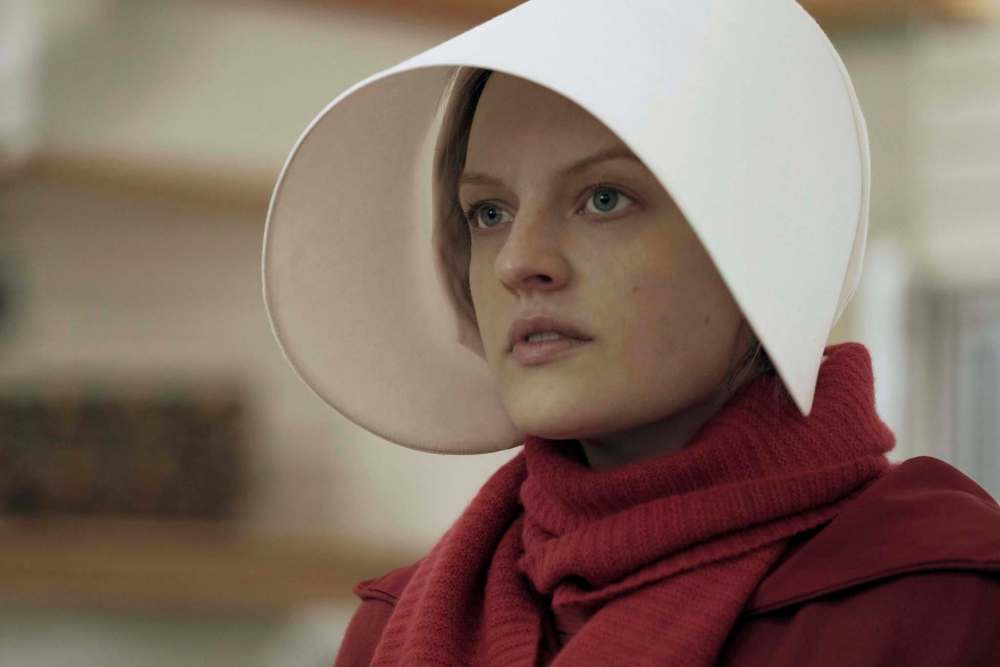
Her name is Offred, or “of Fred,” marking her as a man’s property. She is dressed in a blood-red uniform designed to deny her personality and reduce her to a reproductive role. She is told to speak in the words given to her by her oppressors: “May the Lord open;” “Blessed be the fruit;” “Under his eye.”
Her opinions, her emotions and her body have been subsumed into her official status as a walking womb, someone who has no purpose or meaning beyond bearing the children of a powerful man and his wife.
Even with all these constraints, Moss crafts a ferocious, focused portrayal of an insistently individual woman. In extreme close-ups — sometimes we’re even brought into that winged handmaid’s bonnet to share her character’s claustrophobic world — we see Offred’s personality distilled into Moss’s fascinating face. With passionate minimalism, Moss conveys a full range of feelings — despair, anger, boredom, contempt, resilience, humour and, yes, even hope.
If Moss somehow manages to convey Offred’s uniqueness, it could be because Moss herself is unique.
Since her career-making turn in Mad Men as secretary-turned-copywriter Peggy Olson, Moss has operated in unusual terrain, somewhere between leading lady and character actor.
Just as Offred resists the Republic of Gilead’s fascist theocracy, Moss resists Hollywood’s subtler forms of patriarchal control, which generally require female actors to be not just beautiful, but beautiful according to a narrow set of conventional standards. This extends even to the industry’s recent — and putatively feminist — embrace of Strong Female Characters. Strength is great, Hollywood seems to say, if it looks like Scarlett Johansson in a catsuit.
Within mainstream movies and television, female beauty often becomes another kind of uniform, a weirdly interchangeable outfit of flawless face, flowing hair and long limbs, imprisoning women within the unforgiving outlines of physical perfection.
Moss isn’t a standard-issue female star. She’s a little too short in the neck, a bit too emphatic of feature. She possesses an unexpected, difficult, downright quality that sets her apart from many of her contemporaries but connects her with women such as Bette Davis, a Golden Age icon whom Moss has cited as an important influence. As with Davis, a lot of Moss’s beauty comes from her attitude, her energy and her self-aware way of carrying herself.
Moss can look glam and gorgeous on the red carpet, but she’s not afraid to look ugly in her roles. And not just “Hollywood ugly,” which usually means haggard in an attractive kind of way, maybe with a fetching smudge under the eye to suggest suffering.

Moss is willing to go all-out ugly, with a kind of courage that is crucial for The Handmaid’s Tale. Living in a society where makeup is considered a form of harlotry, Offred often looks colourless, washed-out and exhausted. In her thick socks and dowdy Victorian underwear, she can seem frumpy and shapeless. Moss owns this homeliness, which makes the scenes in which she flashes back to her former life as June Osborne, beautiful in her self-confidence and sensuality, even more striking.
The entertainment industry isn’t quite Gilead, but it does tend to slot women into rigid roles, whether that’s the hot young ingenue — often cycled out just as she’s getting interesting, to be replaced by a fresher model — or the offbeat character player, usually sidelined into quirky best-friend bits or sexless supporting roles.
As Moss pushes back against this system with her hard-to-classify screen persona, her blazing work in The Handmaid’s Tale reminds us of what we might be missing.
Gilead deals ruthlessly with women who don’t conform to their standards. But how many talented female actors have been shunted out of Hollywood because they don’t easily fit?
alison.gillmor@freepress.mb.ca
Studying at the University of Winnipeg and later Toronto’s York University, Alison Gillmor planned to become an art historian. She ended up catching the journalism bug when she started as visual arts reviewer at the Winnipeg Free Press in 1992.
Our newsroom depends on a growing audience of readers to power our journalism. If you are not a paid reader, please consider becoming a subscriber.
Our newsroom depends on its audience of readers to power our journalism. Thank you for your support.
Studying at the University of Winnipeg and later Toronto’s York University, Alison Gillmor planned to become an art historian. She ended up catching the journalism bug when she started as visual arts reviewer at the Winnipeg Free Press in 1992.
Our newsroom depends on a growing audience of readers to power our journalism. If you are not a paid reader, please consider becoming a subscriber.
Our newsroom depends on its audience of readers to power our journalism. Thank you for your support.
Advertisement Advertise With Us
Advertisement Advertise With Us