Tuca & Bertie tackles human issues within a surreal world
Advertisement
Read this article for free:
or
Already have an account? Log in here »
To continue reading, please subscribe:

Digital Subscription
One year of digital access for only $205*
- Enjoy unlimited reading on winnipegfreepress.com
- Read the E-Edition, our digital replica newspaper
- Access News Break, our award-winning app
- Play interactive puzzles
*First annual payment billed as $205.00 + GST for one year. This annual subscription will automatically renew at $233.00 + GST every 52 weeks (10% off the regular annual price of $259.35). Offer available to new and qualified returning subscribers only. Cancel any time.
To continue reading, please subscribe:
Add Free Press access to your Brandon Sun subscription for only an additional
$1 for the first 4 weeks*
- Enjoy unlimited reading on winnipegfreepress.com
- Read the E-Edition, our digital replica newspaper
- Access News Break, our award-winning app
- Play interactive puzzles
*Your next Brandon Sun subscription payment will increase by $1.00 and you will be charged $17.95 plus GST for four weeks. After four weeks, your payment will increase to $24.95 plus GST every four weeks.
Read unlimited articles for free today:
or
Already have an account? Log in here »
Hey there, time traveller!
This article was published 12/05/2019 (2659 days ago), so information in it may no longer be current.
A few episodes into Lisa Hanawalt’s new, terrifically funny animated series, Tuca & Bertie, there’s a moment when a puffin in a pink suit calls a crowded auditorium to attention. In the process, she tidily summarizes the show’s twisted and (yet undeniably human) perspective.
“Ladies and gentle-birds,” the MC begins, “and plants, humans and sometimes inanimate objects that talk — what a weird world!”
Even for viewers who may be coming to Tuca & Bertie from Hanawalt’s other television job — character designer and producer of the biting yet melancholy Hollywood satire BoJack Horseman, created by her longtime friend Raphael Bob-Waksberg, who also executive produces the new show — the statement can’t be denied.
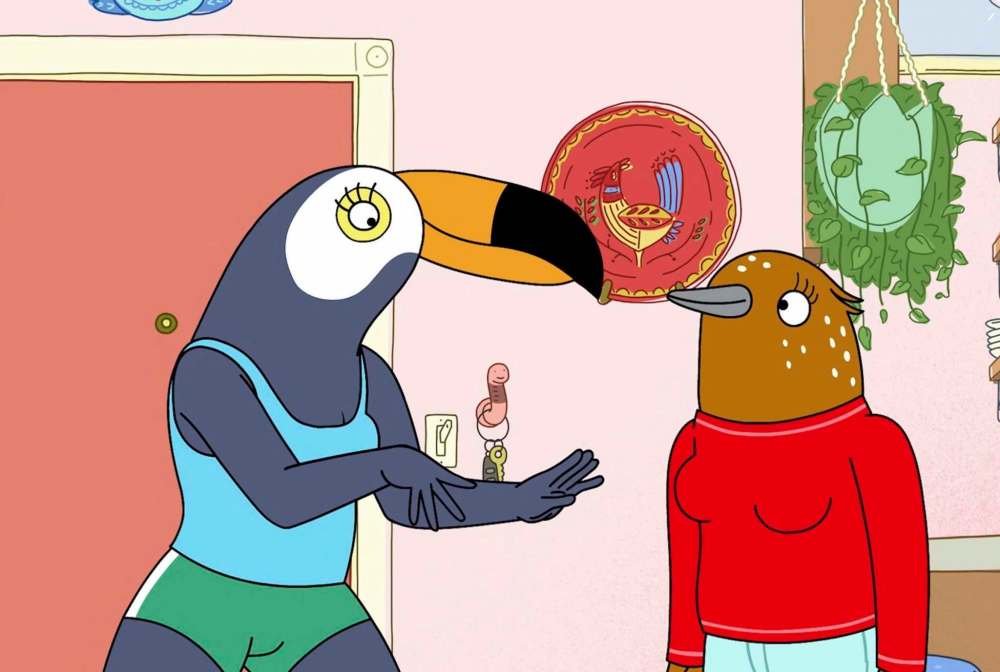
Featuring standup stars Ali Wong and Tiffany Haddish as a pair of bird best friends at the cusp of their 30s, their home of Birdtown is a freewheeling dreamscape where the subway is a snake and freeways loop like roller-coasters around cat-infested yarn hillsides and lakes of grape jelly. A few scenes incorporate snippets of live action and Claymation, and, at one point, Bertie drives her car off the road and her profanity, spilling from the window in puffy balloons of text, builds a bridge to safety.
At times capturing a hallucinogenic meeting between Broad City and Tex Avery, Tuca & Bertie stands in a strange territory all its own.
“Having worked on BoJack for — now I’m working on the sixth season — it felt fun to me to have an opportunity to break the rules a bit and create a different universe where things are a little more loosey-goosey and surreal,” the 35-year-old Hanawalt said by phone. “And closer to my personal work, where plants can walk around and wear clothing, and there are boobs on buildings. That really is more like my comics and my own little world.”
But for all the visual goofiness, playful puns and anything-goes sense of comic adventure, Tuca & Bertie remains grounded in very human realities. Though rendered in candy-coloured hues and framed by a sunny, dance-funk soundtrack, the series fearlessly but beautifully makes room for issues around childhood trauma, social anxiety and sexual harassment in a way not dissimilar from BoJack’s candid depictions of depression.
“I want to get into that dark stuff because that’s part of growing up as well, and that’s what I like about working with Raphael,” Hanawalt said. “We’re both really drawn to things that are both extremely funny, silly and surreal, and then extremely dark and relatable.”
While TV has grown more adept with nuanced storylines that years ago would have struggled for airtime or even an appropriate level of honesty if forced to run between detergent ads, there’s something about Hanawalt’s line-drawn, anthropomorphized esthetic that creates a powerful Trojan horse for much heavier material.
Whether it’s Tuca reflecting on the loss of her mother or Bertie describing a nightmarish incident from her childhood, the mix of image and storytelling makes an emotional impact that live action struggles to approach.
“Something about making them cute little birds kind of makes it more universal,” Hanawalt said. “If you’re seeing a human on-screen, you have a very specific association with whatever human you’re seeing; they remind you of someone. But if it’s a cartoon animal, then it’s not as specific, it’s more universal, so maybe it’s easier to project yourself onto that.”
In another instance of grounding a decidedly unreal show in reality, Hanawalt also wanted to depict how young women — or bird-women — at the cusp of growing up sound and behave. Citing Broad City and Hulu’s Pen15 as inspirations, Hanawalt said, “I just love shows that show how funny and gross women actually are, because that’s how I am with my friends, and I don’t see that represented as often as men being men.

“A lot of adult animation gets pretty raunchy, but it’s all from a male perspective,” she said. “I definitely wanted (Tuca & Bertie) to be an adult show with adult themes.”
While this includes more nudity and frank discussion about sex and sexuality than perhaps expected (“Perverts will love it,” Hanawalt said dryly), there’s also the welcome inclusion of a slapstick standby in at least one perfectly timed, perfectly placed flatulence joke. Upon being reminded of the scene, Hanawalt expresses pride in her work.
“I really carefully chose that fart noise,” she said. “I mean, never thought that I would have such strong opinions in a sound mix. I’ve never done this before, whatever, but I was like, ‘Uh, can we get a smaller fart?’
“You’d be surprised,” she said with a laugh, “how much funnier it made it.”
— Los Angeles Times