All’s well when a TV series ends well

Advertisement
Read this article for free:
or
Already have an account? Log in here »
To continue reading, please subscribe:

Digital Subscription
One year of digital access for only $205*
- Enjoy unlimited reading on winnipegfreepress.com
- Read the E-Edition, our digital replica newspaper
- Access News Break, our award-winning app
- Play interactive puzzles
*First annual payment billed as $205.00 + GST for one year. This annual subscription will automatically renew at $233.00 + GST every 52 weeks (10% off the regular annual price of $259.35). Offer available to new and qualified returning subscribers only. Cancel any time.
To continue reading, please subscribe:
Add Free Press access to your Brandon Sun subscription for only an additional
$1 for the first 4 weeks*
- Enjoy unlimited reading on winnipegfreepress.com
- Read the E-Edition, our digital replica newspaper
- Access News Break, our award-winning app
- Play interactive puzzles
*Your next Brandon Sun subscription payment will increase by $1.00 and you will be charged $17.95 plus GST for four weeks. After four weeks, your payment will increase to $24.95 plus GST every four weeks.
Read unlimited articles for free today:
or
Already have an account? Log in here »
Hey there, time traveller!
This article was published 01/02/2020 (2423 days ago), so information in it may no longer be current.
In the age of Prestige TV, with all this talk about television series being novelistic, there is an increased pressure for shows to end well.
All those long narrative arcs, all those character trajectories, all those multilayered themes — they need to be wrapped up in a way that feels maybe a little unexpected but also completely satisfying. Audiences have been very tough on series finales lately, and the more they love the show, the more they crave meaningful closure.
The Sopranos offered an audacious cut to black. (Is Tony alive or dead?) Mad Men played with ambiguity. (Has ad man Don Draper finally found peace — or just a way to market inner peace in the sell-out ’70s?) Game of Thrones arguably collapsed under the weight of massive build-up and feverish fan expectation. (Bran Stark? What?)
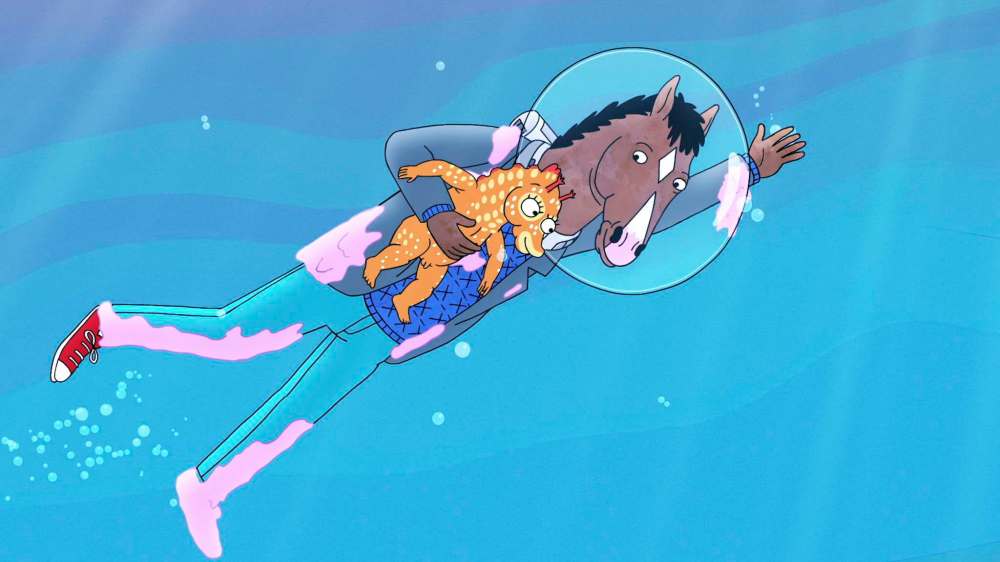
The final eight episodes of BoJack Horseman dropped on Netflix last weekend, and the end of this smart, funny, feeling animated series is, on first look, not an obvious crowd-pleaser. There’s no big drama, no sudden reveal, no neat wrap-up. The final hours spent with our damaged, washed-up celebrity half-man half-horse protagonist (voiced by Will Arnett) seem a little raggedy, a little unresolved, a little anticlimactic. The last scene, which swells to deep sadness with an undercurrent of tentative hope, doesn’t feel like a conclusion but rather a lovely suspended moment in what will be an ongoing story.
That muted, melancholic finish feels right, though, for this rule-breaking, genre-jumping show. Mixing up comedy and tragedy, layering emotional realism with visual absurdity, BoJack Horseman has always been about issues that don’t have easy endings — addiction, depression, trauma, recovery, redemption. It may be set in a bizarro cartoon universe, but the series is better than almost anything else out there at examining difficult, ongoing, stop-and-start emotional processes — in particular, the complicated project of trying to be a better man or woman (or horse).
At the start of the second half of Season 6, BoJack seems intent on new beginnings. He’s attempting to be an adult. He’s let his mane go grey. He’s attending AA meetings. He’s moved away from Hollywood, where it was so tempting to fall back into old habits, and is teaching drama at Wesleyan.
“Acting is about leaving everything behind and becoming something new,” he tells his students. But a fast-talking ’40s-style reporter (Paget Brewster) who’s digging into BoJack’s role in the death of former child star Sarah Lynn (Kristen Schaal) reminds us that the past is not past.
As we head toward BoJack’s moral reckoning, several looping storylines converge on an end-of-term performance by his earnest acting students. All the major characters are dealing with their own issues. Diane (Alison Brie) is recovering from a major depression, and the show follows her story with care and insight as she struggles to adjust to medication and deal with side-effects. She can’t quite kick her deep distrust of happiness, though, or her sense that as a writer she needs her pain because it makes her interesting and different.
Princess Carolyn (Amy Sedaris), that perpetual overachiever, is trying to be the perfect mother, the perfect Hollywood executive and the perfect contemporary woman. Poking fun at the movie industry’s often superficial feminism, the show lists some of her “female empowerment” projects, including a blockbuster movie “from the point of view of the female ticket-taker at the theatre where Batman’s parents got shot.”
Mr. Peanutbutter (Paul F. Tompkins) is being as introspective as a golden retriever can be. Only Todd’s (Aaron Paul) storyline, a possible reconciliation with his estranged mother, feels underwritten, stranded awkwardly between poignancy and hijinkery.
So what about the “new” BoJack? His initial response to his past catching up with him (“They can’t get me on that old s**t. I’m a different person now”) sounds a lot like the old BoJack, dodging responsibility, deflecting blame. The finale looks at whether real redemption is possible, and under what conditions, treating the question in ways both broadly comic — a whiteboard list of bad things BoJack has done includes, “Lied about ‘getting’ Radiohead” — and deeply serious.

Will he be just another poster boy for performative male penance — a “remorse horse,” as one media pundit calls him — or will he truly come to terms with the devastation he’s caused? Will he fixate on his own pain, or will he acknowledge the pain he’s caused others?
Tackling the hard work of personal growth — insisting that BoJack feeling bad about himself is not enough; he also has to be better, do better — the show itself has grown and changed. Always funny and satirical, the series deepened and darkened and even began to examine its own premise in a self-critical way.
Having presented us with a destructive but charismatic male anti-hero, the show refuses to let him off the hook. Maybe that’s why its ending is so perfectly imperfect. BoJack Horseman finishes not with a big concluding statement but with many small questions, not with a grand dramatic flourish but with a glimpse of an ongoing, open-ended emotional process. And that’s enough.
alison.gillmor@freepress.mb.ca
Studying at the University of Winnipeg and later Toronto’s York University, Alison Gillmor planned to become an art historian. She ended up catching the journalism bug when she started as visual arts reviewer at the Winnipeg Free Press in 1992.
Our newsroom depends on a growing audience of readers to power our journalism. If you are not a paid reader, please consider becoming a subscriber.
Our newsroom depends on its audience of readers to power our journalism. Thank you for your support.
Studying at the University of Winnipeg and later Toronto’s York University, Alison Gillmor planned to become an art historian. She ended up catching the journalism bug when she started as visual arts reviewer at the Winnipeg Free Press in 1992.
Our newsroom depends on a growing audience of readers to power our journalism. If you are not a paid reader, please consider becoming a subscriber.
Our newsroom depends on its audience of readers to power our journalism. Thank you for your support.
Advertisement Advertise With Us
Advertisement Advertise With Us