Tough day at work? Good question

Advertisement
Read this article for free:
or
Already have an account? Log in here »
To continue reading, please subscribe:

Digital Subscription
One year of digital access for only $205*
- Enjoy unlimited reading on winnipegfreepress.com
- Read the E-Edition, our digital replica newspaper
- Access News Break, our award-winning app
- Play interactive puzzles
*First annual payment billed as $205.00 + GST for one year. This annual subscription will automatically renew at $233.00 + GST every 52 weeks (10% off the regular annual price of $259.35). Offer available to new and qualified returning subscribers only. Cancel any time.
To continue reading, please subscribe:
Add Free Press access to your Brandon Sun subscription for only an additional
$1 for the first 4 weeks*
- Enjoy unlimited reading on winnipegfreepress.com
- Read the E-Edition, our digital replica newspaper
- Access News Break, our award-winning app
- Play interactive puzzles
*Your next Brandon Sun subscription payment will increase by $1.00 and you will be charged $17.95 plus GST for four weeks. After four weeks, your payment will increase to $24.95 plus GST every four weeks.
Read unlimited articles for free today:
or
Already have an account? Log in here »
Hey there, time traveller!
This article was published 26/02/2022 (1677 days ago), so information in it may no longer be current.
Severance(currently streaming on Apple TV+, with new episodes dropping Fridays) is a COVID-era show, though not in an obvious way. Conceived by Dan Erickson and directed by Ben Stiller and Aoife McArdle, the series starts off with a wild speculative concept: employees of the Lumon Corp. can “of their own free will” undergo a process known as “severance,” in which their memories are bifurcated into a job mode and a home mode.
The show is about work, a topic that’s become increasingly fraught in the last two years. At a time when that well-worn 21st-century term “work-life balance” already seemed like a mean joke, the pandemic hit. Even for those fortunate enough to be able to work remotely, pressures often increased.
Remote work can be beguiling. (Good coffee! Staying in your PJs! No commute!) At its worst, though, it can erode the boundaries between office and home so that labour and leisure, day and night meld into an undifferentiated sludge, where you’re neither fully committed to work nor fully able to relax, just stuck in a limbo of uncompleted, overwhelming multitasking.
It’s no wonder so many people started to re-evaluate their relationship to work, time and money during the depth of the pandemic. Now many don’t want a return to pre-COVID norms. They want something different, something better.
For viewers dealing with these tricky issues, Severance — part dark office comedy and part mind-messing sci-fi puzzle — is smart, stylish, slick and also surprisingly poignant.
Presented as a clean, neat solution to the work-life balance problem, the severance procedure is supposed to construct two separate and contained worlds. You can head to work and focus on the task at hand without wondering what you’re going to make for dinner. You can go home without carrying the stresses and worries of your workday.
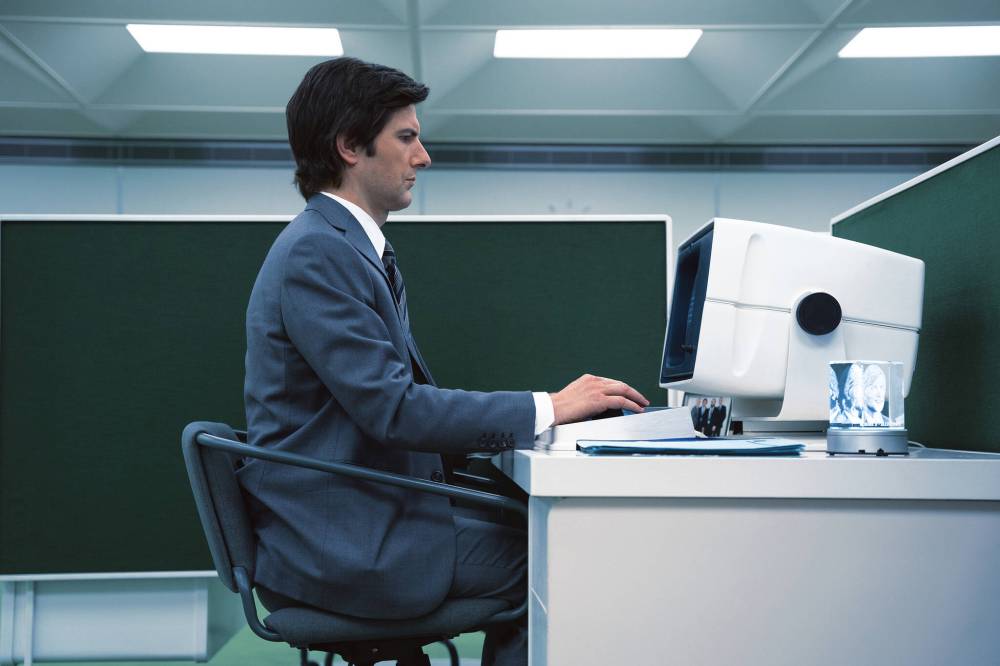
Of course, once we see it in action, severance reveals itself as an ethical morass and a monstrous dystopian nightmare. We meet Mark S. (Adam Scott) sobbing in his car in the company parking lot. Hunched, sad, parka-wearing, he trudges into the building to switch over to work mode. As the elevator takes him down to the “severed” basement and his outside memories disappear, he visibly changes, becoming alert, perky and, above all, productive.
His workday begins with coffee and office banter, but something is slightly off. Petey (Yul Vazquez), Mark’s best work pal, has disappeared without explanation, and Helly (Britt Lower), the new severed hire, isn’t adjusting well to her confusing new reality.
We soon realize that Mark has one consciousness that lives only to work, that subsists solely on food from the office fridge, that never reads the news or sees the sun, that can’t remember his hometown or the colour of his mother’s eyes.
The other Mark, the one we’re predisposed to think of as the “real” one, the lucky one, gets to spend his paycheque without even remembering the work that earned it. Mark at home has a ghostly quality, though. When he reluctantly attends a social gathering, the revelation of his severed status stops conversation. He’s viewed by others as a kind of freak, a half-man living a half-life.
Then there’s the question of what kind of work Mark and his colleagues might be doing. The severed employees spend their days sorting metadata, in a murky and menacing process, but it’s unclear what that data involves. Could Mark and his co-workers be doing something so terrible the corporation can’t risk it leaking to the outside world?
The series sets up Mark’s dual life with a super-stylized look that’s slightly out-of-time and also extremely cool. (Lumon may be a secretive and sinister mega-corporation, but, wow, it has great chairs.) At corporate headquarters, there’s an endless labyrinth of hallways, blindingly white and completely disorienting. Mark’s colleagues (including John Turturro, Zach Cherry, Patricia Arquette, Christopher Walken and Dichen Lachman) can be strange and stilted, delivering their off-kilter dialogue with a stone-faced tone that teeters toward the absurd.
But under this Kubrickian chilliness, there’s also something human and messy — the office chatter and the stale running jokes and the trust exercises and the employee celebrations with trays of melon balls.
Deftly mixing high-concept, high-style sci-fi with the familiar banalities of office comedy, Severance is like the 1960s series The Prisoner if it were set at the Scranton branch of Dunder-Mifflin. The series is deeply unsettling but it also summons glints of humanist optimism, reminding us that even under the most callous corporate conditions, we still struggle to connect.
alison.gillmor@freepress.mb.ca
Studying at the University of Winnipeg and later Toronto’s York University, Alison Gillmor planned to become an art historian. She ended up catching the journalism bug when she started as visual arts reviewer at the Winnipeg Free Press in 1992.
Our newsroom depends on a growing audience of readers to power our journalism. If you are not a paid reader, please consider becoming a subscriber.
Our newsroom depends on its audience of readers to power our journalism. Thank you for your support.
Studying at the University of Winnipeg and later Toronto’s York University, Alison Gillmor planned to become an art historian. She ended up catching the journalism bug when she started as visual arts reviewer at the Winnipeg Free Press in 1992.
Our newsroom depends on a growing audience of readers to power our journalism. If you are not a paid reader, please consider becoming a subscriber.
Our newsroom depends on its audience of readers to power our journalism. Thank you for your support.
Advertisement Advertise With Us
Advertisement Advertise With Us