The limits of control
Why Widow’s Bay feels like the perfect show for our current moment
Advertisement
Read this article for free:
or
Already have an account? Log in here »
To continue reading, please subscribe:

Digital Subscription
One year of digital access for only $205*
- Enjoy unlimited reading on winnipegfreepress.com
- Read the E-Edition, our digital replica newspaper
- Access News Break, our award-winning app
- Play interactive puzzles
*First annual payment billed as $205.00 + GST for one year. This annual subscription will automatically renew at $233.00 + GST every 52 weeks (10% off the regular annual price of $259.35). Offer available to new and qualified returning subscribers only. Cancel any time.
To continue reading, please subscribe:
Add Free Press access to your Brandon Sun subscription for only an additional
$1 for the first 4 weeks*
- Enjoy unlimited reading on winnipegfreepress.com
- Read the E-Edition, our digital replica newspaper
- Access News Break, our award-winning app
- Play interactive puzzles
*Your next Brandon Sun subscription payment will increase by $1.00 and you will be charged $17.95 plus GST for four weeks. After four weeks, your payment will increase to $24.95 plus GST every four weeks.
Read unlimited articles for free today:
or
Already have an account? Log in here »
Do you ever get the feeling that the world around you is being shaped by events totally beyond your control?
Is it even possible not to have that feeling these days?
If you count yourself among the number who feel powerless in the face of contemporary reality, fret not, because there is a show that understands that feeling perfectly.
That show is Widow’s Bay. If you haven’t heard of it, ask around. It’s all but guaranteed that someone you know loves it. In fact, try as you might, you’ll be hard pressed to find anyone who’s experienced the show’s well-balanced blend of horror, comedy and pathos who isn’t a fan. And for good reason.
Funny and spooky in all the best ways, the series follows Matthew Rhys as Tom Loftis, the striving mayor of the titular island hamlet, whose dreams of turning his community into the next Martha’s Vineyard run head on into a generational curse straight out of Stephen King.
The Apple TV series delivers memorable characters, thrills, genuine scares and some of the most finely calibrated comedy on television.
What makes Widow’s Bay feel especially timely, however, isn’t simply that it’s funny, frightening or well-crafted. Beneath all its eerie happenings and small-town eccentricities lies a story about one of the defining anxieties of contemporary life: the growing suspicion that we have no control over the forces influencing our lives.
That anxiety finds its clearest expression in Mayor Tom. He begins Widow’s Bay with fairly straightforward goals. As mayor, he wants tourists, jobs, economic growth, a future for his community and for his son.
Unfortunately, there’s the small matter of the curse he doesn’t even believe in.
Funny thing about curses, though: they don’t care if you believe in them or not. They’re going to wreak their nightmarish havoc anyway.
One of the things that makes the series such a delight is the tension between Tom’s confidence and his growing realization that the dark powers governing Widow’s Bay’s fate are immune to his good intentions and can-do spirit.
Whether it’s zombie fogs, haunted inns or ghostly bells, Tom’s efforts to first deny and then control the evil he’s confronting do little more than reveal the limits of his power in the face of it.
And it’s a huge part of what makes this funny, freaky show about a town full of doomed weirdos feel so resonant.
It’s no stretch to suggest that uncertainty and a sense of powerlessness are among the defining experiences of contemporary life.
We still make plans, pursue careers, build families and imagine futures for ourselves. We behave as though effort should translate to outcomes in a legible way. Yet many of us can’t escape the broader cultural feeling that the overwhelming forces determining the outcomes — pandemics, gas prices, grocery expenses, the rise of AI, the erosion of political institutions, climate change, global instability and conflict — are larger and less responsive to our individual intentions than we’d like them to be.
Widow’s Bay gleefully taps into this tension, but substitutes reanimated serial killers for late-stage capitalism.
The curse in Widow’s Bay operates less like a traditional monster than a system. It is inherited, difficult to understand and largely indifferent to individual intentions and agency. All anyone can do is try to minimize the carnage.
The nightmares surrounding the town, like many of the ones we face every day, don’t really resolve; they reproduce. Tom’s attempts to interact rationally with the world around him have almost no outward effect on the forces at work there. He can’t negotiate with the curse. He can’t reason with it. He can’t simply work harder and make it disappear.
You’d be forgiven if this seems like the familiar feeling you get after watching five minutes of any news broadcast on the planet.
The horrors don’t recede. The outrages don’t resolve. There are small victories, of course, but lately they seem outnumbered by fresh crises most of us feel unable to influence.
Apple TV
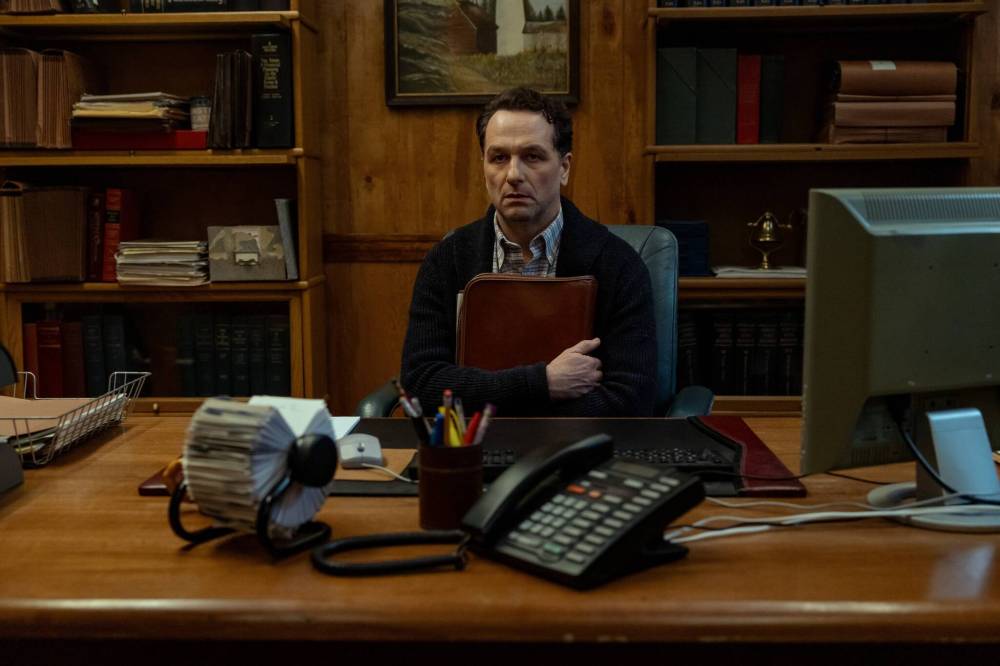
Matthew Rhys is Mayor Tom, who just wants to protect the town of Widow’s Bay from a curse he doesn’t believe in.
Yet for all that, Widow’s Bay isn’t a depressing show. If anything, it’s an oddly comforting one. That’s where its magic truly lies.
That comfort comes from the way it gives shape to anxieties that often feel abstract and impossible to grasp.
More importantly, Widow’s Bay understands that the value of Tom’s efforts isn’t measured by whether he ultimately overcomes the curse. He doesn’t become a master of the universe. He doesn’t discover that determination alone can bend reality to his will.
Instead, he keeps showing up.
Perhaps that’s the show’s quiet answer to the anxieties that make it feel so timely. Widow’s Bay doesn’t promise that the forces shaping our lives can be fully understood, controlled or overcome. If anything, it suggests the opposite.
But it also suggests that our obligations to one another don’t disappear simply because the world has become complicated, frightening or uncertain.
Tom keeps trying to protect his town. He keeps helping his neighbours. He keeps working toward a future he may never have a handle on.
The curse remains. The fog rolls in. The ghostly bells keep ringing.

Yet he keeps going.
In a moment when so many people feel powerless, there is something unexpectedly reassuring about that. Not because Widow’s Bay tells us we’ll win, but because it reminds us that meaning doesn’t depend on winning. Sometimes it comes from refusing to stop caring even when victory is far from guaranteed.
And Tom gets up the next morning and goes back to work.
Scott Montgomery is a Winnipeg-based writer and critic with a background in television, comedy, and literature.
arts@freepress.mb.ca