Roadkill for dinner? Rules vary by province and territory in Canada

Advertisement

Advertise with us

Jeremy Vander Meer had his first experience with salvaging a roadkill moose soon after he moved to Alaska nearly five years ago.

Read this article for free:


or

Already have an account? Log in here »

To continue reading, please subscribe:

Subscribe and receive a limited-edition Free Press branded hat or tote.

Digital Subscription

One year of digital access for only $205*

  • Enjoy unlimited reading on winnipegfreepress.com
  • Read the E-Edition, our digital replica newspaper
  • Access News Break, our award-winning app
  • Play interactive puzzles

*First annual payment billed as $205.00 + GST for one year. This annual subscription will automatically renew at $233.00 + GST every 52 weeks (10% off the regular annual price of $259.35). Offer available to new and qualified returning subscribers only. Cancel any time.

To continue reading, please subscribe:

Add Free Press access to your Brandon Sun subscription for only an additional

$1 for the first 4 weeks*

  • Enjoy unlimited reading on winnipegfreepress.com
  • Read the E-Edition, our digital replica newspaper
  • Access News Break, our award-winning app
  • Play interactive puzzles
Start now

*Your next Brandon Sun subscription payment will increase by $1.00 and you will be charged $17.95 plus GST for four weeks. After four weeks, your payment will increase to $24.95 plus GST every four weeks.

Hey there, time traveller!
This article was published 20/01/2019 (2765 days ago), so information in it may no longer be current.

Jeremy Vander Meer had his first experience with salvaging a roadkill moose soon after he moved to Alaska nearly five years ago.

“It was pretty easy, actually,” he said in an interview with The Canadian Press. “It was kind of perfect.”

The 31-year-old, who grew up in Oshawa, Ont., said it happened in the winter, it wasn’t too cold or too dark and there was some snow on the ground.
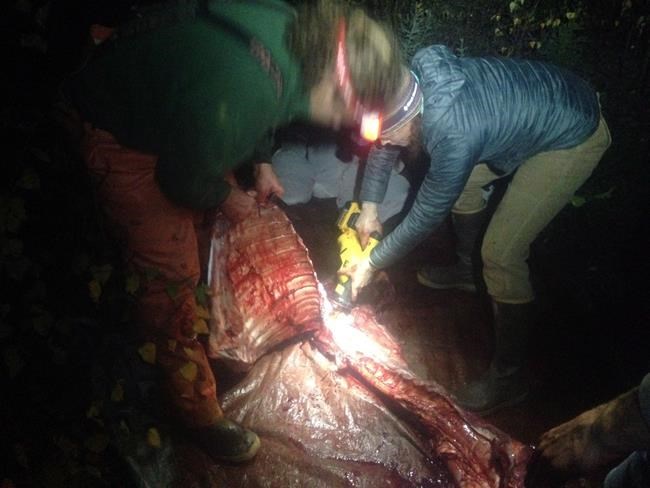
People cut up a moose carcass after being hit by a car in Alaska in this undated handout photo. Jeremy Vander Meer had his first experience with salvaging a roadkill moose soon after he moved to Alaska nearly five years ago.
People cut up a moose carcass after being hit by a car in Alaska in this undated handout photo. Jeremy Vander Meer had his first experience with salvaging a roadkill moose soon after he moved to Alaska nearly five years ago. "It was pretty easy, actually," he said in an interview with The Canadian Press. "It was kind of perfect." THE CANADIAN PRESS/HO - Jeremy Vander Meer

A pregnant cow moose had been hit by a car and had to be shot by state troopers, who called the next person on a roadkill applicants list. In this case, it was a friend of Vander Meer so he and his partner, Joanna Young, headed to the scene to help clean up the moose.

“We helped finish cutting it up and took it to the car and drove home,” said Vander Meer. “After that, it’s a couple evenings of butchering it and severing it into steaks and cubes and hamburger, and packaging it up and freezing it.

“Everybody takes their cut, depending on how many hours you worked.”

Eating roadkill is quite common in the northern state where wildlife troopers maintain the list of people who are interested in salvaging one of the hundreds of moose and other game hit by vehicles every year.

In Oregon, a law went into effect Jan. 1 that allows people to harvest and eat roadkill. About 20 other states allow people to take meat from the animals.

The laws on collecting roadkill vary in Canadian provinces and territories. The one constant is that the Canadian Food Inspection Agency doesn’t allow the meat to be sold.

“Federal regulations require that a meat product can only be sold if it is derived from a healthy animal which was slaughtered in accordance with commonly accepted practices,” said spokeswoman Lisa Murphy.

“Dead (roadkill) and diseased animals are not allowed to enter the food chain.”

In Alberta, people are required to contact a Fish and Wildlife officer.

“They would need to get a hold of the government to obtain permission to pick that up,” said Insp. Richard Lyons of Alberta Fish and Wildlife. “Nobody can possess wildlife unless there is an authority to do so.”

Officers consider each request on a case-by-case basis, including whether the roadkill would be used for food, he said.

“It’s definitely common for an officer to authorize possession,” said Lyons. “Then the person would be allowed to have it and use the meat, but normally what we do on those authorization permits is indicate on there that the meat hasn’t been inspected.

“In most cases, we can’t confirm that it’s fit for human consumption.”

Lyons said it’s difficult for officers to know how long the meat has been sitting there or whether it’s carrying disease so people would be eating it at their own risk.

Similar to Alberta, anyone who wants to pick up dead wildlife in British Columbia must apply for a permit.

“It would then be inspected to ensure that it was not killed illegally,” said Dawn Makarowski, a public affairs officer for the B.C. Ministry of Forests, Lands, Natural Resource Operations and Rural Development.

If conservation officers determine the meat is salvageable, a person who wants to keep it can get a permit.

Officials said the only rule around roadkill in Yukon is that the person must have a permit for the possession of wildlife.

Ontario also has some legislation on wildlife found dead on the side of the road.

“In most cases, you may keep these carcasses without approval,” Jolanta Kowalski, a spokeswoman for the Ministry of Natural Resources and Forestry, said in an email. “But certain species must be registered online … before you can keep them for personal use.

“This includes all large mammals, birds of prey and fur-bearing mammals.”

Kowalski said no one is allowed to buy or sell roadkill, although there are exceptions for pelts sold by licensed trappers.

“Anyone who is attempting to retrieve road-killed wildlife is reminded to do it only in a safe and responsible manner,” she said. “Proper carcass-handling practices will help ensure a quality food product for the table.”

That includes keeping the meat clean, using clean cutting tools, wearing gloves and proper hanging and cooling.

Vander Meer said he has learned those practices from friends by helping salvage roadkill a handful of times.

“I’m not a particularly good hunter, so this is a great way to get moose still, without having to be successful hunting,” he said.

“Most years I get roadkill moose in my fridge rather than hunted moose, because that’s the way it works out.”

— Follow @cderworiz on Twitter.
Report Error Submit a Tip

More Stories

Trailblazing Western Scrap Metals heavy-equipment operator relishes role at massive crane’s control

David Sanderson 7 minute read Preview

Trailblazing Western Scrap Metals heavy-equipment operator relishes role at massive crane’s control

David Sanderson 7 minute read Friday, Aug. 14, 2026

Less than five per cent of heavy-equipment operators in the country are women but that number is trending upward, according to a study conducted by trade magazine Crane & Hoist Canada.

It was reported that in Ontario roughly eight per cent of jobs in the transport and heavy-equipment field are currently held by women. Furthermore, in 2024 almost 20 per cent of graduates at an Edmonton-based heavy-equipment operator training school were female, the article stated.

That brings us to Harmony Guspodarchuk, the first female crane operator in the 70-year history of Western Scrap Metals, a family-owned business at 18 Sutherland Ave.

Three years ago, Guspodarchuk literally stepped into the driver’s seat of a 27,500-kilogram, Liebherr C 924 Heavy Lift Litronic crane. The 29-year-old hasn’t looked back much since.

Read
Friday, Aug. 14, 2026

West Kildonan Industrial residents call for speed bumps after child hit by truck

Morgan Modjeski 3 minute read Preview

West Kildonan Industrial residents call for speed bumps after child hit by truck

Morgan Modjeski 3 minute read Updated: Yesterday at 3:09 PM CDT

Residents in the West Kildonan Industrial neighbourhood are calling on the city to install speed bumps in their area after a child was hit and dragged by a vehicle Thursday.

Katelyn Bemister lives near the area where the child — who was hospitalized as a result of the incident and has been upgraded to stable condition — was struck. She says people frequently speed in the area.

“They’re going really fast, and they’re not really paying attention at all to the pedestrians in the area,” says Bemister.

In video supplied to the Free Press by a resident, the child can be seen riding a bike down a sidewalk along the 500 block of North Point Boulevard.

Read
Updated: Yesterday at 3:09 PM CDT

Today’s horoscope

Georgia Nicols 4 minute read Preview

Today’s horoscope

Georgia Nicols 4 minute read 2:00 AM CDT

MOON ALERT: There are no restrictions to shopping or important decisions today. The moon is in Libra.

ARIES (March 21-April 19)

The day is a mixed bag. For the most part, it’s romantic, friendly, congenial and a great time to socialize with others and enjoy playful activities with kids. Nevertheless, you might meet a real sourpuss or someone who is a wet blanket. Keep things light!

TAURUS (April 20-May 20)

Read
2:00 AM CDT

HSC weapons scanners effective, needed at other hospitals: nurses union

Carol Sanders 5 minute read Preview

HSC weapons scanners effective, needed at other hospitals: nurses union

Carol Sanders 5 minute read Yesterday at 9:57 AM CDT

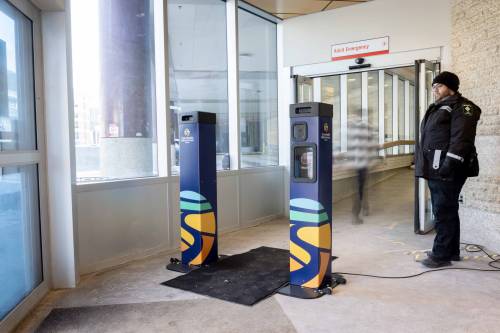
The AI weapons scanners at Health Sciences Centre have detected close to 2,000 items since they were installed at Manitoba’s largest hospital.

From March 6, 2025 to the beginning of this month, a total of 1,973 items had been flagged by the scanners and identified for further review, Shared Health said this week.

Knives, Swiss army knives and other multi-tools, drugs, alcohol, box cutters, syringes and other injection devices were detected, it said. The technology set up at entrances to the adult and children’s emergency rooms and the crisis response centre is designed to identify a wide range of objects that may require review under site safety protocols.

But Manitoba Nurses Union president Darlene Jackson said the technology isn’t available everywhere at HSC, and a sawed-off rifle was discovered in the adult ER earlier this month.

Read
Yesterday at 9:57 AM CDT

Firefighter’s death fuels cancer fight

Zoe Pierce 5 minute read Preview

Firefighter’s death fuels cancer fight

Zoe Pierce 5 minute read Yesterday at 2:01 AM CDT

The United Fire Fighters of Winnipeg is mourning the loss of Winnipeg firefighter Darrel Maynard while continuing its work to raise awareness of occupational cancer and improve health protections for firefighters.

Maynard, a senior firefighter II and acting lieutenant with the Winnipeg Fire Paramedic Service, died Aug. 5 at age 41 after a three-year battle with occupational cancer.

He served Winnipeg for nearly two decades and leaves behind his wife Francine and sons Colin and Christian.

“Darrel was an incredible, incredible person, an incredible firefighter, and really, really special to all of us,” said Nick Kasper, president of UFFW.

Read
Yesterday at 2:01 AM CDT

RCMP searching for missing 34-year-old woman

1 minute read Yesterday at 6:29 PM CDT

Police are asking for the public’s help locating a 34-year-old woman last heard from almost a week ago.

Tamara Stevens, who also goes by Tammy, was last heard from on Sunday last weekend and was reported missing Tuesday morning, said a Thompson RCMP news release Saturday.

RCMP and family are worried for her well-being.

Stevens is believed to be in Thompson and is described as 5'7, with a slender build and long red hair, said RCMP. She also has a piercing on her lip and was last seen wearing black T-Shirt featuring the Twilight character Jacob, pants and work boots.