This is Toronto’s destination for coffee drinks from around the world
Advertisement
Read this article for free:
or
Already have an account? Log in here »
To continue reading, please subscribe:

Digital Subscription
One year of digital access for only $205*
- Enjoy unlimited reading on winnipegfreepress.com
- Read the E-Edition, our digital replica newspaper
- Access News Break, our award-winning app
- Play interactive puzzles
*First annual payment billed as $205.00 + GST for one year. This annual subscription will automatically renew at $233.00 + GST every 52 weeks (10% off the regular annual price of $259.35). Offer available to new and qualified returning subscribers only. Cancel any time.
To continue reading, please subscribe:
Add Free Press access to your Brandon Sun subscription for only an additional
$1 for the first 4 weeks*
- Enjoy unlimited reading on winnipegfreepress.com
- Read the E-Edition, our digital replica newspaper
- Access News Break, our award-winning app
- Play interactive puzzles
*Your next Brandon Sun subscription payment will increase by $1.00 and you will be charged $17.95 plus GST for four weeks. After four weeks, your payment will increase to $24.95 plus GST every four weeks.
Read unlimited articles for free today:
or
Already have an account? Log in here »
Hey there, time traveller!
This article was published 06/04/2022 (1616 days ago), so information in it may no longer be current.
Something’s been long brewing along College Street for the last decades, but it took the closure of dozens of Starbucks locations in the city during the pandemic for me to notice.
College Street is a coffee destination, but not in an oversaturated, cookie-cutter chain way. Rather, it’s where independent coffee shops specializing in brews from around the world rule.
There are the decades-old Italian cafés primed for patio season (hello Café Diplomatico); Manic Coffee helping to usher in the city’s third-wave coffee boon of the early 2000s; Turkish coffee at Istanbul Shawarma and Colombian roaster Maderas Cafe at the College and Ossington intersection to name a few. Oh yes, Snakes and Lattes as well.
But throughout the pandemic, when coffee chain locations shuttered as commuters stayed home, College Street saw a new wave of coffee shops open up, such as Japanese vegan bakery Tsuchi Cafe doing miso caramel macchiatos and matcha lattes alongside more standard espresso-based drinks. While not technically a shop, there’s also RC Coffee Robo Cafe, a coffee vending machine where a robotic arm prepares the drink.
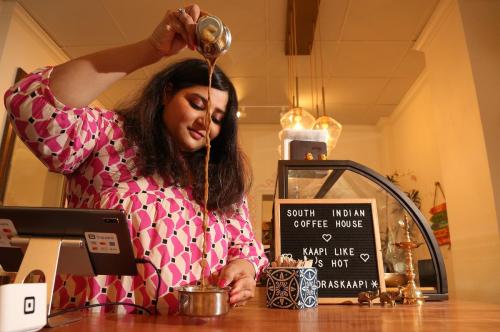
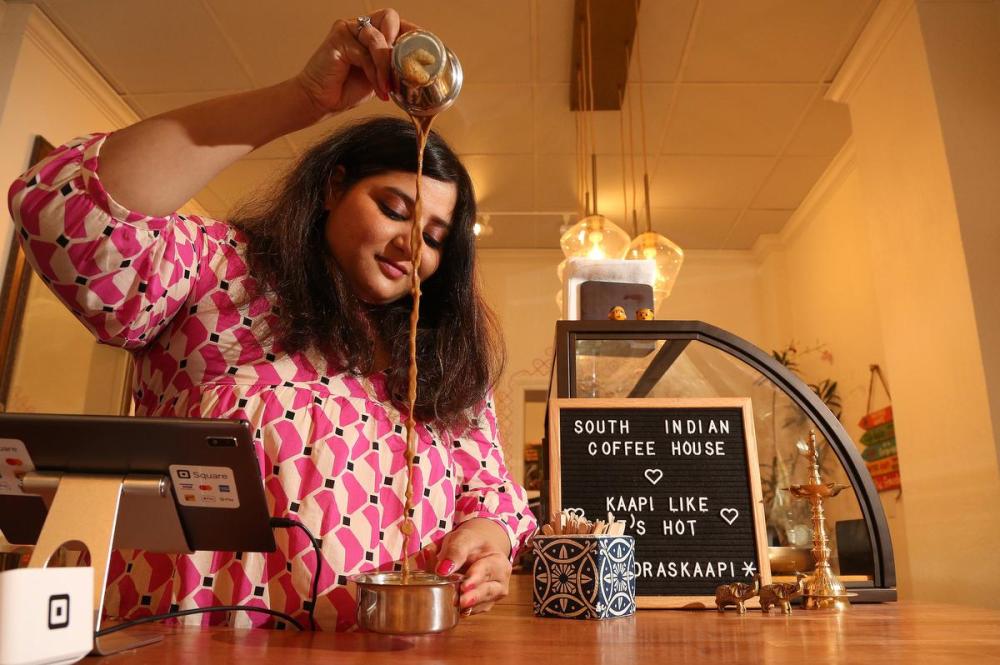
Just west of Tsuchi at Concord Avenue is Madras Kaapi, a South Indian café that opened last December. Its speciality is kaapi, a South Indian filter coffee where the grounds are blended with chicory to add a subtle woody flavour.
Couple Shilpa Kotamarthi and Aditya Srivathsan started Madras Kaapi as an online business six years ago when they lived in Montreal and had a hard time finding the kaapi they were used to drinking when growing up in South India.
“Madras Kaapi gained traction because there’s a lot of South Asians here so we didn’t have to do much marketing for people to notice us,” said Kotamarthi, adding that the café will be starting kaapi brewing classes later this month. “People are more open to trying more coffees now, and at the café it’s not like we only get South Asian people, it’s been a great mix of people and that makes us happy.”
Kaapi is brewed using a filter comprised of two metal cylinders stacked on top of each other.
The grounds (a blend of chicory, peaberries, Arabica and Robusta beans grown in Tamil Nadu) are tamped down into the upper cylinder.
Hot water is added to allow the coffee to percolate to the bottom cylinder, creating a concentrate called a decoction.
Jaggery and hot milk is added and then the drink is aerated by pouring it back and forth in a davara, which is essentially a tumbler and a bowl.
While the creation of the café was fuelled by the nostalgia for the kaapi that Kotamarthi had, there are also lattes, mochas and iced versions. The nutty flavour oat milk pairs exceptionally with the chicory and is an example of evolving coffee culture.
Farther east is cheese and pantry shop Kiss My Pans where married couple Jeanne Chai and David Burga make kopi, a type of coffee found in Singapore and Malaysia. The two previously lived in Singapore and got used to drinking the strong coffee brewed with Robusta beans that have been roasted with butter, salt and sugar to mellow out the beans’ bitterness.
“People would hang out at the coffee shops in the old-school places drinking kopi,” said Chai. “They’d be known as the kopi uncle; reading newspapers and people watching.”
With kopi, the grounds are filtered through a coffee sock then poured between two kettles to aerate and cool the coffee, akin to South Indian kaapi. Their basic version has sweetened condensed and evaporated milk added, but like the Double Double at Tim Hortons, there’s lingo Singaporeans use to describe how they want their kopi.
“One of our most popular is the espresso version, the kopi o kosong,” said Chai. “It’s zero sugar, zero milk. Kopi siu dai means less sweet; kopi-bing is coffee with ice; kopi o is with sugar and no milk; kopi c is with evaporated milk and sugar. David likes stronger coffee so that’s called kopi gau, and kopi po is weaker.”
On the northern edge of Chinatown at Spadina Avenue is Vietnamese coffee shop Dak Lak Coffee, founded by former Centennial College culinary management classmates Katie Pham and Aimee Zhou in 2015. After graduating, the two opened a small takeout coffee shop at Markham’s Langham Square and later a second location at Pacific Mall serving Vietnamese iced coffee.
“People in America and Canada drink mostly Arabica beans like at McDonald’s and Tim Hortons. The coffee is lighter so you can drink a big cup, but Vietnamese coffee is a smaller portion because it uses Robusta beans which have more caffeine,” said Zhou, noting that the beans are also roasted with butter. “It’s a more bitter coffee so you mix it with condensed milk, and it goes well with ice. If you do this with a lighter coffee, it will overwhelm the coffee.”
In late 2018 the two opened a sit-down location of Dak Lak on the edge of Chinatown and expanded the menu with food and drinks like cà phê trứng or egg coffee, believed to date back to the 1940s in Hanoi when a milk shortage caused by the First Indochina War led a hotel bartender to use eggs as a dairy substitute (like the baguettes in banh mi, coffee in Vietnam was introduced by French colonialists).
Cà phê trứng is made by first brewing coffee using a phin, a metal filter that sits on top of the cup, like how kaapi is made. Egg yolks are separately whipped with condensed milk and poured on top of the coffee like a creamy, custard-like foam and finished with a dusting of cocoa powder.
“It’s a really special product famous in the north of Vietnam,” said Zhou. “We feel the taste is like a tiramisu.”

While it’s not on College Street, a coffee crawl isn’t complete without Ethiopian coffee. A slight detour south to the nearby Market 707 outdoor food court on Dundas West is Ethio and Eri Café where owner Etsehiwot Ejigu roasts and grinds her own beans inside her tiny stall (aside from the coffee, the vegan-heavy menu is a major draw).
It’s one of the newer entries in the city’s Ethiopian coffee scene, and perhaps one of the smallest places to offer the traditional coffee ceremony where the beans are roasted, ground and brewed upon ordering.
“When you make coffee in the old times, you open the door to anybody who passes, and you say hi with a welcoming drink. You (invite them to) come in for a break, a bit of a snack,” said Ejigu.
“You do the roasting, the grinding, the boiling in the jebena, which is like a teapot, and you drink it three times (as the grounds are brewed again). It’s when all the neighbours come together to talk about problems or gossip.”
Karon Liu is a Toronto-based food reporter for the Star. Reach him via email: karonliu@thestar.ca