‘Most challenging Thanksgiving:’ Long weekend marked with soaring food bank use
Advertisement
Read this article for free:
or
Already have an account? Log in here »
To continue reading, please subscribe:

Digital Subscription
One year of digital access for only $205*
- Enjoy unlimited reading on winnipegfreepress.com
- Read the E-Edition, our digital replica newspaper
- Access News Break, our award-winning app
- Play interactive puzzles
*First annual payment billed as $205.00 + GST for one year. This annual subscription will automatically renew at $233.00 + GST every 52 weeks (10% off the regular annual price of $259.35). Offer available to new and qualified returning subscribers only. Cancel any time.
To continue reading, please subscribe:
Add Free Press access to your Brandon Sun subscription for only an additional
$1 for the first 4 weeks*
- Enjoy unlimited reading on winnipegfreepress.com
- Read the E-Edition, our digital replica newspaper
- Access News Break, our award-winning app
- Play interactive puzzles
*Your next Brandon Sun subscription payment will increase by $1.00 and you will be charged $17.95 plus GST for four weeks. After four weeks, your payment will increase to $24.95 plus GST every four weeks.
Read unlimited articles for free today:
or
Already have an account? Log in here »
Hey there, time traveller!
This article was published 08/10/2023 (1096 days ago), so information in it may no longer be current.
VANCOUVER – Food banks across Canada continue to face soaring need this Thanksgiving, with one executive warning that things could quickly get worse.
Amid inflation, increasing food and housing costs, and precarious employment situations, the country’s food banks have watched the need for their goods balloon as the organizations enter what, for many, is a critical time of year for fundraising.
Neil Hetherington, CEO of Toronto’s Daily Bread, which supports more than 200 food programs in the area, said this long weekend has been the “most challenging Thanksgiving we have ever had.”
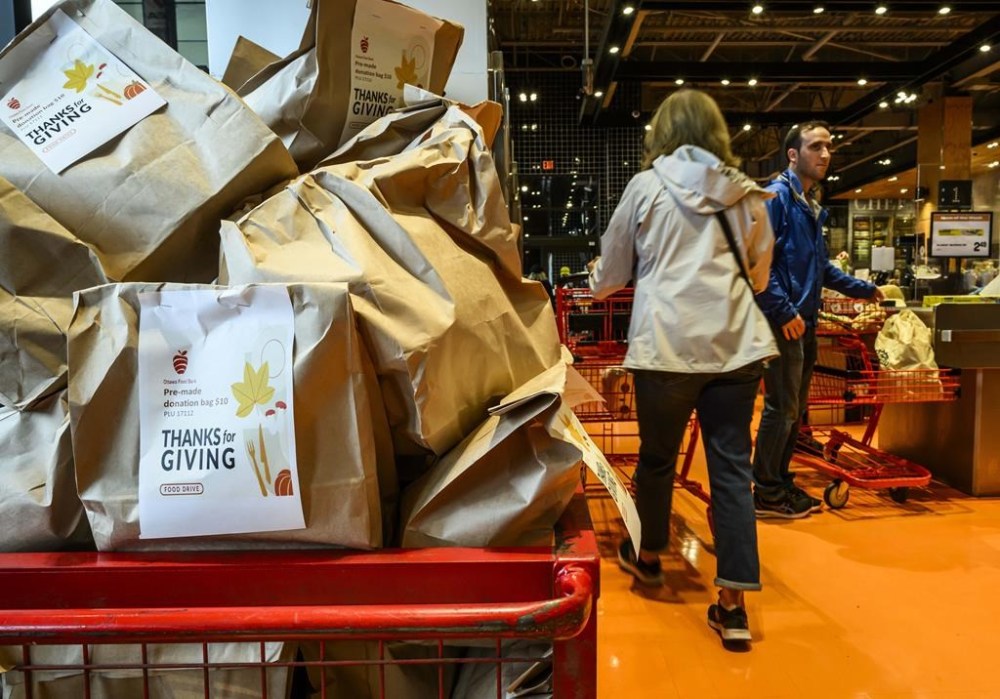
Prior to the COVID-19 pandemic, the organization saw about 65,000 client visits per month, he said. That number last month was 275,000.
“You’ve got food prices, you’ve got a precarious work environment, and most of all lack of decent, affordable housing,” he said.
“And you put all of those things together and suddenly you can understand why people are turning to food banks.”
At the Greater Vancouver Food Bank, chief operating officer Cynthia Boulter said the demand for food her food bank has seen this year is “unprecedented.”
“When I started, about five years ago, we were supporting between 6,000 and 7,000 people a month and we’re up in the 16,000 to 17,000 number at the moment,” she said.
In Quebec, demand for food assistance has been unrelenting for more than a year, according to Martin Munger, director of Les Banques alimentaires du Québec, a network of 32 organizations that supply local food aid programs.
“With inflation on food, the demand continues to rise,” Munger said.
His organization’s latest data, from March 2022, showed its network served 671,000 people in the province on average each month, an increase of nine per cent from 2021 and 33 per cent from 2019.
According to data from Food Banks Canada, the percentage of seniors accessing food banks has increased to 8.9 per cent in 2022 from 6.8 per cent in 2019 and that about one third of food bank users were children.
Hetherington said he’s frightened to see food bank usage be at record highs when unemployment rates in the country remain so low, and it’s something he’s warned both Ontario Premier Doug Ford and Toronto Mayor Olivia Chow about.
“That’s upside down for us,” he said.
“And so I believe … we’re the canary in the coal mine, letting you know that as soon as there is some negative economic indicators on people’s ability to derive income from employment, or as interest rates escalate and people’s repayment terms change, things are gonna get real bad real soon.”
Both Boulter and Hetherington say their organizations have so far been able to keep up with the need by increasing fundraising efforts, though Hetherington notes that Daily Bread is currently running a deficit budget.
Boulter said the Greater Vancouver Food Bank, which stopped accepting food from most community food drives in 2022, has put an increased focus on partnerships with food distributors and farmers to get access to fresh food.
“We focus a lot on recovering large industrial donations of food where, say, the avocados were a few centimetres too small and they were rejected because aesthetically they didn’t look right, or the bread was in the oven for 20 seconds too long, or something like that,” she said.
They’re partnering with Food Banks B.C. on a provincewide campaign to collect online donations for food banks across British Columbia.
Boulter said the food bank’s bulk buying power means it can “at least double” the value of monetary donations.
She said many of the smaller food banks may not have the same online reach or fundraising resources her organization does.
“We’re hoping, with our advertising power, our following, and our ability, to get this out in front of a lot of people,” she said.
Munger said in his case, despite new agreements with food producers and distributors, and funding from Quebec this summer, the food banks’ supply has been unable to match growing demand.
“The information we have from local food banks is it never stopped (growing and) many people are coming more frequently.”
“The number of people using food banks is at the all-time high.”

He issued a plea for Quebecers to consider financial donations to fund food purchases. “We need (the) help of everybody.”
Hetherington said people can help even if they’re not in a position to donate.
“Not everybody can donate food or funds, and we get that, but every one of us can call an elected official and say, ‘Today’s the day to implement your poverty reduction strategy,'” he said.
“All levels of government have one, but their feet are not held to the fire and held to account to be able to implement those.”
This report by The Canadian Press was first published Oct. 8, 2023