The ancient ways of natural wine are finding new fans

Advertisement

Advertise with us

SONOMA, Calif. (AP) — Wine made in ancient ways is gaining new fans.

Read this article for free:


or

Already have an account? Log in here »

To continue reading, please subscribe:

Subscribe and receive a limited-edition Free Press branded hat or tote.

Digital Subscription

One year of digital access for only $205*

  • Enjoy unlimited reading on winnipegfreepress.com
  • Read the E-Edition, our digital replica newspaper
  • Access News Break, our award-winning app
  • Play interactive puzzles

*First annual payment billed as $205.00 + GST for one year. This annual subscription will automatically renew at $233.00 + GST every 52 weeks (10% off the regular annual price of $259.35). Offer available to new and qualified returning subscribers only. Cancel any time.

To continue reading, please subscribe:

Add Free Press access to your Brandon Sun subscription for only an additional

$1 for the first 4 weeks*

  • Enjoy unlimited reading on winnipegfreepress.com
  • Read the E-Edition, our digital replica newspaper
  • Access News Break, our award-winning app
  • Play interactive puzzles
Start now

*Your next Brandon Sun subscription payment will increase by $1.00 and you will be charged $17.95 plus GST for four weeks. After four weeks, your payment will increase to $24.95 plus GST every four weeks.

Hey there, time traveller!
This article was published 16/10/2023 (1086 days ago), so information in it may no longer be current.

SONOMA, Calif. (AP) — Wine made in ancient ways is gaining new fans.

Natural wine — which emphasizes sustainability and minimal processing — is seeing growing interest in the U.S even though overall wine consumption has been declining since 2015, according to IWSR Drinks Market Analysis, a research firm. While natural and other sustainable wines made up less than 1% of sales in 2021, demand was rising faster than the wine category as a whole, according to alcohol delivery site Drizly.

Generally, natural wine is made with hand-picked organic grapes that haven’t been sprayed with herbicides or pesticides. Once they’re crushed — sometimes by foot, the way they were crushed by ancient Romans — they are naturally fermented with no added water, yeast or other ingredients. Some natural winemakers add sulfites, a chemical found naturally in grapes, as a preservative; others don’t. Some filter their wines; others leave them cloudy and full of sediment.
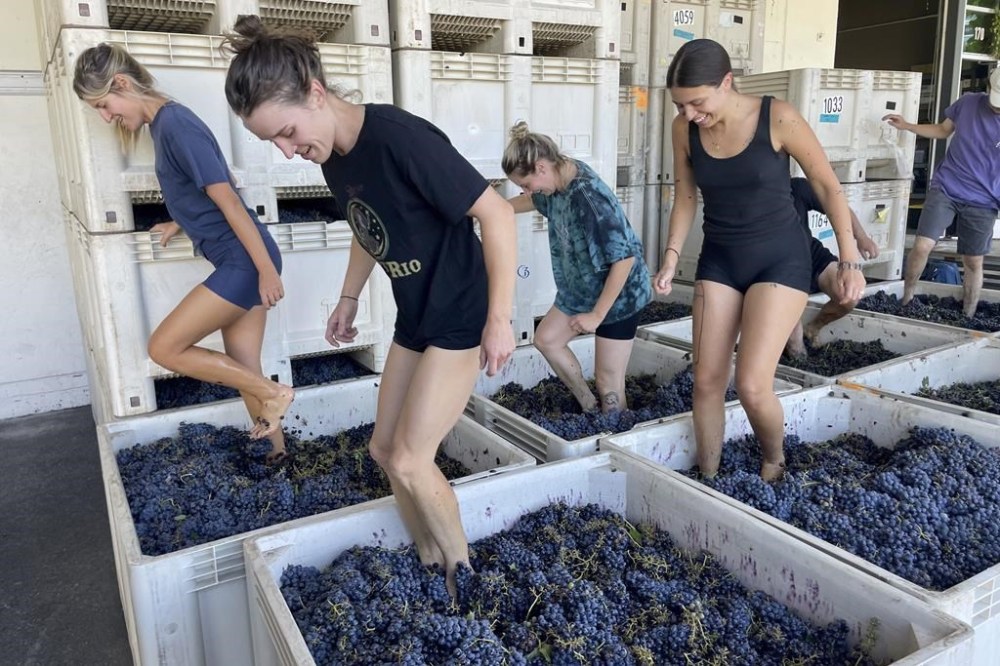
Interns at Pax Wines in Sebastopol, Calif., stomp organic grapes with their bare feet in large vats, pulling out the juice to start the fermentation process on Sept. 8, 2023. More wineries and wine bars dedicated exclusively to natural wine are opening in the U.S., with a focus on a back-to-basics approach, avoiding additives, pesticides and other manipulative techniques. (AP Photo/Haven Daley)

The result is wines that are earthy, savory and less predictable than many of the wines churned out by big producers.

“The first time you taste it, you can tell it’s alive,” said John Keller, the owner and winemaker at Neu Cellars in Northern Michigan.

But natural wine needs to overcome some hurdles that may be hampering its growth. Unlike organic wine — which must be government certified — natural wine has no set definition in the U.S. It’s not easy to find, since most natural wines don’t have the word “natural” on their labels.

“Natural just sounds good, but conventional wine is pretty natural too,” said Anita Oberholster, a professor in the Department of Viticulture and Enology at the University of California, Davis. “If the idea of natural wine is going to grow, we should do research on it and define it.”

Keller, who has a degree in biochemistry, started out working for a big winemaker in California. But he was disillusioned by all the chemical manipulation that went into making each bottle consistent. There are dozens of additives regularly used in the wine industry, including gelatin, oak dust and egg whites.

In 2019, Keller and his father opened Neu Cellars to focus on making natural wines. Last year, they produced 3,000 bottles.

Natural winemaking is “100% scary,” Keller said. He only gets to practice once a year and he can’t fall back on additives if things go wrong.

“It’s how life happens. You can’t really control it. You just have to give it the best conditions for the best outcome you can get,” he said.

Natural wine is not so much a fad as a return to tradition, said Erin Coburn, the owner of Minimo, a natural wine bar in Oakland, California. In some countries, like Georgia, winemakers never stopped making natural wine; they still ferment grapes in the egg-shaped clay pots they’ve used for thousands of years.

But others say the line between natural and conventional wines is a very thin one, especially for higher-end wines made with good grapes.

Many additives like yeast — which aids fermentation — are natural substances that are found in vineyards already, Oberholster said. And many conventional wines are made without additives.

Some in the industry would like to see standards adopted for natural wine. That’s what happened in France, where the wine industry approved the “vin method nature” label and certification process in 2020. More than 430 vintages have used the label since then, according to the Union for the Defense of Natural Wines.
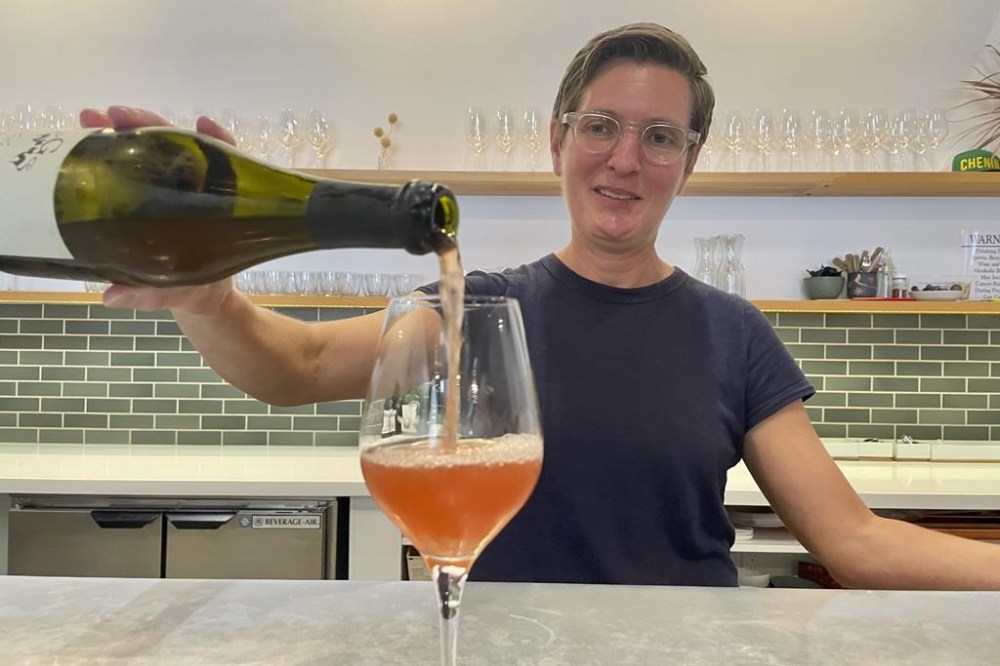
Erin Coburn, owner of the minimo wine shop in Oakland, Calif., pours a natural wine at her tasting bar on Sept. 7, 2023. More wineries and wine bars dedicated exclusively to natural wine are opening in the U.S., with a focus on a back-to-basics approach, avoiding additives, pesticides and other manipulative techniques. (AP Photo/Haven Daley)

Brian Gelb, the vice president of wine for Total Wine, a retail chain with 257 U.S. stores, has been adding natural wines to store shelves in the last two years to meet growing demand. But he isn’t sure how much of Total Wine’s inventory was already considered “natural.”

“I would just like to have a consistent set of terms and phrases that can be universally understood,” Gelb said.

Anthony Zhang, the co-founder and CEO of Vinovest, a wine investment company, said some wine brands are taking advantage of the lack of standards and using natural imagery without being transparent about how they define “natural.”

That can mislead consumers, who generally pay more for natural wines because they are made by smaller producers. Absentee Red, a natural California red blend, costs around $26 per bottle. Vivino, an online wine merchant, says similar bottles of conventional wine start around $14.

Still, winemakers don’t always welcome standards, which come with significant costs and rules. Keller uses organic grapes but says he can’t justify the cost of repeated inspections for an organic label.

Cheryl Stanley, a senior lecturer of food and beverage management at Cornell University, said standardization would be a challenge since there are so many perceptions of what makes wine “natural.” She questions if any wine is truly natural; after all, there is human intervention at every step, from how grapes are trellised to the date they are harvested.

Greater transparency on wine labels could be coming soon. Starting in December, wines sold in the European Union will have to carry ingredient labels and nutrition information. Oberholster expects the U.S. to adopt ingredient labels in the next few years as well, which would make it easier to see which wines were made without additives.

Pax Mahle, the proprietor and winemaker at Pax Wine Cellars in Sebastapol, California, is devoted to natural winemaking; he even crushes his grapes by foot. But he wants the freedom to add a little sugar or acid or sulfur to those grapes if he needs to, and he filters some of his white wines to make them taste cleaner and fresher.

“I think that the natural wine movement was never about these absolutes,” Mahle said. “I don’t fall into this belief that if you add sulfur you’re kicked out of the clubhouse. I think you should be kicked out of the clubhouse for making bad wine.”


Report Error Submit a Tip

More Stories

Brandon meat packer thriving on its own

Abiola Odutola 3 minute read Preview

Brandon meat packer thriving on its own

Abiola Odutola 3 minute read Saturday, Oct. 3, 2026

BRANDON — Canada Packers has strengthened its business and laid the foundation for future growth during its first year as an independent company, its president says.

The Brandon-based pork producer, separated from Maple Leaf Foods in October 2025, established its own leadership, strategy, systems, culture and identity while continuing operations across its hog production farms and regional hog barns in southern and eastern Manitoba.

The company’s first year was focused on building a successful standalone business while continuing to serve customers, communities and shareholders, president Dennis Organ said.

“Market conditions over the past year have been more challenging than we anticipated when we became a separate entity,” he said in an email. “Despite that, we continued to execute against our priorities, including increasing processing volumes, maintaining disciplined operations and strengthening the business.”

Read
Saturday, Oct. 3, 2026

Woman who joined mother in young girl’s brutal abuse, neglect should go to prison for nine years, Crown says

Dean Pritchard 4 minute read Preview

Woman who joined mother in young girl’s brutal abuse, neglect should go to prison for nine years, Crown says

Dean Pritchard 4 minute read 5:31 PM CDT

A Winnipeg woman who, along with her mother, subjected a young girl to prolonged abuse and neglect that took her to the brink of death should be sentenced to nine years in prison, a judge was told Monday.

The 25-year-old accused — who can only be identified by her initials A.A.R. because she is related to the victim, who is now 15 – pleaded guilty Monday to one count of aggravated assault.

A.A.R.’s mother, N.A., 48, pleaded guilty to the same charge in 2024 and was sentenced to 12 years in prison.

The crimes of the mother and daughter came to light only after the then-12-year-old, dangerously malnourished victim fled their Arlington Street home through a second-floor bedroom window in August 2023 wearing only a diaper, with duct tape clinging to her arms.

Read
5:31 PM CDT

Hydro Québec faces issue we should avoid

Editorial 4 minute read Preview

Hydro Québec faces issue we should avoid

Editorial 4 minute read 2:01 AM CDT

You might be tempted to call it a canary in an electric power generation coal mine.

Read
2:01 AM CDT

Former host/VJ Rick Campanelli revisits his gambling addiction in new memoir

Jen Zoratti 7 minute read Preview

Former host/VJ Rick Campanelli revisits his gambling addiction in new memoir

Jen Zoratti 7 minute read 6:00 AM CDT

To many Canadians, veteran media personality Rick Campanelli is better known as Rick the Temp, the energetic, baby-faced intern-turned-VJ on MuchMusic in the 1990s and early 2000s.

But behind that winning smile was a much darker reality.

In his new memoir, Tempted: My Story, released last month via HarperCollins Canada and co-written with John Meyer, Campanelli, 56, opens up for the first time about his struggles with a serious — and secret — gambling addiction, which reached its nadir in 2008 when the then-host of Entertainment Tonight Canada was detained by U.S. Homeland Security for unpaid casino debts on a flight back from Las Vegas.

The Free Press caught up with Campanelli in advance of his Winnipeg launch Monday evening at McNally Robinson Grant Park. This interview has been lightly edited for length and clarity.

Read
6:00 AM CDT

Living the dream

Ken Wiebe 7 minute read Preview

Living the dream

Ken Wiebe 7 minute read Saturday, Oct. 3, 2026

DETROIT – As Tyrel Bauer took a left turn out of the tunnel from the Winnipeg Jets dressing room and into the stands, he was met with a hearty round of applause from the 25 friends and family members who had made the trek from various points around North America.

Bauer had just realized a childhood dream and the significance of the moment was not lost on some of his biggest supporters.

“It was a special walk, for sure. A special walk,” Bauer said on Saturday afternoon before the Jets departed for a two-game road trip that begins on Sunday in Detroit against the Red Wings. “Those people who came – and many more that weren’t there and were cheering on from afar – they’ve always been there.

“I wanted that for my family, maybe even more than I wanted it for me. They’ve been through thick and thin. I’ve stressed mom out quite a bit over the years doing my job. That meant a lot for them and I’m really happy they could be there for it.”

Read
Saturday, Oct. 3, 2026

Modern myths: RWB updates classic Slavic folk tales as part of Stravinsky-based double bill

Jen Zoratti 6 minute read Preview

Modern myths: RWB updates classic Slavic folk tales as part of Stravinsky-based double bill

Jen Zoratti 6 minute read 6:21 PM CDT

Two stories, two choreographers, one composer: the Royal Winnipeg Ballet opens its 2026/27 season with a double bill that celebrates the influential works of Igor Stravinsky.

Stravinsky Stories, which runs Thursday to Sunday at the Centennial Concert Hall, pairs veteran Russian-Ukrainian choreographer (and former RWB principal dancer) Alexei Ratmansky’s The Fairy’s Kiss with the world première of emerging Chicago-born choreographer Houston Thomas’s Firebird.

Much like Tchaikovsky before him, Stravinsky was a composer who took commissions for ballets, but there are actually no definitive versions of either of these works, says RWB artistic director Christopher Stowell.

“Unlike Swan Lake or Sleeping Beauty, where there’s sort of a blueprint of a classical production that most people follow, there have been famous productions of both The Fairy’s Kiss and Firebird, but there isn’t one that everyone’s following at all,” he says.

Read
6:21 PM CDT