Beyond the shelf: How grocers decide what gets donated and what gets dumped
Advertisement
Read this article for free:
or
Already have an account? Log in here »
To continue reading, please subscribe:

Digital Subscription
One year of digital access for only $205*
- Enjoy unlimited reading on winnipegfreepress.com
- Read the E-Edition, our digital replica newspaper
- Access News Break, our award-winning app
- Play interactive puzzles
*First annual payment billed as $205.00 + GST for one year. This annual subscription will automatically renew at $233.00 + GST every 52 weeks (10% off the regular annual price of $259.35). Offer available to new and qualified returning subscribers only. Cancel any time.
To continue reading, please subscribe:
Add Free Press access to your Brandon Sun subscription for only an additional
$1 for the first 4 weeks*
- Enjoy unlimited reading on winnipegfreepress.com
- Read the E-Edition, our digital replica newspaper
- Access News Break, our award-winning app
- Play interactive puzzles
*Your next Brandon Sun subscription payment will increase by $1.00 and you will be charged $17.95 plus GST for four weeks. After four weeks, your payment will increase to $24.95 plus GST every four weeks.
Read unlimited articles for free today:
or
Already have an account? Log in here »
Hey there, time traveller!
This article was published 16/02/2024 (961 days ago), so information in it may no longer be current.
TORONTO – On a cool-but-sunny February day in Toronto’s west end, a temperature-controlled truck pulls up at the rear of a Metro grocery store, where pallets of food about to reach their sell-by date sit waiting. It’s time for the Daily Bread food bank’s weekly pickup.
Each package of meat, loaf of bread and deli item has been carefully inspected before ending up on the loading dock.
For grocers, selling perishable items means making continual choices about every item on display — especially the ones nearing the end of their shelf life. For those that don’t sell in time, most stores try to donate them to food banks rather than throw them away.
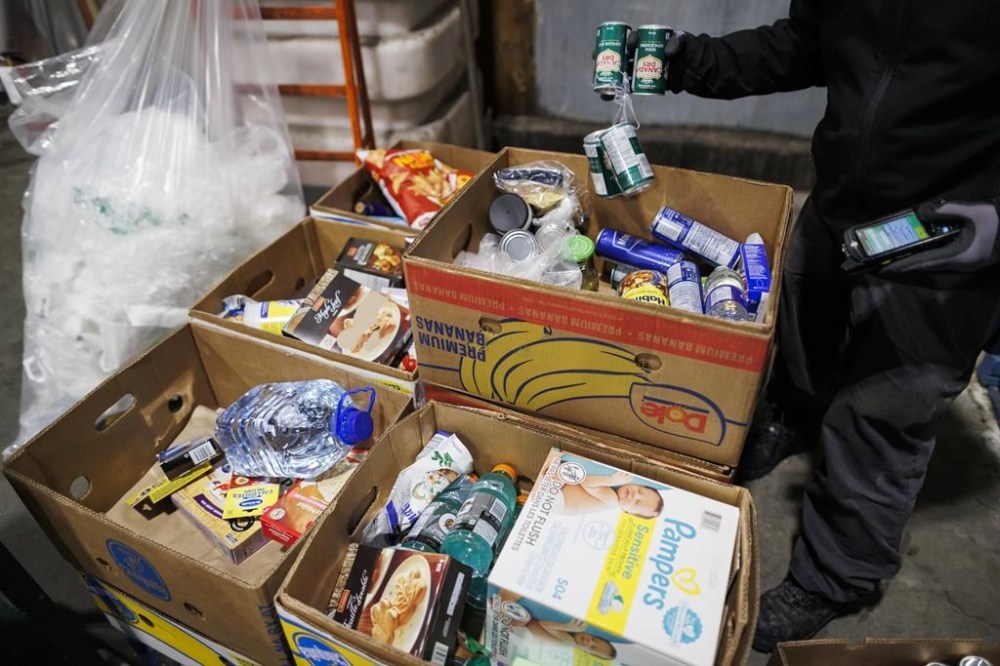
“It’s daily calls (on the floor),” said John Crisafulli, manager of the Metro location, during a walk-through with a Canadian Press reporter. All departments begin their day by scanning for items nearing expiration and picking them out, along with those with blemishes or flaws that make them undesirable.
Metro’s guidelines are straightforward. Two days ahead of their best-before dates, packaged items are discounted at 30 per cent. If still unsold the night before, an employee pulls the items off the shelf and freezes them in the backroom storage for donations to local food banks.
Some of those products are also sold on food-rescue apps such as Too Good To Go, said Dave Dinning, senior director of operations at Metro in Ontario.
But the shelf life of fresh produce is harder to determine and left to the employees’ discretion.
Take the apples, for example. Crisafulli examined the honeycrisps, galas and Granny Smiths, rearranging the display and picking out misfits with blemishes, bruises or holes. He then placed less appealing picks in a bag, marked it at $2 and re-shelved it in the discount section. Later, fresher apples replenished the selection. Finally, unsold quantities become fodder for animals.
At Metro, this process happens several times a day.
There are three things you can do with unsold food — discount, dispose or donate, said John Lowrey, an assistant professor at Northeastern University’s D’Amore-McKim School of Business who studies food waste and retail donations. Deciding a fresh item’s fate can be labour-intensive, he added.
“It requires the employee to first inspect the product, and move (it) to another part of the store,” Lowrey said in an interview. And if it doesn’t sell, it gets re-inspected before being thrown away.
Donations can be more efficient.
Food retailers often donate food to avoid waste management costs and fees for landfills, Lowrey said. They may also qualify for tax incentives.
“Because when you are faced with leftover food, you can either pay a per-pound pickup fee to waste management companies … or remove it for free and donate it to the food bank.”
Last year, Metro said it donated four million kilograms of food through its One More Bite program. Other Canadian grocers, including Loblaw,Sobeys and Walmart, similarly donate some of their surplus food.
Loblaw said its franchises, stores and distribution centres donated 6.7 million kilograms of food to local organizations in 2022.
Sobeys and Walmart have their own programs but didn’t respond when asked for details.
Food banks have been in a long-standing partnership with grocery retailers — major chains and local stores, said Kirstin Beardsley, CEO of Food Banks Canada.
“We rely on the support of grocery stores,” she said, as donations from food drives went down during the pandemic and haven’t recovered. Beardsley said food banks receive about 50 per cent of donations from the food industry, including retailers, manufacturers and farmers.
Donations aren’t one-size-fits-all. Edmonton’s Food Bank, for instance, receives a large amount of rescued food from its partners Loblaw, Sobeys and Walmart — including strawberries, spinach and other fresh produce.
Toronto’s Daily Bread Food Bank, meanwhile, doesn’t accept fresh produce from its partners, Metro and Food Basics, given the challenges of a tight turnaround window — and ensuring food remains healthy to eat.
Food past its best-before date is still safe to consume, despite losing its peak freshness, said Heather McLeod-Kilmurray, a law professor at the University of Ottawa, who focuses on food law.
“Grocery stores believe consumers won’t want to buy that food and won’t want to see it on the shelves,” she said. “It gives the impression that food is not safe or something that you’d want to buy. But, in fact, that’s not true.”
Food bank staff typically sort through the donations, adding an extra layer of food safety measures before redistributing.
But there might be a possibility that food donation is linked to higher store prices, Lowrey suggested.
“Food donations in a sense might be a double-edged sword,” he said.
Lowrey said, anecdotally, his study found when grocers intervene early in the product’s sellable shelf life, replacing it with fresh inventory, it makes the overall quality higher for shoppers.
“This, in turn, raises the quality of products on the shelf and average prices — which keeps prices high,” he added.

Nonetheless, Lowrey said grocers’ donation initiatives promote sustainability and help communities meet their emergency needs.
For Daily Bread, the store-level partnership with Metro banners is a lifeline.
With every pallet loaded into the back of the truck each day, one less family is going to bed hungry — and one less pallet ends its journey in a landfill.
This report by The Canadian Press was first published Feb. 16, 2024.
Companies in this story: (TSX:MRU, TSX:L, TSX:EMP-A)
Related Articles
Rise in community fridges in Atlantic Canada sign of government support falling short
Advertisement Advertise With Us
Advertisement Advertise With Us