From rooftops to honey jars, Athens is abuzz with urban beekeeping

Advertisement

Advertise with us

ATHENS, Greece (AP) — Nikos Chatzilias spends his days tending to buzzing bee colonies with a unique view out over the rooftops of Greece’s capital.

Read this article for free:


or

Already have an account? Log in here »

To continue reading, please subscribe:

Subscribe and receive a limited-edition Free Press branded hat or tote.

Digital Subscription

One year of digital access for only $205*

  • Enjoy unlimited reading on winnipegfreepress.com
  • Read the E-Edition, our digital replica newspaper
  • Access News Break, our award-winning app
  • Play interactive puzzles

*First annual payment billed as $205.00 + GST for one year. This annual subscription will automatically renew at $233.00 + GST every 52 weeks (10% off the regular annual price of $259.35). Offer available to new and qualified returning subscribers only. Cancel any time.

To continue reading, please subscribe:

Add Free Press access to your Brandon Sun subscription for only an additional

$1 for the first 4 weeks*

  • Enjoy unlimited reading on winnipegfreepress.com
  • Read the E-Edition, our digital replica newspaper
  • Access News Break, our award-winning app
  • Play interactive puzzles
Start now

*Your next Brandon Sun subscription payment will increase by $1.00 and you will be charged $17.95 plus GST for four weeks. After four weeks, your payment will increase to $24.95 plus GST every four weeks.

Hey there, time traveller!
This article was published 02/10/2025 (366 days ago), so information in it may no longer be current.

ATHENS, Greece (AP) — Nikos Chatzilias spends his days tending to buzzing bee colonies with a unique view out over the rooftops of Greece’s capital.

He is among the dozens of Athenians who have embraced urban beekeeping to support local ecosystems, reconnect with nature and enjoy honey flavored by each neighborhood’s local plants and flowers.

Chatzilias, 37, was a heavy honey consumer, eating it with bread and tea for breakfast and using it to replace sugar everywhere else, including in cookies and other sweets. He grew dissatisfied with run-of-the-mill product and decided to make his own, signing up for beekeeping classes in 2020 and becoming a professional shortly thereafter.

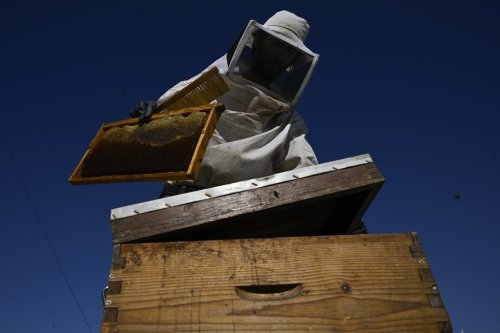
Nikos Chadjilias places a frame with honey in an empty beehive on the roof of a building in the Ilioupoli suburb of Athens, Greece, July 3, 2025. (AP Photo/Michael Varaklas)

“I saw that it worked really well for the hives. For us, the daily contact with the bees brought us a lot of joy, and that’s why we continued,” he said.

This summer, Chatzilias cared for 30 hives he placed on seven Athens-area rooftops, including one with a view of the Parthenon. The approximately 1.2 million bees in his hives produced 500 kilograms (1,100 pounds) of honey, roughly the weight of a large brown bear. Each batch was packaged and named for its neighborhood of origin.

Varying tastes of Athens honey, he explained, come from the proportion of eucalyptus, acacia and bitter orange present in different areas of the city, plus other flora. On the southern coast, for example, pine trees impart a forest-like note.

Urban beekeeping is neither new around the world nor in Athens. Decades ago, Greek families brought hives with them when they moved from the countryside. But Chatzilias sees today’s beekeeping as more intentional and focused on environmental implications, which resonates across society.

One of Chatzilias’ recent recruits, Aggelina Chatzistavrou, first fell in love with bees while she was a university student.

“I really liked the idea of having my own,” she said on her rooftop overlooking the Acropolis. “If everyone could have a hive in an open space at their home, I believe it would change our environment in a big way.”

Despite growing interest, would-be beekeepers can be stopped by objections from fellow residents of their apartment buildings. Urban beekeeping entails hauling heavy hives up staircases to the rooftops for the spring and down again before winter sets in.

“There are fears along the lines of, ‘They might sting me, my children, my dog. What if I’m allergic?’” Chatzilias said. “In general, for city people — because they have been cut off from nature for so many years — even something natural that happens (…) can provoke fear.”

Athens’ constant bloom cycles of different pollinator-friendly plants makes it an ideal setting to experiment with leaving the bees atop the rooftops all year round, which he is doing for the first time this year, he said.

“Even with a chaotic urban environment that we’ve created, nature — or whatever remains of it in the city — still responds and can give life,” Chatzilias said.

Report Error Submit a Tip

More Stories

From rooftops to honey jars, Athens is abuzz with urban beekeeping

Theodora Tongas, The Associated Press 3 minute read Preview

From rooftops to honey jars, Athens is abuzz with urban beekeeping

Theodora Tongas, The Associated Press 3 minute read Friday, Oct. 3, 2025

ATHENS, Greece (AP) — Nikos Chatzilias spends his days tending to buzzing bee colonies with a unique view out over the rooftops of Greece’s capital.

He is among the dozens of Athenians who have embraced urban beekeeping to support local ecosystems, reconnect with nature and enjoy honey flavored by each neighborhood’s local plants and flowers.

Chatzilias, 37, was a heavy honey consumer, eating it with bread and tea for breakfast and using it to replace sugar everywhere else, including in cookies and other sweets. He grew dissatisfied with run-of-the-mill product and decided to make his own, signing up for beekeeping classes in 2020 and becoming a professional shortly thereafter.

“I saw that it worked really well for the hives. For us, the daily contact with the bees brought us a lot of joy, and that’s why we continued,” he said.

Read
Friday, Oct. 3, 2025

May be whiff of truth to ex’s odour ardour

Maureen Scurfield 5 minute read 2:01 AM CDT

DEAR MISS LONELYHEARTS: I ran into an old boyfriend I used to curl on a team with, and we went for drinks. We’ve been almost eight years apart, and I couldn’t remember why we broke up, as we always had such a great time together.

It wasn’t until the second date — this time on a weekend — that it came back to me, with a jolt. Pee-yew! I remembered he doesn’t use deodorant on weekends. Why? He enjoys his own body odour. I recalled that a bit too late, and it was just as awful as ever! I went home early.

Tonight, he called and I refused him another date. I said, “Think back. You remember why we broke up?” Then he said, “Oh yeah, you hated my no-deodorant weekend policy. Well, guess what? Some women don’t mind!” I said I really doubted that, and that ended the conversation. Miss L., wouldn’t any women find stinky underarms offensive?

— Sensitive Nose, Fort Richmond

Clock ticks down on destruction of records documenting residential school abuses

Marsha McLeod 13 minute read Preview

Clock ticks down on destruction of records documenting residential school abuses

Marsha McLeod 13 minute read Yesterday at 12:49 PM CDT

In less than a year, a private company is set to destroy the largest cache of records detailing the widespread abuse of Indigenous children at residential schools in Canada.

The destruction, which was ordered by an Ontario court in 2014 and later upheld by the Supreme Court, is set to take place on Sept. 19, 2027.

This countdown is igniting emotional conversations that seek to balance the immense historical value of the records alongside the confidentiality survivors were promised as part of the process of providing detailed testimony about abuses they’d suffered.

The records were created as part of the Indian Residential Schools Settlement Agreement, a class-action settlement stemming from survivors who began suing the federal government in the late 1990s over the harm they’d been subjected to at residential schools.

Read
Yesterday at 12:49 PM CDT

Mayoral candidate Vogiatzakis criticized for living outside Winnipeg

Malak Abas 4 minute read Preview

Mayoral candidate Vogiatzakis criticized for living outside Winnipeg

Malak Abas 4 minute read Updated: Yesterday at 6:03 PM CDT

A mayoral hopeful took heat from other candidates Friday for living outside Winnipeg while running in the civic election.

Mike Vogiatzakis’s primary residence is in the Rural Municipality of St. Andrews, about 25 kilometres north of Winnipeg — a community with its own mayor and councillors.

But the funeral director said he owns a home in Winnipeg where he divides his time, and he would move to the city full-time if elected mayor.

“It doesn’t matter where a person lives. Why are we dividing St. Andrews and Manitoba and Winnipeg? I’ve met the criteria to run for mayor,” Vogiatzakis said Friday morning.

Read
Updated: Yesterday at 6:03 PM CDT

Jets bench boss Arniel talks rebuilding from last season’s struggles

Mike McIntyre and Ken Wiebe 12 minute read Preview

Jets bench boss Arniel talks rebuilding from last season’s struggles

Mike McIntyre and Ken Wiebe 12 minute read Thursday, Oct. 1, 2026

Scott Arniel has a lot on his plate these days.

But the head coach of the Winnipeg Jets took some time Thursday to sit down with Free Press hockey writers Mike McIntyre and Ken Wiebe to discuss a number of topics on the eve of a new hockey season. This interview has been condensed and edited for clarity.

Wiebe: What was the evaluation of last season like? What did you personally do in an attempt to improve after going from first-overall to 26th-overall?

I just went back and looked at things and made sure my communication was where it needed to be with my players. Was my communication where it needed to be with my boss, with my general manager (Kevin Cheveldayoff)? How our coaching staff worked. How we handled highs and lows. Things I felt I could have done better.

Read
Thursday, Oct. 1, 2026

Six high school hockey programs ceased operations following new Hockey Manitoba policy

Joshua Frey-Sam 7 minute read Preview

Six high school hockey programs ceased operations following new Hockey Manitoba policy

Joshua Frey-Sam 7 minute read Updated: Yesterday at 8:19 PM CDT

She lived the best of both worlds.

For the last three years, the 17-year-old wore a sweater for two different hockey programs — her high school team and AAA club in the Manitoba Female Hockey League — and was preparing to flourish in both colours again this winter.

Recently, however, the blue-liner was disappointed to learn she is no longer eligible to play her Grade 12 season with her school owing to a new policy imposed by Hockey Manitoba that bans players from participating in the Manitoba Women’s High School Hockey League if they are rostered on a U18 AAA team.

The rule applies to all athletes who play for both Winnipeg-based and rural AAA teams.

Read
Updated: Yesterday at 8:19 PM CDT