Interprovincial trade barriers falling but challenges remain: experts

Advertisement

Advertise with us

The collapse of talks with the United States has added urgency to reducing trade barriers within Canada, but experts say it's not a simple fix.

Read this article for free:


or

Already have an account? Log in here »

To continue reading, please subscribe:

Subscribe and receive a limited-edition Free Press branded hat or tote.

Digital Subscription

One year of digital access for only $205*

  • Enjoy unlimited reading on winnipegfreepress.com
  • Read the E-Edition, our digital replica newspaper
  • Access News Break, our award-winning app
  • Play interactive puzzles

*First annual payment billed as $205.00 + GST for one year. This annual subscription will automatically renew at $233.00 + GST every 52 weeks (10% off the regular annual price of $259.35). Offer available to new and qualified returning subscribers only. Cancel any time.

To continue reading, please subscribe:

Add Free Press access to your Brandon Sun subscription for only an additional

$1 for the first 4 weeks*

  • Enjoy unlimited reading on winnipegfreepress.com
  • Read the E-Edition, our digital replica newspaper
  • Access News Break, our award-winning app
  • Play interactive puzzles
Start now

*Your next Brandon Sun subscription payment will increase by $1.00 and you will be charged $17.95 plus GST for four weeks. After four weeks, your payment will increase to $24.95 plus GST every four weeks.

The collapse of talks with the United States has added urgency to reducing trade barriers within Canada, but experts say it’s not a simple fix.

Efforts to boost interprovincial trade have ramped up recently, including at a meeting this week of federal, provincial and territorial trade officials in Iqaluit.

In a communique released late Thursday, ministers agreed that the suspension of negotiations with the U.S. means it’s more critical than ever to strengthen the economy at home.
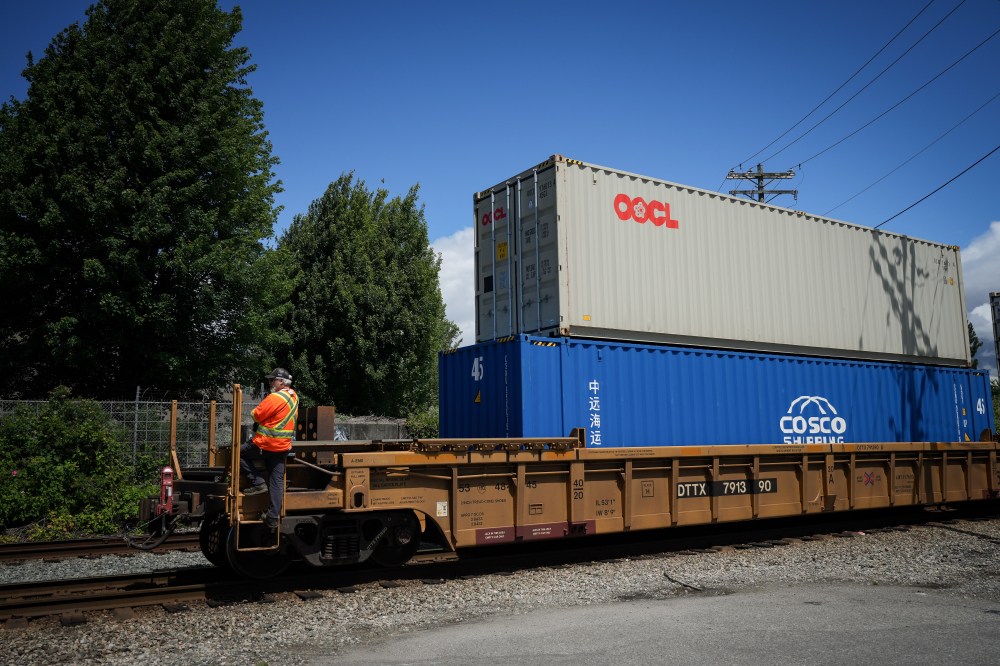
A worker rides on the outside of a rail well car as a CN Rail train moves containers from port, in Vancouver, on Wednesday, June 10, 2026. THE CANADIAN PRESS/Darryl Dyck

As part of that push, nine provinces agreed last month to allow direct-to-consumer alcohol sales across provincial boundaries.

But even this kind of progress, dealing with a niche side of the booze industry, shows the challenges of opening up sales. Some provinces have added on extra charges and rules, on top of what producers face in their home province.

“Having to pay two wholesale markups — that’s just lunacy,” said Jeff Guignard, chief executive officer of Wine Growers British Columbia.

Forcing B.C. wineries to also register in other provinces, just to mail wine there, also goes against the push to open up trade within Canada, he said.

“It’s just noise, right, and bureaucratic nonsense that doesn’t need to happen,” said Guignard.

“For too long we’ve treated every province as though it’s a completely different economy, which it is not.

“We’re talking about one Canadian economy.”

The potential benefits of simplifying domestic trade are substantial.

The International Monetary Fund estimates that removing internal trade barriers could boost Canada’s real gross domestic product upwards of seven per cent, or about $210 billion, over the long term.

CIBC put out a less optimistic figure in March of a potential one per cent boost to the GDP but noted that it would still be helpful and very much worth pursuing.

The meeting in Iqaluit saw ministers agree to accelerate efforts on creating a common Canadian market and supporting labour mobility, including aiming to have model legislation by the end of this fall. They’ve set Oct. 2 to meet again.

Priorities at the meeting also included working toward an agreement on a freer flow of services across the country by the end of the year, harmonizing the approval process for prefabricated homes and new building materials, and making it easier to trade food in Canada.

The renewed push on removing provincial barriers is welcome, said Corinne Pohlmann, executive vice-president of advocacy at the Canadian Federation of Independent Businesses.

“It had felt in the last six months that they took their foot off the pedal a little bit,” she said.

Pohlmann said important progress has been made, such as the agreement by provinces to recognize the standards of other provinces when it comes to goods.

The deal came into force in June, but making sure it’s actually working is another matter, she said.

“Unfortunately, it now gets into more of the nitty-gritty detail side of things, and actually looking at how each province is actually operating on the ground.”

The layers of rules mean that someone can buy a ladder or chainsaw from another province but not necessarily be able to use it on a job site, she said.

“If we’re really going to take it seriously to become one economy across the country, we really have to start looking at some of these things more closely.”

Looking closely is what University of Ottawa professor Wolfgang Alschner is trying to do.

Alschner, who is the Hyman Soloway Chair in Business and Trade Law at the university, is using artificial intelligence to catalogue regulations across Canada and find where there’s unnecessary divergence.

Part of the problem is many of these rules have been in place for ages and, even if antiquated, no one’s been forced to deal with them, he said.

Public toilet seats are an example, he said. Ontario is the only province that requires a U-shaped seat. It’s a rule that aligns with U.S. industry standards, limiting trade options with other suppliers.

“Even though it’s sort of a ridiculous example, it just shows you how through vested interest, and through sort of locked-in trade relationships, we’re actually not trading enough with the rest of the world.”

To find other hidden barriers to trade, Alschner is working to assemble the 17,000-or-so regulatory texts in Canada, each of which has multiple thousands of sections, to substitute a very anecdote-based approach with something more systematic.

“We are talking about really an immense maze of regulatory material,” said Alschner.

While provinces have made progress on recognizing each other’s regulations, it would be better to just have one set of rules, he said.

“It matters, because ultimately we care not only about cutting red tape on paper, but actually facilitating more trade in real life, right?”

This report by The Canadian Press was first published Aug. 28, 2026.

Report Error Submit a Tip

More Stories

Manitoba e-scooter legislation changes set to impose speed limit, age restrictions, sidewalk ban

Matthew Frank 5 minute read Preview

Manitoba e-scooter legislation changes set to impose speed limit, age restrictions, sidewalk ban

Matthew Frank 5 minute read Updated: Yesterday at 11:26 AM CDT

People riding e-scooters and other personal electric vehicles in Manitoba will have to strap on a helmet, stay off sidewalks and follow new age limits once new provincial rules for the devices take effect next year.

The vehicles, which also include electric skateboards, hoverboards and unicycles, will fall under The Highway Traffic Act starting in 2027, according to the province’s website. E-bikes are excluded from the new rules, according to the province’s frequently-asked-questions page.

All riders must be at least 16 years old and wear properly fitting helmets — that goes for passengers, too, the province said.

The proposed new legislation sets a speed limit of 25 km/h and would prohibit personal electric vehicles from sidewalks unless signs specifically allow sidewalk use. Riders would be using shared paths or roads with speed limits of 50 km/hr or less. They won’t be allowed to operate the vehicles under the influence of alcohol or drugs and they must use hand signals and obey traffic signs.

Read
Updated: Yesterday at 11:26 AM CDT

Crime-weary North End daycare declines cabinet minister’s offer to help with relocation

Matthew Frank 5 minute read Preview

Crime-weary North End daycare declines cabinet minister’s offer to help with relocation

Matthew Frank 5 minute read 6:13 PM CDT

Manitoba’s minister for early childhood learning offered to help a North End daycare move to a new location after it suffered a break-in, thefts and repeated vandalism in recent months, but the centre says it is staying put.

Gerrie Prymak, a board member for non-profit Woman Healing For Change Inc, which operates the Little Stars Playhouse daycare, said Minister Tracy Schmidt made the offer by phone Wednesday morning after media reports highlighted the incidents.

She said she was baffled by the minister’s offer because the centre’s location on Selkirk Avenue was selected after extensive research was done to find the best spot for the community’s needs.

“We built this place. Why do we have to move? Why can’t you get rid of those derelict buildings behind us?” Prymak said.

Read
6:13 PM CDT

Developer ‘anxiously’ awaits judge’s decision on Granite Curling Club construction

Joyanne Pursaga 4 minute read Preview

Developer ‘anxiously’ awaits judge’s decision on Granite Curling Club construction

Joyanne Pursaga 4 minute read Yesterday at 6:19 PM CDT

The developer of a hotly debated project that would add 110 housing units to the Granite Curling Club’s parking lot has begun investigative work at the site while awaiting a judge’s decision on construction.

While some digging took place at the city-owned property last week, its developer said construction has yet to begin.

“I would call (the digging so far) investigative site work. It’s not preparing in any way for construction, other than to ensure that the reports that are required for any site have been completed,” said Jeremy Read, chief executive officer of UWCRC 2.0 Inc.

A heritage resources impact assessment will determine if the site has archeological significance. That work will check for everything from fossils to unmarked graves, said Read.

Read
Yesterday at 6:19 PM CDT

Riding the Unity Bus to rally support for Canada in Alberta

Melissa Martin 8 minute read Preview

Riding the Unity Bus to rally support for Canada in Alberta

Melissa Martin 8 minute read Monday, Oct. 12, 2026

It’s a chilly Thanksgiving Monday morning on the eastern edge of Alberta. A sharp wind nips at exposed skin and drab grey clouds hang low in the sky. Such weather does not encourage high spirits, but Unity Bus volunteers can’t afford to let theirs falter: in just one week, on Oct. 19, Albertans will vote on a historic question on whether to remain in Canada.

Read
Monday, Oct. 12, 2026

Ontario to move northwest regions to permanent daylight time

Liam Casey, The Canadian Press 3 minute read Preview

Ontario to move northwest regions to permanent daylight time

Liam Casey, The Canadian Press 3 minute read Updated: Yesterday at 11:29 AM CDT

TORONTO - Ontario is set to move parts of the province's northwest region to permanent daylight time in order to align with Manitoba, Indigenous Affairs Minister Greg Rickford told The Canadian Press.

Rickford said there is overwhelming consensus among municipalities, First Nations and businesses to make the time change permanent.

The province intends to make a regulatory change in the Time Act on Nov. 1 to allow regions west of the 90th meridian to align with Manitoba, he said.

Manitoba Premier Wab Kinew announced last month the province would stop twice-annual clock changes and stay on daylight time year-round in the central time zone, leaving it one hour ahead of the other Prairie provinces rather than aligned with them.

Read
Updated: Yesterday at 11:29 AM CDT

Chief says minister offered money to remove highway checkstop

Kelly-Anne Riess 5 minute read Preview

Chief says minister offered money to remove highway checkstop

Kelly-Anne Riess 5 minute read 5:53 PM CDT

The chief of the Bloodvein River First Nation says a Manitoba cabinet minister offered up to $250,000 for economic development as he was trying to persuade her to remove a highway checkstop that has outraged hunters.

Chief Lisa Young said Ian Bushie, the minister of Indigenous futures, raised the money in a private conversation in September, also telling her the First Nation would receive a letter directing it to move the checkstop because it’s on a provincial highway.

Young said Bushie described the money as support for economic development in the community.

“I really felt like I was being pushed into a corner. I also felt that I was being bribed,” Young said in an interview. “It may not have come off that way. But he even further said, ‘And I’m not bribing you.’ So, I really didn’t know what to say.”

Read
5:53 PM CDT