Entrepreneur with Asperger’s peddling cheaper electric bike
Advertisement
Read this article for free:
or
Already have an account? Log in here »
To continue reading, please subscribe:

Digital Subscription
One year of digital access for only $205*
- Enjoy unlimited reading on winnipegfreepress.com
- Read the E-Edition, our digital replica newspaper
- Access News Break, our award-winning app
- Play interactive puzzles
*First annual payment billed as $205.00 + GST for one year. This annual subscription will automatically renew at $233.00 + GST every 52 weeks (10% off the regular annual price of $259.35). Offer available to new and qualified returning subscribers only. Cancel any time.
To continue reading, please subscribe:
Add Free Press access to your Brandon Sun subscription for only an additional
$1 for the first 4 weeks*
- Enjoy unlimited reading on winnipegfreepress.com
- Read the E-Edition, our digital replica newspaper
- Access News Break, our award-winning app
- Play interactive puzzles
*Your next Brandon Sun subscription payment will increase by $1.00 and you will be charged $17.95 plus GST for four weeks. After four weeks, your payment will increase to $24.95 plus GST every four weeks.
Read unlimited articles for free today:
or
Already have an account? Log in here »
Hey there, time traveller!
This article was published 08/03/2015 (4207 days ago), so information in it may no longer be current.
MALIBU, Calif. — Storm Sonders has a house in Malibu, a daily surfing routine and one of the hottest crowdfunding campaigns on the Internet.
The veteran entrepreneur has raised more than US$3.6 million to build an affordable electric bicycle — after starting Feb. 1 with a goal of just US$75,000.
But while entertaining visitors in his ocean-front living room one recent day, Sonders stared at the sea and fidgeted nervously.
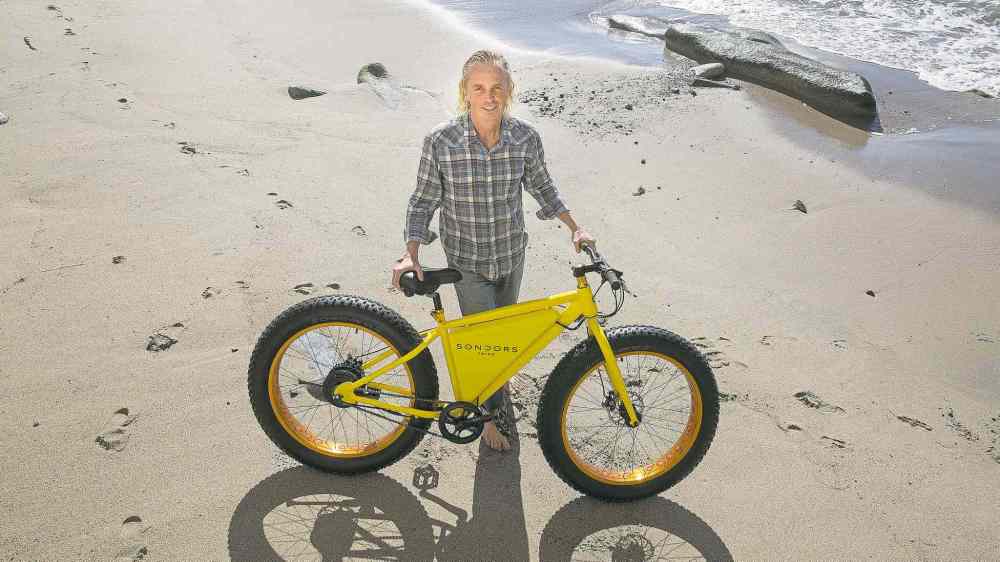
“It’s the Asperger’s,” he said. “I’m just really not comfortable talking about myself.”
Sonders, with his surfer tan and blond ponytail, was 38 when a therapist first identified his condition three years ago. Growing up in Latvia, he said, his parents recognized something strange and special about him before he turned three.
The eccentricity expressed itself in isolation and creativity. Sonders had difficulty going to school and playing with other children. Withdrawing, he became obsessed with woodworking, finished high school at 14 and went to art school as a sculptor.
By his early 20s, he was living in Chicago, building wooden models for toys — for Mattel, Fisher-Price and even McDonald’s Happy Meals. Soon he was running his own toy company, wholesaling radio-controlled cars, planes and helicopters to retail partners such as Wal-Mart, Kmart and Target.
The business success did not bring him happiness.
“I was miserable,” he said, running his long, delicate fingers through his hair. “I had a lot of anxiety being around people. I couldn’t make eye contact. I always felt like I just didn’t belong.”
A girlfriend finally insisted he seek help, after a series of “tantrums” — what Sonders calls “a Level-10 response to Level-2 stimulus.”
It took the therapist less than 30 minutes to make the diagnosis.
Sonders had seen other therapists. He had taken antidepressants. No one had ever mentioned Asperger’s syndrome.
But longtime friends were not entirely surprised at the assessment.
“He was always very driven — like a freight train,” said Todd Hannon, who has known and worked with Sonders for more than 20 years.
“There was some odd behaviour. He’d just suddenly walk out of a room. He’d blurt things out. People would say, ‘That guy is way too intense.’ “
Asperger’s — which was declassified as its own diagnosis in 2013 and is now considered a mild form of autism — typically includes difficulties with communication and social interaction, often paired with intense or repetitive behaviours.
It commonly goes undiagnosed until adulthood, particularly in high-functioning or creative people — especially those Sonders’ age or older, said Dr. Susan Bookheimer, an autism expert who is director of the Intellectual and Developmental Disabilities Research Center at UCLA.
“People called them quirky or geeky or nerdy or awkward,” Bookheimer said. “And if someone is bright and verbal, they might go undiagnosed entirely.”
For Sonders, the diagnosis was a liberation.
“It was such a relief,” he said. “As a designer, it was important for me to understand the process. I started reading textbooks, and I was like, ‘Hey! You stole my life story!’ But I also realized it could change my life 100 per cent.”
Therapy followed. Sonders practised making eye contact and listening to questions, gradually learning how to be comfortable around other people.
That made the electric-bike campaign possible, he said.
“Otherwise,” he said, gesturing at the visitors in his home, “I could never do this. I couldn’t have people in my house asking questions. I like to be in the background. I don’t want anyone to know who I am.”
Jonathan Chaupin of Agency 2.0, Sonders’ fundraising campaign partner, said the company has already sold 6,000 units of the Sonders eBike — all through the Internet, on the strength of a prototype and a series of public test rides — to become the third-most-successful campaign in Indiegogo’s five-year history.
Under the terms of the online crowdfunding campaign, participants could make a “Reserve Now, Pay Later” investment, or reserve a bike with a whole payment.
Most chose the latter, Sonders said. The first investors committed US$499 for one of the brightly coloured, fat-tired beach cruisers. Later investors were asked to pay US$599 for a bike.
Either way, that’s far less than the cost of most electric bikes, which often sell for US$2,500 or more, and less than half of the post-campaign price for the Sonders eBike, which will cost US$1,299, plus a fee of about US$200 for shipping.
The bike project began organically. Sonders, who had sold his toy company and was spending his days surfing and paddle-boarding, got interested in electric bikes after being sidelined with a knee injury. Last summer, he saw a friend’s fat-tired electric bike and loved it.
But it retailed at US$4,000 — far more than Sonders was willing to pay for a bicycle, electric or otherwise.
So he designed a bike stripped of everything but the essentials — a frame, a single pedal gear, brakes and a battery — and made production deals with manufacturing contacts in Taiwan and China.
The resulting two-wheeler weighs 22.5 kilograms, can go 32 km/h and travel up to 80 kilometres between charges.
The bicycles are assembled in the Chinese manufacturing city of Shenzhen. The first units will be shipped in May, Sonders said, with deliveries to the people who contributed to the Indiegogo campaign continuing through the summer.
The eBike has forced Sonders into the public eye, which he resisted.
“He didn’t want to be in the spotlight,” said Christopher Olenik, Agency 2.0 founder and chief executive. “But now he has to talk to people.”
Sonders agreed, calling the campaign “my coming-out situation.”
As part of the process, not long after the diagnosis, Sonders told his parents what the therapist had determined. His father was stunned. His mother wept.
“She felt if they would have known, it would have been easier for everyone,” Sonders said, “because it wasn’t an easy gig — to have a child like me.”
The diagnosis and the therapy didn’t eliminate Sonders’ autism. (“It’s a daily work,” he said. “You have to try. You have to stay present.”) He still prefers to surf alone and, though he owns a Dodge Durango, finds driving in traffic extremely stressful.
“For someone with Asperger’s,” he says, “there’s a lot going on.”
But freed from a lifetime of struggling to explain his quirkiness — to himself, and to friends and girlfriends — Sonders now wonders whether sharing his experience might help others in his situation.
Bookheimer believes it will. Her most common new patients, she said, are self-referred adults who have heard or read something about Asperger’s or autism.
“‘I know there’s something wrong with me, but I don’t know what it is,'” she said they tell her. Almost all of them, she added, are somewhere on the autism spectrum.
“For people who have felt awkward and different all of their lives, to have a label, and to know they’re not alone, can be really life-changing,” Bookheimer said.
That knowledge allowed Sonders, for the first time, to interact comfortably with strangers. He now regularly engages with customers who want test drives of his new eBike.
“It was like I was born again,” he said. “I am no longer living in a jail of my own thoughts.”
— Los Angeles Times