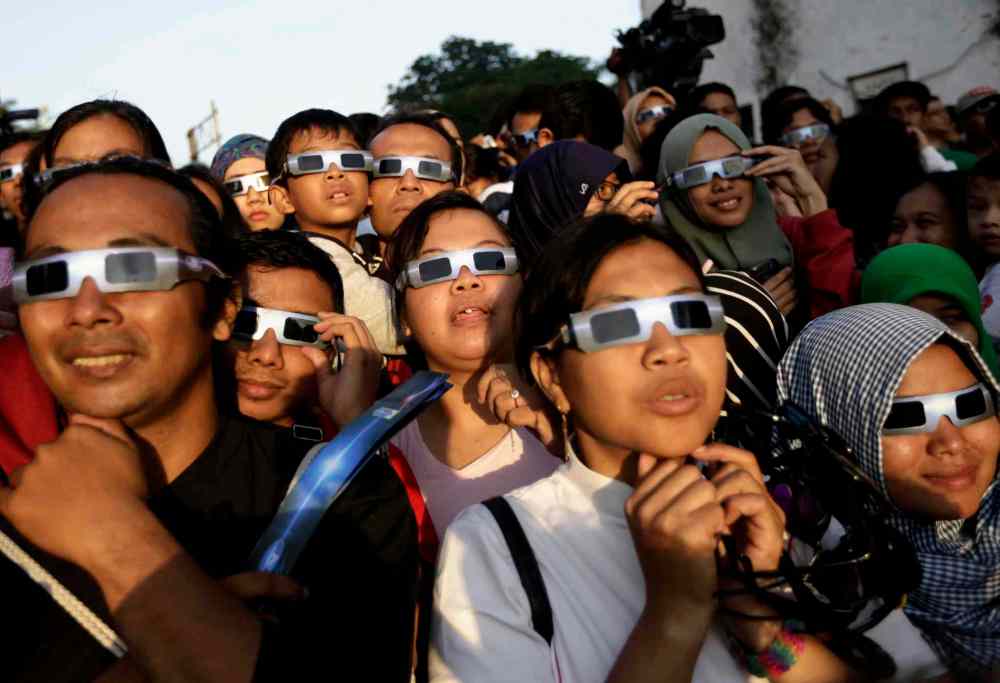
All eyes on the skies
Past comes to light as North America preps for once-in-a-lifetime solar eclipse
Advertisement
Read this article for free:
or
Already have an account? Log in here »
To continue reading, please subscribe:

Digital Subscription
One year of digital access for only $205*
- Enjoy unlimited reading on winnipegfreepress.com
- Read the E-Edition, our digital replica newspaper
- Access News Break, our award-winning app
- Play interactive puzzles
*First annual payment billed as $205.00 + GST for one year. This annual subscription will automatically renew at $233.00 + GST every 52 weeks (10% off the regular annual price of $259.35). Offer available to new and qualified returning subscribers only. Cancel any time.
To continue reading, please subscribe:
Add Free Press access to your Brandon Sun subscription for only an additional
$1 for the first 4 weeks*
- Enjoy unlimited reading on winnipegfreepress.com
- Read the E-Edition, our digital replica newspaper
- Access News Break, our award-winning app
- Play interactive puzzles
*Your next Brandon Sun subscription payment will increase by $1.00 and you will be charged $17.95 plus GST for four weeks. After four weeks, your payment will increase to $24.95 plus GST every four weeks.
Read unlimited articles for free today:
or
Already have an account? Log in here »
Hey there, time traveller!
This article was published 18/08/2017 (3268 days ago), so information in it may no longer be current.
As celestial events go, this one is shaping up as a really big deal.
According to online news reports, one astronomer has already predicted it will be the “most photographed, most shared, most tweeted event in human history.”
Unless you’ve been hiding in a cave, you will know on Monday a dark shadow will sweep over much of North America as millions of people are treated to a once-in-a-lifetime solar eclipse.
A solar eclipse occurs when the moon passes between the sun and the Earth, casting a shadow onto the Earth and literally turning day into night in affected areas.
In the United States, it’s billed as “the Great American Eclipse,” as it will be the first total solar eclipse — when the moon entirely covers the sun — to race over the entire country, from coast to coast, since 1918.
To experience the so-called “totality,” you must be within a 110-kilometre-wide swath created by the moon’s shadow that will travel from northwest to southeast across the U.S., starting in Oregon around 10:15 a.m. local time and ending in South Carolina about an hour-and-a-half later.
Sadly, Canadians won’t be able to see the total eclipse because we’re too far north.
In Winnipeg, sky-watchers will be able to see roughly 70 per cent of the sun covered by the moon in an event that will begin here at 11:40 a.m. and end about two hours, 36 minutes later.
But you already knew that, didn’t you, stargazers? Well, in honour of Monday’s big show, here’s the Top Five Things You Didn’t Know About Solar Eclipses:
5) Earthlings have the best view
It has been said Earth is the only planet in our solar system from which you can witness a perfect total solar eclipse. Sadly, whoever said that was wrong, but what is true is Earth is almost perfectly situated for enjoying an eclipse. This is because while the sun is 400 times the diameter of Earth’s moon, it’s also 400 times farther away, meaning both bodies appear to be the same size in the sky, and the moon is able to completely cover the sun.
“If the moon were closer, it would block out both the sun and its corona; farther away and it would not cover the sun completely,” exploratorium.edu points out.
Total solar eclipses can happen on other planets, provided they have moons big enough to obliterate the sun’s disk and orbit the planet on the same plane as the sun. “To get a solar eclipse, the first thing you need is a moon,” Christa Van Laerhoven, a post-doctoral fellow of astronomy at the University of British Columbia, told LiveScience.com. “This immediately rules out solar eclipses on Mercury or Venus (two planets without moons).”
Mars has two moons, but both are too small to create total eclipses that would be visible on the Red Planet. In contrast, the famed gas giants — Jupiter, Saturn, Uranus and Neptune — have large enough moons to do the job, but astronomers note it would be impossible to stand on the surface and enjoy the sight.
So, yes, if you had a magical spaceship, you could visit Jupiter, which has up to 67 moons, and enjoy a total solar eclipse. As for the dwarf planets, such as Pluto, Van Laerhoven said: “Charon (Pluto’s largest moon) is large enough and close enough to Pluto to produce total solar eclipses,” but because the same side of Pluto and Charon always face each other, only one side of the planet can experience an eclipse. But enjoy it while you can, earthlings, because our moon is slowly moving away from the planet, meaning it will be too small to completely cover the sun in the distant future.
4) Solar eclipses have groupies
Like fans of famous rock bands, some eclipse junkies lose their minds over the prospect of watching the sun blocked by the moon.
According to BuzzFeed News, so-called “eclipse chasers” and professional astronomers started booking travel and reserving lodging years in advance of Monday’s spectacle.
Here’s what David Baron, author of American Eclipse: A Nation’s Epic Race to Catch the Shadow of the Moon and Win the Glory of the World, told the website: “Experiencing a total solar eclipse is the closest most of us will ever get to space travel. During totality, the Earth’s blue sky draws back like a receding curtain, revealing what’s above our heads but unseen at any other time: the inner reaches of our solar system… It’s as if you are standing on some distant world, looking back at creation.” CBS reports a special Amtrak train taking passengers along the route of Monday’s eclipse sold out in less than a day, with the 409-passenger express travelling to Carbondale, Ill., from Chicago’s Union Station.
The Associated Press, which rarely kids around, notes “eclipse chasers” are giddy about Monday’s event, including Utah sky-watcher Patrick Wiggins, who has collected souvenir T-shirts at five eclipses around the world. “An eclipse-o-maniac, they call it,” Wiggins told the AP. “It gets in your blood, and the next thing you know you’re spending way more money than you probably should. And you’re going to far-flung places on the planet.”
At least one Winnipeg couple knows exactly what he’s talking about. According to CTV Winnipeg, Jay and Judy Anderson are heading to Wyoming. “This one coming up will be our 30th eclipse,” Jay told CTV. “So, 29 of them outside of Winnipeg. When you see the eclipse… you suddenly feel connected with the solar system.” Chimed in Judy: “It’s so beautiful. The light gets silvery and kind of liquid… Honestly, there is nothing like it!”
But eclipses can also break hearts. A host of online sites note distinguished astronomer, Prof. J.W. Campbell of the University of Alberta, travelled the world for 50 years trying to see 12 different eclipses. “He ran into overcast skies every time,” the website of Discover magazine notes.
3) Animals are people, too
You might want to keep a close eye on your pets during the solar eclipse, because scientists say humans aren’t the only ones expected to act a little weird.
There’s not a lot of research on the matter, but what there is suggests animals react to a total solar eclipse much the way they do when night falls. For instance, bees and ants reportedly return to their nests and daytime birds return to their roosts in preparation to sleep, whereas nocturnal birds become noisy and active and bats start flying and hunting. Even cows stop grazing, because they prefer to munch during daylight hours.
“During a total eclipse, the sky darkens to twilight levels and air temperatures drop,” notes National Geographic magazine’s website. “Over the centuries, people who have witnessed these effects have also noted that a variety of animals seem to change their behaviours in response.” When a total eclipse turned day into night on June 3, 1239, the magazine notes, Italian monk Ristoro d’Arezzo wrote “all the animals and birds were terrified; and the wild beasts could easily be caught.”
More recently, according to National Geographic, eclipse chaser Dave Balch was in Kona, Hawaii, for the 1991 total eclipse and noticed odd bird activity as the sun vanished. “We could hardly hear each other talk!” Balch said. “Then came totality — not a sound. It was deathly quiet.”
During Monday’s eclipse, the California Academy of Sciences is asking citizen-scientists to record observations of animal behaviour as part of its Life Responds project using its free iNaturalist app. “Basically, they are looking to collect behavioural observations of animals (and plants) from the largest geographic area ever covered by observers during any solar eclipse so far,” Forbes magazine’s website notes. Adds NASA on its website: “You can explore this yourself with your own pets, or by watching local wildlife, especially birds.” So you don’t have to be human to howl at the moon.
2) The eclipse that ended a war
It seems the world might be a more peaceful place if there were solar eclipses on a more regular basis. We base that statement on the surprising historical fact that, on May 28, 585 BC, a solar eclipse ended a six-year war.
The forces of King Alyattes of Lydia were at war with soldiers of King Cyaxares of Media. They’d been going at it hammer and tongs for six years and neither side was prevailing, online history sites note.
“Their war was particularly bitter because a group of hunters working for the Medes had killed one of Cyaxares’s sons and served him up as a meal (yikes). This fight was personal,” notes MentalFloss.com. Just before the eclipse May 28, the two sides were going at it near the Halys River in what is now central Turkey, historical reports state.
“Suddenly, the skies darkened and the sun was obliterated,” explains history.com. “Stunned, both armies lay down their weapons. With that, the battle — and the war — was over, thanks to an astronomical intervention. The kings of Cilicia and Babylon helped negotiate a treaty between the enemies.”
It seems the warring armies viewed the eclipse as an omen indicating it was time to stop fighting, so they lay down their weapons, called a truce and sealed the peace with a royal wedding between Alyattes’s daughter and a living son of Cyaxares.
While it wasn’t the first solar eclipse in history, it is believed to have been the first that was predicted in advance. The famed Greek historian Herodotus wrote the philosopher Thales of Miletus somehow predicted the eclipse would occur when the Medians and Lydians were at war. No one knows whether this is true, but it makes a great story. And if think otherwise, maybe it’s time to put up your dukes.
1) An eclipse revealed the universe
In terms of its impact on modern history and scientific thought, few events have been as significant as the solar eclipse that occurred on May 29, 1919, an astronomical event frequently referred to as “Einstein’s Eclipse.”
The eclipse — more than six minutes of darkness along a path that stretched from South America to Africa — confirmed Einstein as the genius we know him to be, and forever altered the way humans look at their universe.
British astronomer Arthur Eddington was in Africa to photograph the eclipse, photos that proved light rays from distant stars had been wrenched off their paths by the gravitational pull of the sun. According to the New York Times, Eddington’s work affirmed the prediction of Einstein’s theory of general relativity, ascribing gravity to a warp in the geometry of space-time, that gravity could bend the light beams.
“According to Einstein’s final version of the theory, completed in 1915, as their light rays curved around the sun during an eclipse, stars just grazing the sun should appear deflected from their normal positions by an angle of about 1.75 second of an arc, about a thousandth of the width of a full moon,” Dennis Overbye wrote in the Times last month.
“Eddington’s report made Einstein one of the first celebrities of the new 20th century and ushered in a new dynamic universe, a world in which space and time could jiggle, grow, warp, shrink, rip, collapse into black holes and even disappear. The ramifications of his theory are still unfolding; it was only two years ago that a rippling of space-time — gravitational waves produced by colliding black holes — was discovered.”
You could say — and we’re just about to do it — the historic 1919 eclipse threw the world into darkness, and brought light at the same time.
* * *
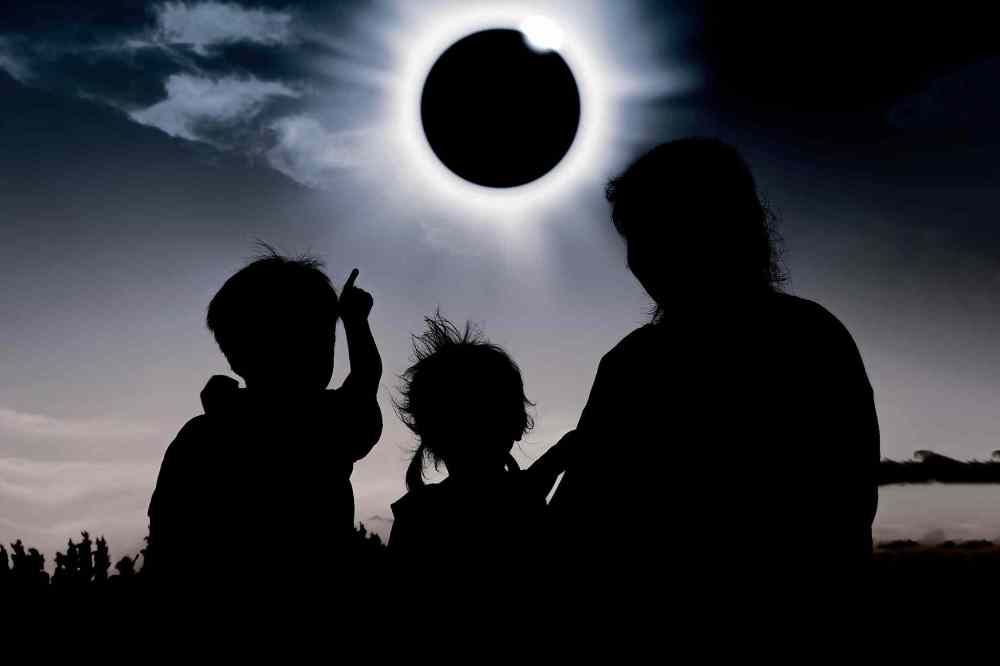
Before we leave you, here’s an important safety reminder: do not look directly at the sun during the eclipse. You need special protective eyewear to do that. It’s something your pets know intuitively, by the way.
doug.speirs@freepress.mb.ca