

Measure twice… and try not to hurt yourself

Advertisement
Read this article for free:
or
Already have an account? Log in here »
To continue reading, please subscribe:

Digital Subscription
One year of digital access for only $205*
- Enjoy unlimited reading on winnipegfreepress.com
- Read the E-Edition, our digital replica newspaper
- Access News Break, our award-winning app
- Play interactive puzzles
*First annual payment billed as $205.00 + GST for one year. This annual subscription will automatically renew at $233.00 + GST every 52 weeks (10% off the regular annual price of $259.35). Offer available to new and qualified returning subscribers only. Cancel any time.
To continue reading, please subscribe:
Add Free Press access to your Brandon Sun subscription for only an additional
$1 for the first 4 weeks*
- Enjoy unlimited reading on winnipegfreepress.com
- Read the E-Edition, our digital replica newspaper
- Access News Break, our award-winning app
- Play interactive puzzles
*Your next Brandon Sun subscription payment will increase by $1.00 and you will be charged $17.95 plus GST for four weeks. After four weeks, your payment will increase to $24.95 plus GST every four weeks.
Read unlimited articles for free today:
or
Already have an account? Log in here »
Changing speeds. It’s a hard thing to do.
A hard thing, because it’s also an admission that the speed you once had just isn’t really there anymore.
A couple of weeks ago, I began to think about a concept I’m currently calling “old-man carpentry.” It’s like any other kind of carpentry, really, just slower and more deliberate. It’s also about self-preservation.
Russell Wangersky / Free Press
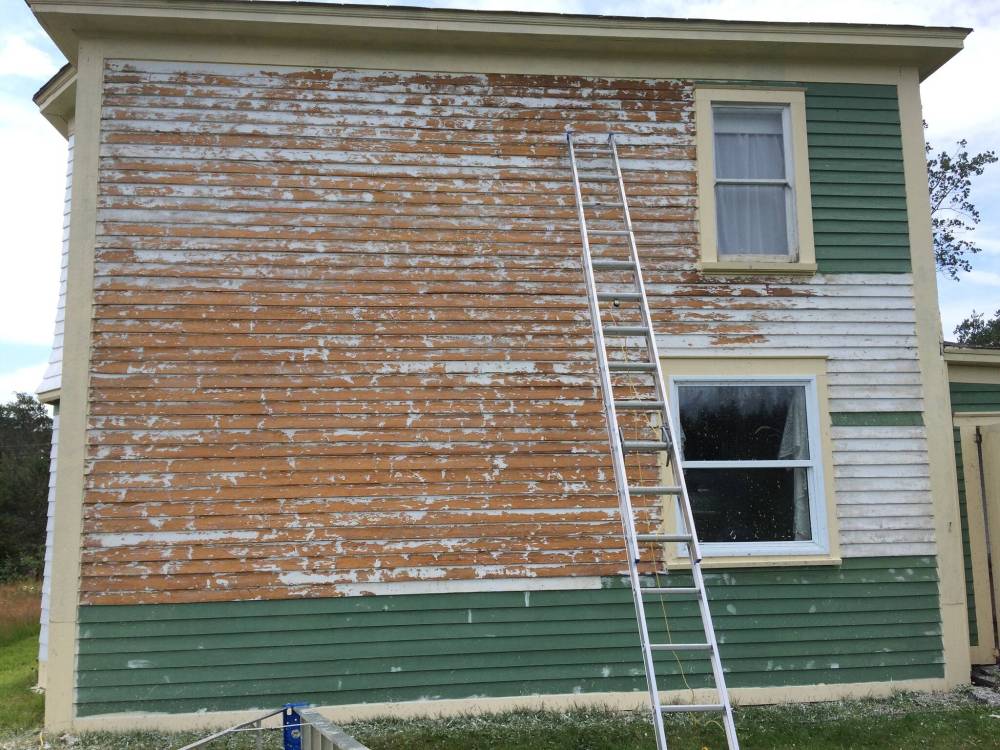
A house and a ladder. Just add water, electricity and a power washer, and you’ve got all the ingredients of a bad idea.
At the moment, it’s only a handful of adages, the first and foremost being, “If something falls, don’t try to catch it.” The idea sounds simple enough, but it takes real effort and deliberate restraint — you have to get in the way of your own instinctive reactions to reach out and catch something.
If your ladder starts to fall, don’t lunge along the roof to stop it. Just watch it fall away and lodge in a nearby tree or hit the ground, and say softly, “Wow. There goes the ladder.”
If the end of a rafter slips off the far wall as you’re trying to put it in place, let go.
If you manage to hold it, there’s a good chance you won’t have to climb down and bring it up again. However, the weight of the beam and the awkwardness of catching it is likely to tear up something in your back or shoulder that you need to place all the other beams. (Of course, all bets are off if the beam is likely to fall onto someone else.)
My second new rule? “Calculate risk of injury.”
I had to move three full-size pavement stones last weekend so I could redo the sand underneath and slope it away from the foundation. Just three of them — but the big, thick concrete ones.
First, I spent a good deal of time thinking fondly about my toes and fingers, and how, though there are many of them, I’d like to keep them all intact. Then, a comparable period of time thinking about my lower back.
I ended up using a variety of tools, including pry bars, rock hammers and, most importantly, a dolly to stand them up on edge and move them out of the way and then back again.
It was not artful or fast, but I can attest that no Russells were hurt during the process. And I didn’t have to lift their full weight at all.
Remember “measure twice, cut once?” I now subscribe to a corollary version, “Cut the same piece the wrong length twice in a row, and it’s time to take a break, drink water, have a snack or maybe just stop for the day.”
Besides calling it old-man carpentry, I’ve also considered an alternate tag — The Tao of Butt — because I realize now I watched a true expert in old-man carpentry for years, without really understanding the exquisitely careful method to his madness.
Remember the slow-food craze? Well, Len Butt has passed away, but when he was alive, our across-the-street neighbour was a master of the slow project.
I met him when he was already in his seventies. Every project he undertook started in exactly the same way: he would don his dark-blue coveralls before anything else. Raking leaves? Coveralls. Starting his incredibly ancient and smoky snowblower? Coveralls and a muskrat-fur hat with earflaps, followed by a slow stroll behind the machine as its powered tracks did the heavy work.
House repairs were slow and methodical, often involving lengthy periods of inspection. You might look out the window and spot him up on his own roof, checking the flashing where his rowhouse met the neighbour’s — he’d be down in an hour or two, unscathed. Then back up the next day to slowly apply roofing compound.
I once ran out of the house on an autumn afternoon and across the road to Mr. Butt’s because I’d spotted him from our upstairs window, lying prone on his front walk in his blue coveralls. I thought he’d fallen, or else maybe had a heart attack.
When I got to him, though, he was lying on his stomach, using a small paintbrush to paint the fronts of each one of his concrete steps. It was the best, most comfortable way for him to do the work — and absolutely typical of what I now recognize as his slow-work approach.

I have taken on some truly stupid projects in my lifetime. To strip paint off the wood siding of an old house with a pressure washer, I once used the absurd combination of a 20-foot extension ladder, with the pressure washer tied and hanging from the second-highest rung of the ladder (so I could have the most reach possible with the wand of the washer). All of it was connected by a garden hose to that most wonderful of electrical grounds, the artesian well.
It seemed like an inspired solution at the time. I was lucky enough to survive that project, and several others that, in retrospect, were inadvisable and rushed construction solutions.
I think now I might ponder the wisdom of having an energized power tool hanging from an aluminum ladder while water showers down on everything and everyone involved, let alone all the other hazards.
There were clearly better, smarter, safer, slower ways to strip that paint, I realize.
And figuring them out can be part of the pleasure of the completed project.
Russell Wangersky
Perspectives editor
Russell Wangersky is Perspectives Editor for the Winnipeg Free Press, and also writes editorials and columns. He worked at newspapers in Newfoundland and Labrador, Ontario and Saskatchewan before joining the Free Press in 2023. A seven-time National Newspaper Award finalist for opinion writing, he’s also penned eight books. Read more about Russell.
Russell oversees the team that publishes editorials, opinions and analysis — part of the Free Press‘s tradition, since 1872, of producing reliable independent journalism. Read more about Free Press’s history and mandate, and learn how our newsroom operates.
Our newsroom depends on a growing audience of readers to power our journalism. If you are not a paid reader, please consider becoming a subscriber.
Our newsroom depends on its audience of readers to power our journalism. Thank you for your support.
Russell Wangersky
Perspectives editor
Russell Wangersky is Perspectives Editor for the Winnipeg Free Press, and also writes editorials and columns. He worked at newspapers in Newfoundland and Labrador, Ontario and Saskatchewan before joining the Free Press in 2023. A seven-time National Newspaper Award finalist for opinion writing, he’s also penned eight books. Read more about Russell.
Russell oversees the team that publishes editorials, opinions and analysis — part of the Free Press‘s tradition, since 1872, of producing reliable independent journalism. Read more about Free Press’s history and mandate, and learn how our newsroom operates.
Our newsroom depends on a growing audience of readers to power our journalism. If you are not a paid reader, please consider becoming a subscriber.
Our newsroom depends on its audience of readers to power our journalism. Thank you for your support.
Advertisement Advertise With Us
Advertisement Advertise With Us