Preserving Riverton’s rich history

Advertisement
Read this article for free:
or
Already have an account? Log in here »
To continue reading, please subscribe:

Digital Subscription
One year of digital access for only $205*
- Enjoy unlimited reading on winnipegfreepress.com
- Read the E-Edition, our digital replica newspaper
- Access News Break, our award-winning app
- Play interactive puzzles
*First annual payment billed as $205.00 + GST for one year. This annual subscription will automatically renew at $233.00 + GST every 52 weeks (10% off the regular annual price of $259.35). Offer available to new and qualified returning subscribers only. Cancel any time.
To continue reading, please subscribe:
Add Free Press access to your Brandon Sun subscription for only an additional
$1 for the first 4 weeks*
- Enjoy unlimited reading on winnipegfreepress.com
- Read the E-Edition, our digital replica newspaper
- Access News Break, our award-winning app
- Play interactive puzzles
*Your next Brandon Sun subscription payment will increase by $1.00 and you will be charged $17.95 plus GST for four weeks. After four weeks, your payment will increase to $24.95 plus GST every four weeks.
Read unlimited articles for free today:
or
Already have an account? Log in here »
Hey there, time traveller!
This article was published 26/08/2017 (3250 days ago), so information in it may no longer be current.
RIVERTON — It’s probably the only Manitoba charitable organization sparked by the discovery of a human skull.
The skull came from a long-forgotten Interlake cemetery, forgotten in part because just six years after a smallpox epidemic took the lives of many of the original immigrants from Iceland and a number of members of the local Indigenous band, several of the original Icelanders decided to move to North Dakota and elsewhere.
As well, a little more than a decade after the first Icelandic settler in Canada came in 1872, an Icelander living on Hecla Island decided to pull up stakes, claimed the land with the cemetery, ripped out the wooden markers and levelled the grave mounds. He proceeded to build his new house on top of the graves and began farming there.
And now this cemetery, where this skull became exposed due to riverbank erosion, is just one of the historic projects of the non-profit Icelandic River Heritage Sites Inc. The group is fundraising to protect the shoreline and create a treed park with interpretive plaques.
Lorraine Sigurdson is the volunteer organization’s president and says the history of the Icelandic community in that section of Manitoba is all around them.
“Every time you see something that hasn’t been commemorated properly you think, ‘We should help that,’” Sigurdson said during a recent tour of three of the projects the group is working on.
“And our fundraising is helped now because people are aware of what we are doing when there is something there. Before, they didn’t know what we were doing; they were funding it on the vision.”
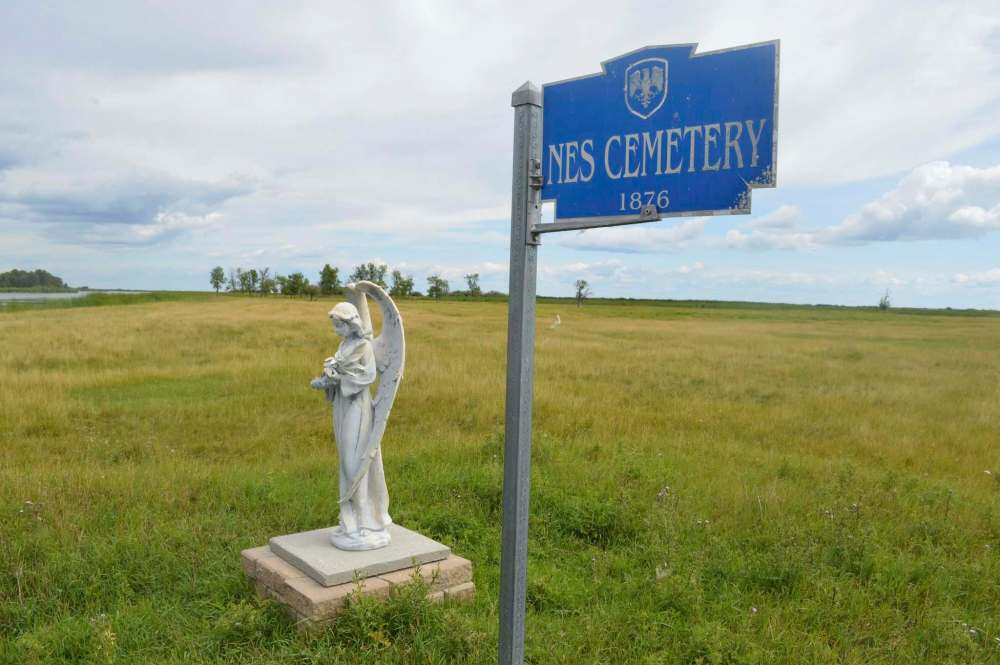
One of the projects is the Nes Cemetery Historic Site. The cemetery is located on Crown land on the northern edge of Riverton, on the east side of the Icelandic River, but it is currently not accessible to the public because you have to get permission to cross privately owned land to get to it.
The original name for the site was Graftarnes, or Grave Point, which was shortened to Nes.
The organization’s vice-president, Nelson Gerrard, said the cemetery is the final resting place of up to 40 Icelandic pioneers — 19 of whom were victims of the smallpox epidemic in the winter of 1876 to 1877 — as well as Indigenous people from the local Sandy Bar band.
Many of the Icelanders in the area finally moved to North Dakota after a flood in 1880, so the cemetery wasn’t being used when Magnus Hallgrimsson — who obviously wasn’t a superstitious man — decided to leave his homestead on Hecla and build his house in the middle of the graveyard.
Just seven years later, Hallgrimsson was dead — he bled to death in his bed, sparked not by anything paranormal, but by a tumour — and his wife and sons abandoned the house.
As the story goes, others tried staying there, but were frightened off by paranormal incidents. Today, the house is gone, but there is a grassy rise in the pasture marking where the house used to be.
But nearby is something just as spooky — disappearing land. Pointing to the jagged gashes at the end of the field above the river’s edge, Gerrard estimated erosion has already claimed at least nine metres of the cemetery, leading to people finding human bones as they became exposed after more than a century.
“Archeologists from Manitoba Historic Resources came out and took remains from the graves practically in the river. There was an adult woman and there were two little boys, probably brothers, as they dug down,” Gerrard said.
“It was a really eerie feeling, but it was like a direct window back 150 years ago.”
Gerrard said they plan someday to have a reburial ceremony for the remains that have been found after they raise the money to protect the riverbank.
● ● ●
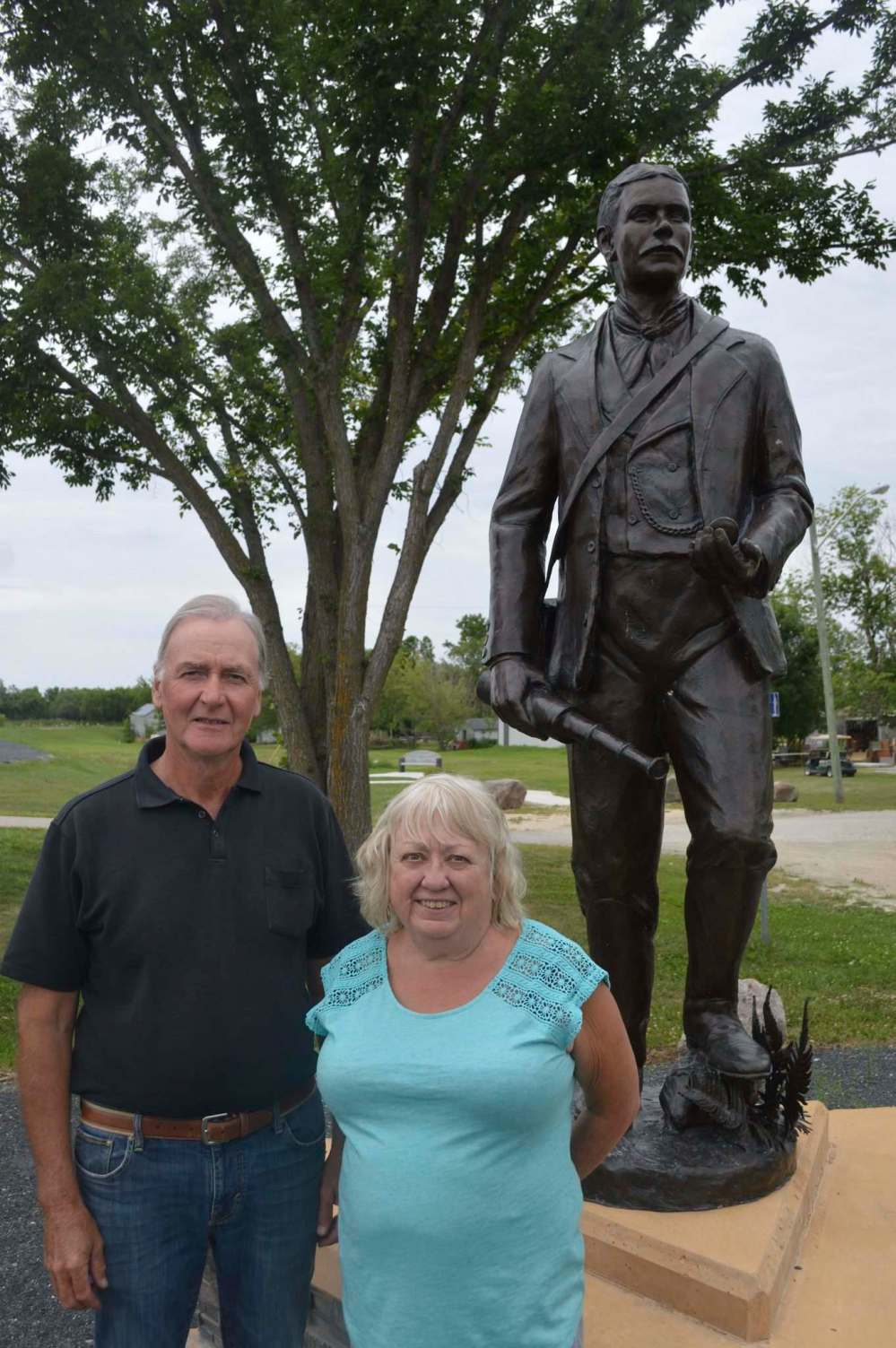
Across the river, the group has been able to complete a statue in honour of Sigtryggur Jonasson, the first Icelander to settle in Canada and the man considered to be the ‘father of New Iceland’.
Standing beside the life-size bronze sculpture of Jonasson, Sigurdson said the group had to raise about $60,000 for the statue and its base.
The sculpture was created by American sculptor Stan Watts, who is best known for his 12-metre-high work, To Lift a Nation, which is located at the National Fallen Firefighters Memorial in Emmitsburg, Md., near Washington, D.C., and Baltimore. It depicts New York City firefighters raising a flag during the aftermath of the destruction of the two World Trade Center towers on 9/11.
The Jonasson sculpture sits in a park on the west side of the Icelandic River at the end of the street named after another illustrious local hero: Reggie Leach.
“It’s one check mark checked off — and it was a very big one,” Sigurdson said proudly.
“We’ve also put that bench there in memory of two of our members who have passed away.”
Gerrard said the group had much discussion about which way Jonasson should be standing and they decided on having him look down the river towards the land he actually settled on.
“It shows the young Sigtryggur at 23 years of age when he came here,” he said.
“We have photographs of him from that period so we know what he looked like. He’s holding a compass and a telescope, symbols of exploration, and a map is sticking out of his satchel… it’s a pretty good likeness.”
###
Back on the east side of the Icelandic River, and just two lots down from the cemetery site, is the 117-year-old house the organization is renovating.
The two-storey, yellow-coloured house, named Engimyri, is historically significant because it not only was the home where Jonasson’s brother, Tomas, and Tomas’ wife Gudrun and their family lived, but it is also where Jonasson himself in later years set up his office in a corner room on the main floor. Present-day houses on the east side of Riverton obscure the view now, but back then Jonasson would have been able to see his own house on the other side of the river from his office window.
The house was also the northernmost point of the Colonization Road that was built through New Iceland, running near Lake Winnipeg from Riverton to the northern border of Manitoba at Winnipeg Beach. Because of that, the house, which was soon doubled in size, served as a stopping place for travellers to stay overnight. The expansion was later removed and incorporated into a house elsewhere in the community.
Gerrard said Tomas’ family came to New Iceland with only one child because four or five other children had died, but after they came here all of their eight children except for one survived to adulthood. They lived in a log house on the site before building the house that still sits there.
“What that tells us is the circumstances in the old country and conditions here,” he said. “Even though they were pioneers here, they had a pretty good life.”
While the outside of the house looks inviting and ready to move in, the inside is a work in progress. The kitchen is completely renovated and there are new cedar shingles on the roof and new windows installed, but the rest of the house still needs walls fixed and painted, floors sanded and ceilings fixed. The organization has signed a 99-year lease from the descendants of the original Jonasson family to look after the house.
But there is already some furniture in the house as well as photographs and other documents to help tell the residence’s story. In one room is Jonasson’s original ledger and his trunk.
“We’re probably about 60-per-cent complete,” Gerrard estimated.

Volunteers Margaret Wishnowski and Val Anderson said they are pleased with how much work has been done already and how local residents are donating decades-old items to them.
“I came here when I was younger, but we mostly played outside,” Wishnowski said. “It’s great that people are donating items for us to put in this house.”
Anderson admitted “it is overwhelming sometimes, because there seems so much to do, but you look at the renovations of the kitchen and you know the rest will come.”
kevin.rollason@freepress.mb.ca
Kevin Rollason is a general assignment reporter at the Free Press. He graduated from Western University with a Masters of Journalism in 1985 and worked at the Winnipeg Sun until 1988, when he joined the Free Press. He has served as the Free Press’s city hall and law courts reporter and has won several awards, including a National Newspaper Award. Read more about Kevin.
Every piece of reporting Kevin produces is reviewed by an editing team before it is posted online or published in print — part of the Free Press‘s tradition, since 1872, of producing reliable independent journalism. Read more about Free Press’s history and mandate, and learn how our newsroom operates.
Our newsroom depends on a growing audience of readers to power our journalism. If you are not a paid reader, please consider becoming a subscriber.
Our newsroom depends on its audience of readers to power our journalism. Thank you for your support.
Art from the Attic, an art sale to benefit Grands ‘n’ More Winnipeg, is being held on Sept. 24. The fundraiser, being held at the Norwood Community Centre, at 87 Walmer St., runs from 10:30 a.m. to 4 p.m. and features hundreds of donated prints, paintings, drawings, fabric art and more. Admission is free and you can call 204-770-6131 or email grandsnmore@gmail.com if you have artwork you want to donate.
You won’t see what you’re eating and drinking, but that’s the point of this fundraiser. The Canadian National Institute for the Blind is holding its fifth annual Dine in the Dark on Sept. 14, at the RBC Convention Centre. After cocktails and entertainment, guests will enter the ballroom, put on blindfolds and learn the challenges faced by blind and partially sighted people when pouring wine, using a knife and fork and looking for food while being guided by a dining coach. Tickets are $100 and can be purchased by calling 204-789-0947 or emailing glenda.gascoigne@cnib.ca. Also contact Glenda for sponsorship information.
The 11th annual Fall for Fashion show is being held to help Inclusion Winnipeg on Sept. 8. The organization, formerly known as Community Living Winnipeg, is holding the event in the Grand Ballroom at the Fort Garry Hotel, with doors opening at 11 a.m. and lunch served at noon. Tickets are $75 and can be purchased by calling 204-786-1414.
The African Children’s Choir will be singing in Winnipeg on Sept. 10. The choir, which sang for Queen Elizabeth II during her diamond jubilee, and has sung with Paul McCartney, Keith Urban and Mariah Carey, is performing at New Beginnings Church at 1073 St. Mary’s Rd., beginning at 10:30 a.m. The performance is free, but a free-will offering will be taken to help support the choir’s programs including education, care and relief and developmental programs. For more information go to africanchildrenschoir.com or call the church at 204-257-0143.
The inaugural Paws for Life Golf Tournament is being held by the Winnipeg Pet Rescue Shelter on Sept. 21. The tournament, being held at Breezy Bend Golf and Country Club at 7620 Roblin Blvd., includes gifts, 18 holes of golf, power carts, lunch and dinner. The entry fee is $175, with a charitable tax receipt of $65 per person. To register or for more information call 204-832-7387 or go to petrescueshelter.com.
How can you help Icelandic River Heritage Sites?
You can send a cheque to IRHS, Box 555, Riverton, MB, R0C 2R0. Tax receipts will be issued for donations over $20.
Or you can buy coffee. The IRHS sells five blends of fundraising coffee beans — one is a special Christmas blend — for $20 per pound plus shipping. Contact Nelson Gerrard at 204-378-2758 or eyrarbakki@hotmail.com, or Wanda Anderson 204-378-2482 or tander@mts.net to make arrangements. Also available for sale at the Hnausa General Store between Gimli and Riverton.
Kevin Rollason is a general assignment reporter at the Free Press. He graduated from Western University with a Masters of Journalism in 1985 and worked at the Winnipeg Sun until 1988, when he joined the Free Press. He has served as the Free Press’s city hall and law courts reporter and has won several awards, including a National Newspaper Award. Read more about Kevin.
Every piece of reporting Kevin produces is reviewed by an editing team before it is posted online or published in print — part of the Free Press‘s tradition, since 1872, of producing reliable independent journalism. Read more about Free Press’s history and mandate, and learn how our newsroom operates.
Our newsroom depends on a growing audience of readers to power our journalism. If you are not a paid reader, please consider becoming a subscriber.
Our newsroom depends on its audience of readers to power our journalism. Thank you for your support.
Advertisement Advertise With Us
Advertisement Advertise With Us
History
Updated on Saturday, August 26, 2017 8:57 AM CDT: Photos added