Swan Upping count an annual tradition
'Snob appeal' of owning birds likely saved them: prof
Advertisement
Read this article for free:
or
Already have an account? Log in here »
To continue reading, please subscribe:

Digital Subscription
One year of digital access for only $205*
- Enjoy unlimited reading on winnipegfreepress.com
- Read the E-Edition, our digital replica newspaper
- Access News Break, our award-winning app
- Play interactive puzzles
*First annual payment billed as $205.00 + GST for one year. This annual subscription will automatically renew at $233.00 + GST every 52 weeks (10% off the regular annual price of $259.35). Offer available to new and qualified returning subscribers only. Cancel any time.
To continue reading, please subscribe:
Add Free Press access to your Brandon Sun subscription for only an additional
$1 for the first 4 weeks*
- Enjoy unlimited reading on winnipegfreepress.com
- Read the E-Edition, our digital replica newspaper
- Access News Break, our award-winning app
- Play interactive puzzles
*Your next Brandon Sun subscription payment will increase by $1.00 and you will be charged $17.95 plus GST for four weeks. After four weeks, your payment will increase to $24.95 plus GST every four weeks.
Read unlimited articles for free today:
or
Already have an account? Log in here »
Hey there, time traveller!
This article was published 21/07/2018 (2920 days ago), so information in it may no longer be current.
STAINES-UPON-THAMES, England — By ancient law and custom, the Queen is entitled to claim ownership of any wild swan paddling in her vast realm. This is because mute swans were viewed as royal birds, symbols of high status, and once-upon-a-time aristocrats enjoyed roasting the young ones for Christmas feasts. Yum!
Much has changed since 1186 — the goose has swapped places with the swan on the holiday carving board — but one ritual that has survived into the 21st century is the annual Swan Upping, the atavistic, bizarre but wonderful count of the mute swan population along the Thames River.
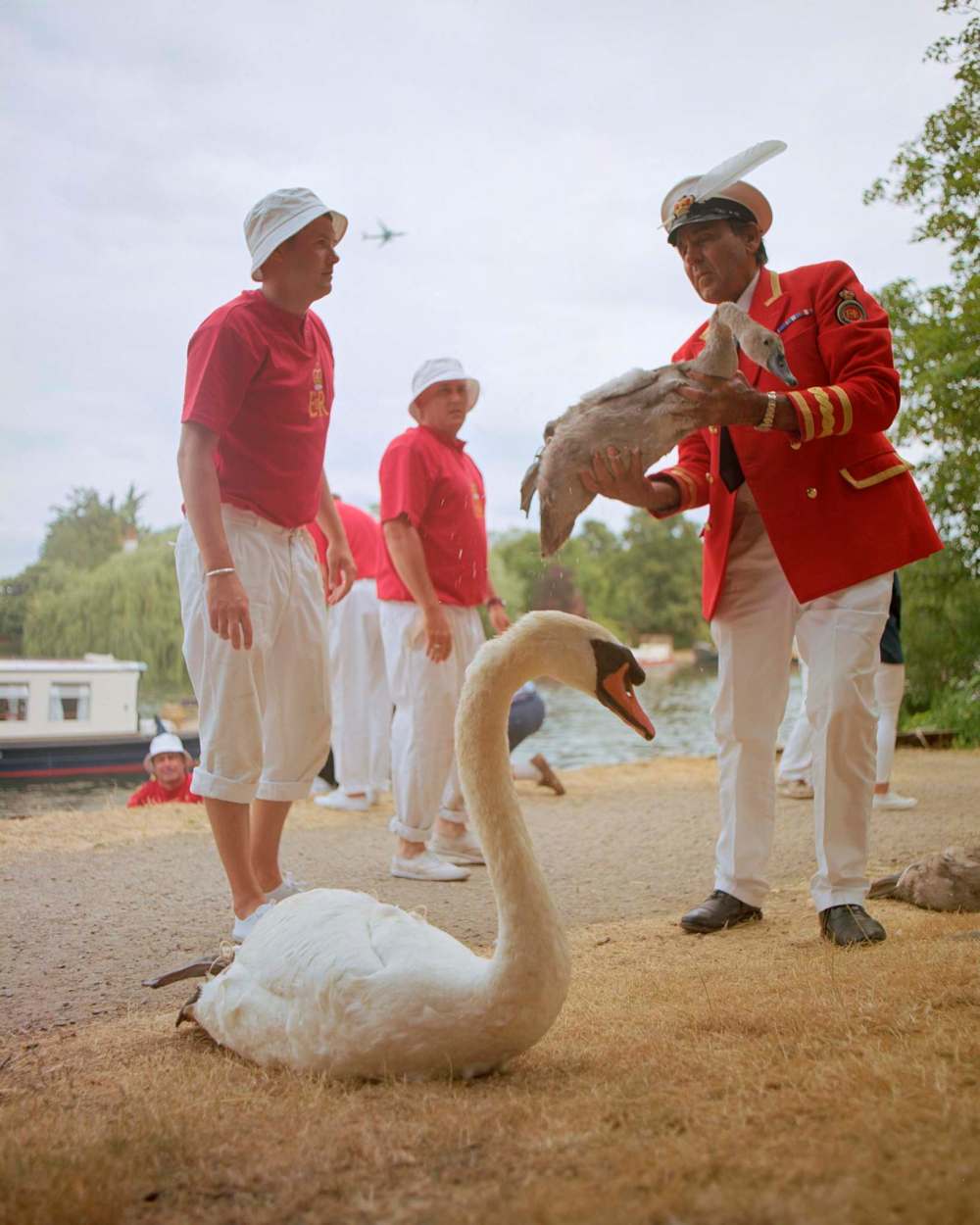
Each year, in the third week in July, grown men in white pants squeeze themselves into brightly varnished skiffs and, commanded by the Queen’s Swan Marker, a hearty 68-year-old bloke named David Barber who sells boat engines, they row up the Thames and wrangle the swans to shore for inspection, marking and counting.
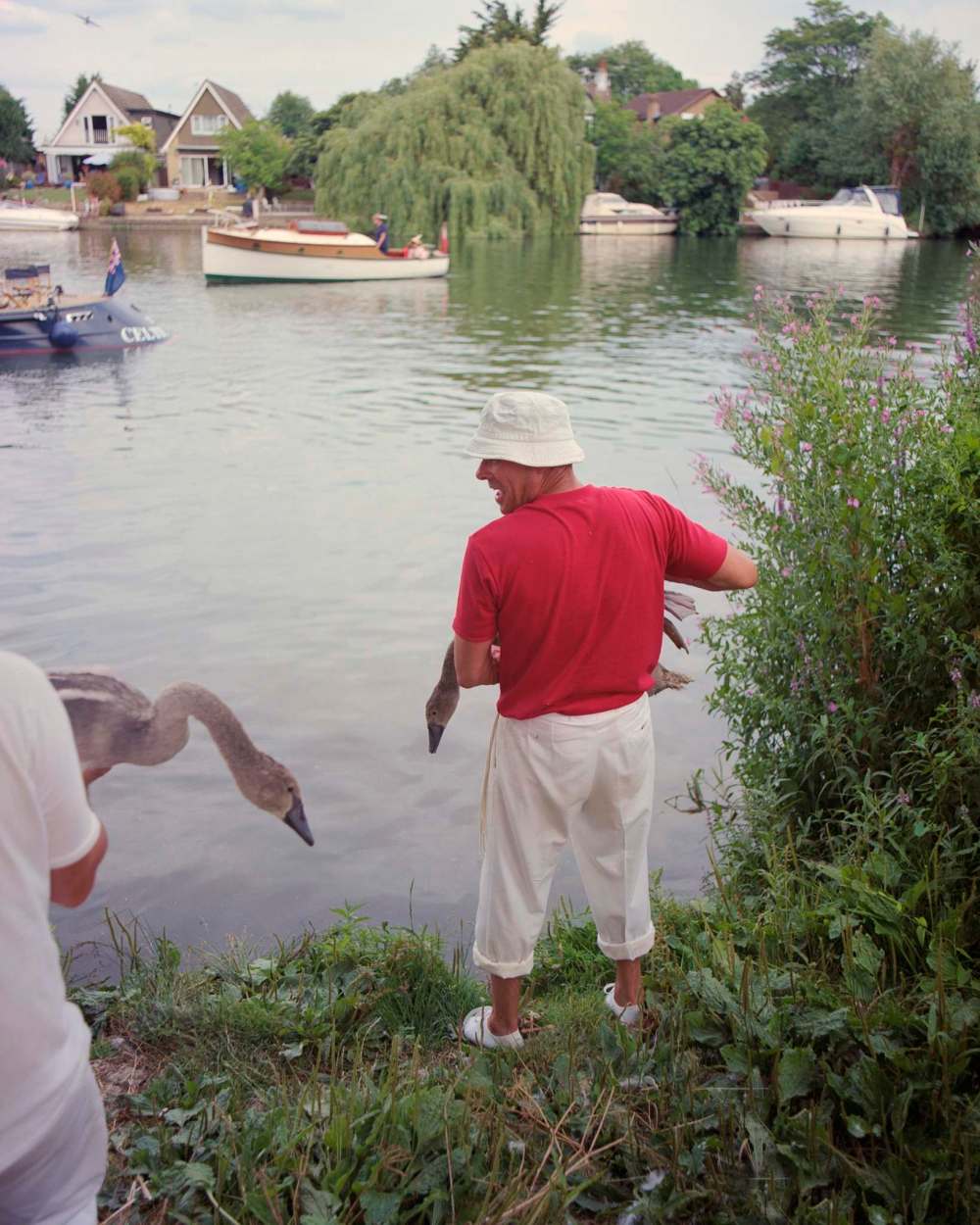
As far as poultry tourism goes, watching Swan Upping cannot be beat: these snowy white beasts, with their long curved necks, are truly elegant waterfowl. They’re also super-territorial and, despite the official name of the species, anything but mute. They hiss and snort and holler.
This week, as the Queen’s swan wranglers made their way past Penton Hook Lock, the watermen cried out “All-up!” signalling they’d spotted a pair of adults — he a cob, she a pen — with a half -ozen downy, grey cygnets.
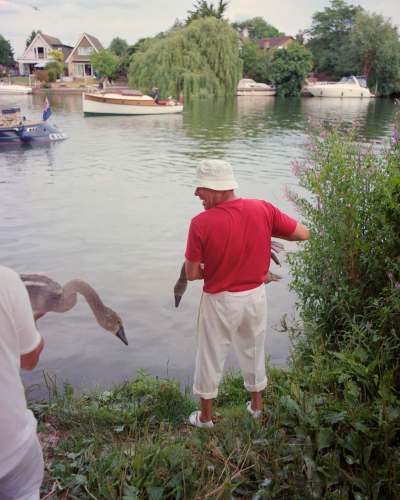
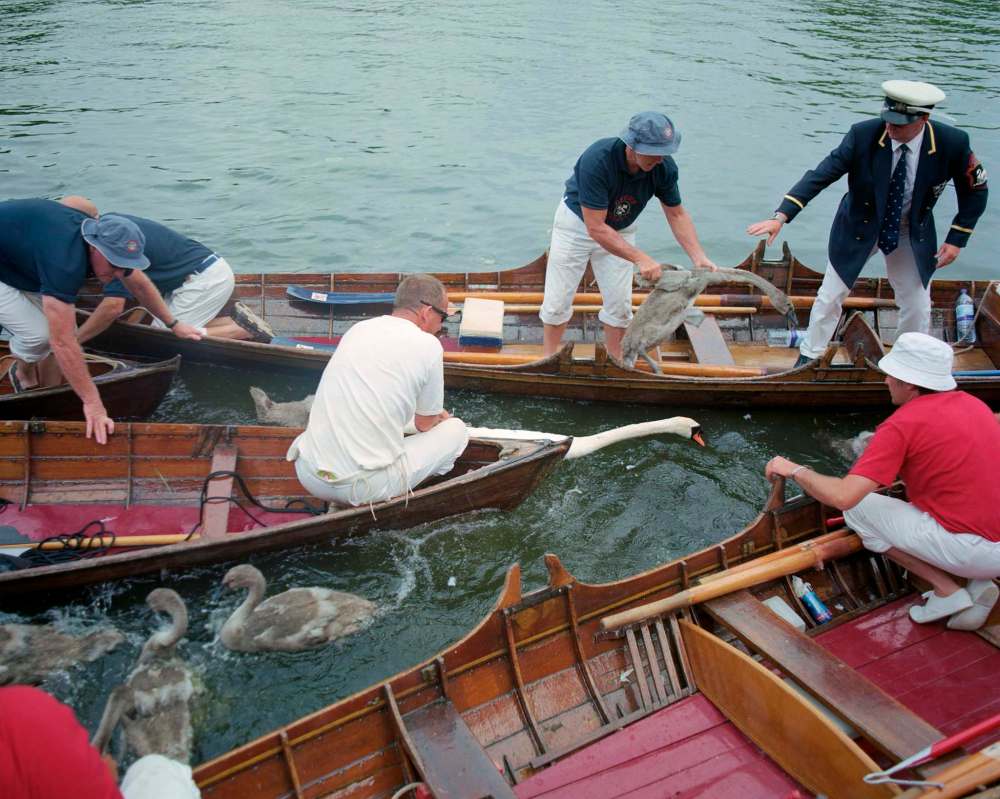
In quick order, the skiffs surrounded the swans and herded them toward shore. The crew members grabbed the birds by the necks and torsos, plucked them from the river one by one and, while steadying the swans against the floor of the boats, tied the birds’ legs behind their backs with lengths of shoe lace.
This operation is not for the timid, and best done with speed and decisiveness.
At the Swan pub on Monday, one of the oarsmen, Roger Spencer, 54, was hoisting a few pints before luncheon, when he told me an adult that morning had gnashed him on his belly with a claw, which protrudes from the bird’s webbed feet.
“It’s the claws you watch for,” he advised.
You might think it’d be the powerful wings or the honking big beak, but no.
“They eat grass. There’s nothing to the beak. A little serrated edge,” Spencer said. “They might nibble you a bit, but that’s it.”
The swans, surprisingly, were pretty chill after they were caught. The young made anxious piping noises, but the adults — famous for their fierce guardianship of the brood — remained regal and unruffled. Mostly, they voided their bowels, sat patiently in a pile of their own poop and allowed venturesome children to pet their feathers.
The Queen’s swan man, bedecked in a scarlet jacket embroidered in gold, took extra care not to soil his splendid uniform. “I’ve got enough gold braid that if I fell into the river, I’d drown,” said Barber, who had tucked a large swan feather into his naval cap. He applied for this job 25 years ago. His predecessor, Capt. John Turk, was memorialized with a riverside bronze statue.
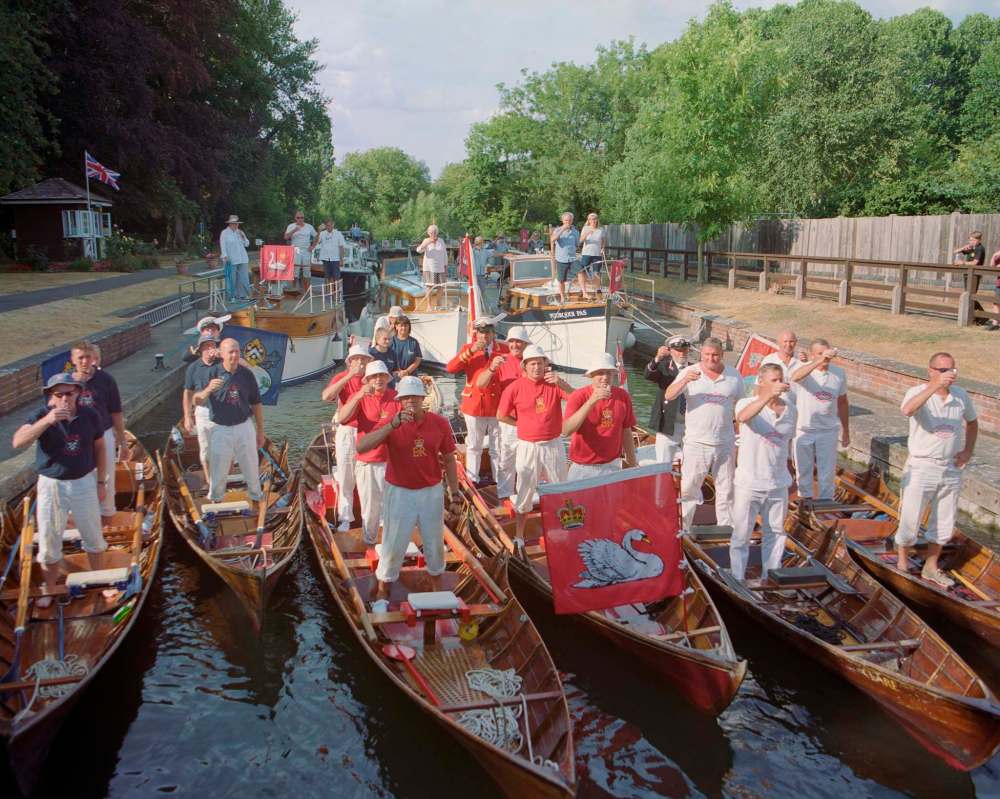
The oarsmen — some representing the Queen, the others from the old trade organizations of the Vintners and Dyers — rowed past Windsor Castle, through the various locks, alongside stubborn bits of remnant wild land and the reeds the swans need for their nests.
It is called the Swan Upping, Barber explained, “because we row up the river and pick up the swans.”
In olden times, the upping took place all over England, with hundreds of boats and gamesmen plying all the major rivers and tributaries.
Swans likely populated England after the last ice age. The bones of mute swans can be found here in trash heaps from the Roman conquest. From the 12th century, there began an elaborate system of ownership, with the crown granting special licence to landed lords and special institutions, such as the universities, abbeys and livery companies, to husband the swans.
The lucky few who were granted permission, and paid fees, marked their swans’ beaks with nicks of a sharp knife — hieroglyphs of triangles, crosses, dots and bands, which were recorded on rolls of velum.
By 1378, there was an Office of the Keeper of the King’s Swans. By 1405, no one could own a swan unless given permission by the crown. By 1547, it was illegal to mow the grass within 12 metres of a nest, according to Arthur MacGregor’s research published in the journal Antropozoologica.
Miscreant yeoman who poached a swan egg, or harassed nesting swans, or — heaven forbid — ate a swan could be punished by a year and a day in jail.
Now the upping is limited to six boats and a 127-kilometre stretch of the Thames River between Sunbury Lock and Abingdon Bridge, and nobody eats the birds.
“It’s all about education and conservation today,” Barber said.
This all takes place a 45-minute train ride west of central London, in exurban fringe villages, Theresa May country, which exudes the simulacra vibe of ye olde England — populated by quaint riverside pubs, arthritic Labradors and garden fetishists. A few kilometres away are dreary auto shops and dying high streets. Above is the 24-7 roaring flight path of nearby Heathrow International Airport.
“So glad to be here and see it,” said Richard Poad, 70, a retired airline pilot who lives nearby aboard his houseboat, Otto.
“The tradition is wonderful, and it’s important to educate the young,” Poad said, remarking that the swans have been harassed by “the hooligan element” armed with air rifles.
He was impressed by professionalism of the uppers. He recalled that a generation ago, the annual count was “was more of a drunken pub crawl.”
On Monday, opening day, a press boat accompanied the upping. At Romney Lock, the crews hoisted their glasses for a photograph, drank a tot of rum and hailed, “The Queen!”
They counted 33 cygnets in eight broods by the time they reached Eton College. “Not bad at all,” Barber said.
On the lawns, the teams laid the trussed birds side by side, weighed them and gave them a quick inspection. (The most common problem for the swans is becoming entangled in plastic trash or fishing line, and the uppers can usually free them on-site.)
Then the swans were divvied up between those belonging to the Queen and the Vintners and Dyers guilds. The crown usually claims half of the new cygnets. And so, on this first day, 17 of 33 of the juveniles went to the Queen and remained unmarked, the others went to the guilds and were awarded a numbered ring on their webbed feet.
The whole ritual is aided by Oxford University Prof. Christopher Perrins, the Queen’s Swan Warden.
Studies of swan mortality by Perrins and colleagues discovered the small lead pellets used by fishermen to weight their lines were being consumed by the swans and slowly poisoning them.
After a lead ban in the late 1980s, the swans rebounded and the population doubled in size. Now, the numbers have mostly levelled off, though Perrins warns the swans are still threatened by aggressive dogs, habitat loss, non-native mink, reckless boaters and, for the first time this year, a nasty strain of avian flu, which decimated some of the Windsor Castle flocks.
An earlier authority on swans, Norman Ticehurst, observed in 1926 that the royal licence required to keep swans, alongside the annual upping, conducted and recorded over centuries, probably saved the birds. He praised the system as “one of the most interesting experiments in combined bird protection and aviculture that England has produced.”
The Oxford professor agrees. The aristocrats craved the status a pair regal swans in the castle moat or manor lake could afford them. “It is rare to preserve such a big, edible, easily caught bird in a heavily populated area,” he said.
“If it weren’t for the snob appeal of owning swans, we probably wouldn’t have them.”
— Washington Post