New pen may allow sale of horses for slaughter

Advertisement

Advertise with us

RENO, Nev. - The U.S. Forest Service has built a new corral for wild horses in Northern California, which could allow it to bypass federal restrictions and sell the animals for slaughter.

Read this article for free:


or

Already have an account? Log in here »

To continue reading, please subscribe:

Subscribe and receive a limited-edition Free Press branded hat or tote.

Digital Subscription

One year of digital access for only $205*

  • Enjoy unlimited reading on winnipegfreepress.com
  • Read the E-Edition, our digital replica newspaper
  • Access News Break, our award-winning app
  • Play interactive puzzles

*First annual payment billed as $205.00 + GST for one year. This annual subscription will automatically renew at $233.00 + GST every 52 weeks (10% off the regular annual price of $259.35). Offer available to new and qualified returning subscribers only. Cancel any time.

To continue reading, please subscribe:

Add Free Press access to your Brandon Sun subscription for only an additional

$1 for the first 4 weeks*

  • Enjoy unlimited reading on winnipegfreepress.com
  • Read the E-Edition, our digital replica newspaper
  • Access News Break, our award-winning app
  • Play interactive puzzles
Start now

*Your next Brandon Sun subscription payment will increase by $1.00 and you will be charged $17.95 plus GST for four weeks. After four weeks, your payment will increase to $24.95 plus GST every four weeks.

Hey there, time traveller!
This article was published 15/01/2019 (2770 days ago), so information in it may no longer be current.

RENO, Nev. – The U.S. Forest Service has built a new corral for wild horses in Northern California, which could allow it to bypass federal restrictions and sell the animals for slaughter.

The agency acknowledged in court filings in a potentially precedent-setting legal battle that it built the pen for mustangs gathered in the fall on national forest land along the California-Nevada border because of restrictions on such sales at other federal holding facilities.

The agency denies claims by horse advocates it has made up its mind to sell the more than 250 horses for slaughter. But it also says it may have no choice because of the high cost of housing the animals and continued ecological impacts it claims overpopulated herds are having on federal rangeland.
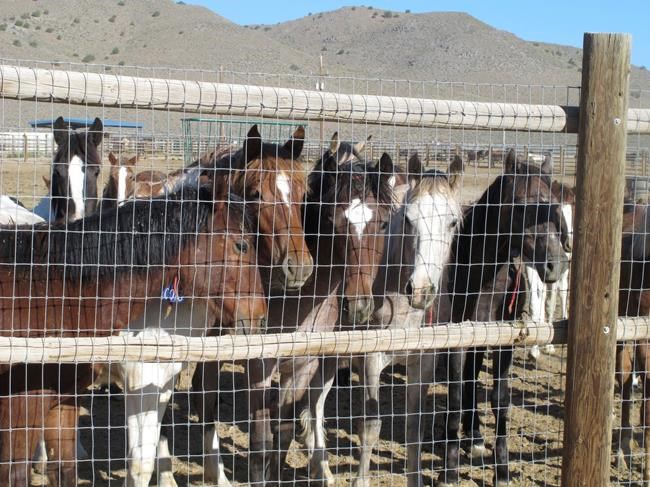
In this June 5, 2013 photo, some of the hundreds of mustangs the U.S. Bureau of Land Management removed from federal rangeland peer at visitors at the BLM's Palomino Valley holding facility about 20 miles north of Reno in Palomino Valley, Nev. The U.S. Forest Service has built a corral in California that could allow it to bypass federal restrictions and lead to the slaughter of wild horses. The agency acknowledged in court filings in a potentially precedent-setting legal battle that it built the new pen for mustangs gathered in the fall on national forest land along the California-Nevada line because horses held at other federal facilities cannot be sold for slaughter. (AP Photo/Scott Sonner)

“While slaughtering wild horses does not present a pleasant picture, the reality of this dire situation is not pleasant,” Justice Department lawyers representing the agency wrote in its most recent filing last month. “The Forest Service is taking a step to reduce what is universally recognized as a natural catastrophe.”

Horse advocates have been suing the government for two decades over mustang roundups that private ranchers say are necessary to curb growing herds that reduce the forage on federal lands they lease for cattle and sheep grazing across the U.S. West. The region holds roughly 90,000 wild horses.

A sharp reduction in demand in recent years for a federal program that offers the horses for adoption to the public has left little room in existing corrals. Horse advocates argue the mustangs are federally protected and that taxpayers subsidize the livestock grazing on U.S. land.

A hearing is scheduled Jan. 31 in federal court in San Francisco on a motion filed by the Animal Legal Defence Fund and American Wild Horse Campaign seeking an injunction to block the sale of the horses captured in the Modoc National Forest in October and November for possible slaughter. The new pen is in the forest, about 170 miles (273 kilometres) northwest of Reno.

Forest Service Chief Vicki Christiansen announced late last year she would postpone any sales for slaughter until at least Feb. 18.

The protection groups say it would be the first time in nearly a half-century the government has sold mustangs “without limitation,” or for any purpose, including slaughter.

Horse slaughterhouses are prohibited in the U.S. but legal in many other countries, including Canada, Mexico and parts of Europe where horse meat is considered a delicacy.

The Wild Free Roaming Horse and Burros Act that President Nixon signed into law in 1971 prohibits the inhumane destruction of wild horses. Congress approved an appropriations amendment in 2004 that allows the Forest Service, under its parent Agriculture Department, to sell horses without limitations if they’re over age 10 and have been offered for adoption three times unsuccessfully.

But in most years since then, Congress has specifically prohibited the Bureau of Land Management, under the Interior Department, from using any appropriations for such purposes. President Donald Trump proposed allowing such sales in his 2017 budget, but Congress refused to go along.

The Forest Service normally holds the horses it gathers at pens belonging to the BLM, which manages 385,000 square miles (997,000 square kilometres) of public lands in the West.

With few exceptions, lawsuits have targeted the bureau because it captures the vast majority of the horses. BLM lands hold an estimated 83,000 wild horses, while national forests managed by the Forest Service hold about 8,000.
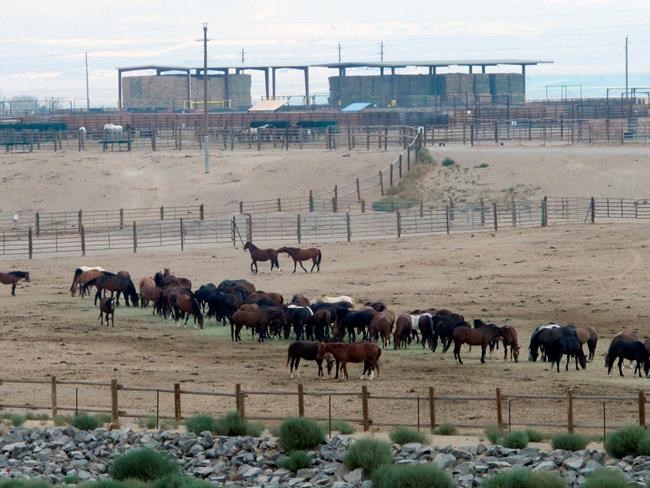
In this Sept. 4, 2013 file photo Mustangs recently captured on federal rangeland roam a corral at the U.S. Bureau of Land Management's holding facility north of Reno, in Palomino, Nev. The U.S. Forest Service has built a corral in California that could allow it to bypass federal restrictions and lead to the slaughter of wild horses. The agency acknowledged in court filings in a potentially precedent-setting legal battle that it built the new pen for mustangs gathered in the fall on national forest land along the California-Nevada line because horses held at other federal facilities cannot be sold for slaughter. (AP Photo/Scott Sonner).

The Forest Service gathered 932 horses in the Modoc National Forest late last year and shipped about 260 to the new corral, while placing about 650 at a BLM facility in nearby Susanville, California.

Justice Department lawyers acknowledged in the December filings “BLM is not permitted to humanely destroy healthy, unadopted horses or conduct any sale that could ultimately result in their destruction, which includes any Forest Service horse in BLM custody.”

“What has changed is that the Modoc now has its own short-term holding facility … which is not subject to congressional restrictions,” they wrote about the corral, which currently can hold up to 300 horses but has room for expansion to accommodate as many as 1,500. They said local ranchers “generally support these sales” because of the horses’ economic impact on leased grazing land.

The attorneys also said the opponents’ assertion the horses will be slaughtered “is only speculative, not concrete and imminent.”

Horse advocates say the government can’t have it both ways.

“It cannot both argue it is harmed by plaintiffs’ delay in bringing this action because of all the time and resources it has expended to allow the sale of horses without limitation, yet also insist to the court that it has not yet made any such decision,” their lawyers wrote Jan. 8. “In short, the record and defendants’ own statements make clear that the decision to sell horses without limitation is final and judicially reviewable.”

____

This story has been corrected to show the new corral is the first built by the U.S. Forest Service in California.

Report Error Submit a Tip

More Stories

Don’t be a big loser — check out Real Love Summer Fest ReunionBig Loser takes the stage at 8:20 p.m. tonight as part of the Real Love Summer Fest Reunion, a one-day event put on by the indie promotion company, which ran the festival in the Interlake area for a decade until last summer’s final edition near Teulon.

Bookers Gil Carroll and Adam Soloway have programmed a full day of music at Blue Note Park (220 Main St.), the outdoor venue adjacent to Times Change(d) High and Lonesome Club.

First up at 4 p.m. is folk-rock songwriter tofusmell, followed at 5 p.m. with a rare performance by indie-songwriting darlings Animal Teeth, a group with several summer fest bills under its belt. Up-and-coming pop-rockers Synthetic Friend take the stage at 6, followed at 7 by the fun electronic dance pop of French Class.

After playing with his full band at last month’s Winnipeg Folk Festival, Amos the Kid will perform a solo set at 8 p.m. Sans band, the performer shows off his affable roots as a Gord Downie acolyte with catchy earworms to match.

Poilievre’s lips moving, but Canadians aren’t interested in what he’s saying

Tom Brodbeck 5 minute read Preview

Poilievre’s lips moving, but Canadians aren’t interested in what he’s saying

Tom Brodbeck 5 minute read Thursday, Aug. 6, 2026

Pierre Poilievre’s biggest political challenge right now isn’t Prime Minister Mark Carney’s popularity.

It’s the fact that he still seems to be campaigning against a political landscape that no longer exists.

More than a year after the 2025 federal election, the Conservative leader is still relying on the same message, the same themes and the same attacks that defined his party’s campaign before voters went to the polls.

And Canadians appear to be tuning it out.

Read
Thursday, Aug. 6, 2026

Could renewed interest in strategically critical rare earth elements finally make sub-sector profitable?

Joel Schlesinger 6 minute read Preview

Could renewed interest in strategically critical rare earth elements finally make sub-sector profitable?

Joel Schlesinger 6 minute read Yesterday at 3:00 AM CDT

Rare earth elements are among the most critical of mined resources for modern economies.

They’re essential in manufacturing specialized magnets used in a host of technologies from wind turbines and electric vehicles to hard drives, smartphones, television screens, and fibre optics. Most notably, however, rare earth minerals are increasingly vital to the defence industry.

These 17 elements — closely related chemically and usually found all together in mineral deposits — have indeed been growing in geopolitical importance as the United States, Canada and other Western nations recognize their dependence on production from China.

It is the world’s largest producer and processor of rare earths, including the most in-demand elements neodymium and praseodymium used to manufacture very light and powerful magnets for an array of technologies, including the most advanced weapons of modern warfare.

Read
Yesterday at 3:00 AM CDT

Trailblazing Western Scrap Metals heavy-equipment operator relishes role at massive crane’s control

David Sanderson 7 minute read Preview

Trailblazing Western Scrap Metals heavy-equipment operator relishes role at massive crane’s control

David Sanderson 7 minute read Friday, Aug. 14, 2026

Less than five per cent of heavy-equipment operators in the country are women but that number is trending upward, according to a study conducted by trade magazine Crane & Hoist Canada.

It was reported that in Ontario roughly eight per cent of jobs in the transport and heavy-equipment field are currently held by women. Furthermore, in 2024 almost 20 per cent of graduates at an Edmonton-based heavy-equipment operator training school were female, the article stated.

That brings us to Harmony Guspodarchuk, the first female crane operator in the 70-year history of Western Scrap Metals, a family-owned business at 18 Sutherland Ave.

Three years ago, Guspodarchuk literally stepped into the driver’s seat of a 27,500-kilogram, Liebherr C 924 Heavy Lift Litronic crane. The 29-year-old hasn’t looked back much since.

Read
Friday, Aug. 14, 2026

Sea Bears finish on top

Joshua Frey-Sam 7 minute read Preview

Sea Bears finish on top

Joshua Frey-Sam 7 minute read Yesterday at 8:27 PM CDT

Beauty. Bliss. Ecstasy.

That is how Aug. 15, 2026 will be remembered in Winnipeg.

What was once a pipe dream in the city’s hoops community became an epic reality on Saturday, when Simon Hildebrandt, who grew up playing on the courts of this very town, made good on a three-pointer from the wing to crown the Winnipeg Sea Bears Canadian Elite Basketball League champions.

A storybook ending to a 98-84 victory over the Brampton Honey Badgers sent a CEBL attendance record of 12,519 fans into pandemonium at Canada Life Centre and capped a Finals run for the ages — one that was fraught with injury, impromptu player exits and unprecedented circumstances.

Read
Yesterday at 8:27 PM CDT

West Kildonan Industrial residents call for speed bumps after child hit by truck

Morgan Modjeski 3 minute read Preview

West Kildonan Industrial residents call for speed bumps after child hit by truck

Morgan Modjeski 3 minute read Updated: Yesterday at 3:09 PM CDT

Residents in the West Kildonan Industrial neighbourhood are calling on the city to install speed bumps in their area after a child was hit and dragged by a vehicle Thursday.

Katelyn Bemister lives near the area where the child — who was hospitalized as a result of the incident and has been upgraded to stable condition — was struck. She says people frequently speed in the area.

“They’re going really fast, and they’re not really paying attention at all to the pedestrians in the area,” says Bemister.

In video supplied to the Free Press by a resident, the child can be seen riding a bike down a sidewalk along the 500 block of North Point Boulevard.

Read
Updated: Yesterday at 3:09 PM CDT