Edmunds: 4 lessons from a 7,100-mile, 48-state test drive

Advertisement

Advertise with us

You don't complete a 7,100-mile, 48-state road trip without learning a few things, especially if you go in the grips of winter. A group of Edmunds editors made such a journey in December, in just seven days. Along the way, they encountered amazing vistas, dark and lonely roads, and plenty of rain, subfreezing temperatures and snow. Here are four takeaways that stood out above the rest.

Read this article for free:


or

Already have an account? Log in here »

To continue reading, please subscribe:

Subscribe and receive a limited-edition Free Press branded hat or tote.

Digital Subscription

One year of digital access for only $205*

  • Enjoy unlimited reading on winnipegfreepress.com
  • Read the E-Edition, our digital replica newspaper
  • Access News Break, our award-winning app
  • Play interactive puzzles

*First annual payment billed as $205.00 + GST for one year. This annual subscription will automatically renew at $233.00 + GST every 52 weeks (10% off the regular annual price of $259.35). Offer available to new and qualified returning subscribers only. Cancel any time.

To continue reading, please subscribe:

Add Free Press access to your Brandon Sun subscription for only an additional

$1 for the first 4 weeks*

  • Enjoy unlimited reading on winnipegfreepress.com
  • Read the E-Edition, our digital replica newspaper
  • Access News Break, our award-winning app
  • Play interactive puzzles
Start now

*Your next Brandon Sun subscription payment will increase by $1.00 and you will be charged $17.95 plus GST for four weeks. After four weeks, your payment will increase to $24.95 plus GST every four weeks.

Hey there, time traveller!
This article was published 23/01/2019 (2762 days ago), so information in it may no longer be current.

You don’t complete a 7,100-mile, 48-state road trip without learning a few things, especially if you go in the grips of winter. A group of Edmunds editors made such a journey in December, in just seven days. Along the way, they encountered amazing vistas, dark and lonely roads, and plenty of rain, subfreezing temperatures and snow. Here are four takeaways that stood out above the rest.

TORQUE-VECTORING ALL-WHEEL DRIVE EXCELS IN SNOW

Four-wheel drive (4WD) and all-wheel drive (AWD) are not interchangeable terms. The 4WD systems found on most pickups are meant to be engaged after the vehicle has left the road. These systems lack something called a centre differential, so binding and slippage will occur while turning if you use 4WD on pavement. It’s not an issue on dirt and snow; such surfaces shift to alleviate the binding.
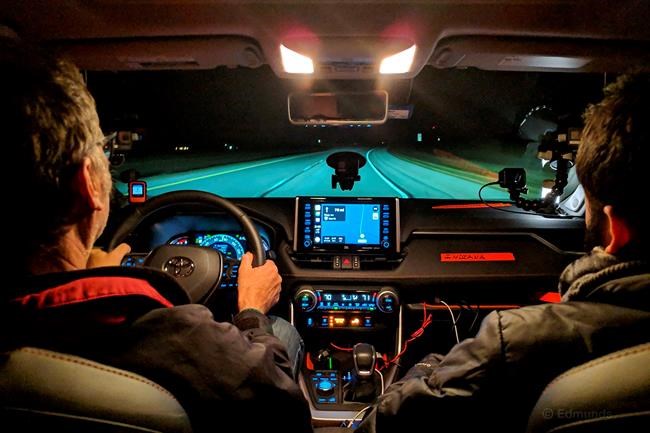
This December 2018 photo provided by Edmunds shows the navigation screen of the 2019 Toyota RAV4, which a team of Edmunds editors drove through the 48 contiguous states in seven days. While Apple CarPlay and Android Auto are convenient, letting you operate a smartphone's navigation apps via a vehicle's touchscreen, only built-in navigation will allow you to see maps and establish guidance when data-level cell service is not present. That's the case in lots of areas around the U.S. (Edmunds via AP)

AWD systems can operate on pavement because they have a centre differential or a similar mechanism. The resulting lack of binding makes them better able to cope with rain, snow and ice because tires maintain more consistent contact with the surface. More advanced AWD systems have an active centre differential that varies the front-to-rear distribution of the engine’s power to reduce tire slippage and improve stability during acceleration.

Our clear favourite is a subgenre called torque-vectoring AWD. Such systems also redistribute power side to side across the rear axle, which helps to reduce slippage and improve stability on iffy surfaces during sharper turns and accident-avoidance manoeuvrs. The Adventure trim level of the 2019 Toyota RAV4 we tested on this trip has such a system, and it gave us a lot of confidence. Various brands offer torque-vectoring AWD systems, but the names differ. Honda calls its system Super Handling AWD (SH-AWD), for instance.

WINTER TIRES OFFER CLEAR BENEFITS

They’re often called snow tires, but winter tires is a better name because they also provide added grip on frigid pavement even when there’s no snow. Winter tires work in two ways: Their specialized tread features numerous fine cuts known as “sipes” that give them myriad biting edges. They also employ a specialized rubber formulation that remains grippy and pliable in subfreezing conditions.

All-season tires have a year-round mission, providing warm-weather grip and durability, not to mention quietness and fuel efficiency. This compromise results in a modest level of winter performance that’s best suited for those who see occasional light snowfall. In many areas, safety officials do not consider all-season tires suitable for tough conditions. They’ll demand tire chains.

Winter tires are by far the better choice for those who live with real winter, particularly if hills and winding roads are involved. Our test-drive route included more than 2,500 miles of subfreezing temperatures and numerous high mountain passes, so we fitted a set of winter tires before we reached the Northern Plains and Rocky Mountain states. In the High Rockies, our vehicle remained confident and well-planted where others struggled.

HEADLIGHTS REALLY MATTER

Away from cities, it’s still dark out there. We drove many roads that were completely unlit, and we often saw no other cars. Several rural states had 80 mph interstate speed limits, but we even found narrow two-lane roads posted at 65 mph or more. These dark rural stretches tend to host wildlife ? big leaping animals such as deer, antelope and elk. We also drove through open grazing lands where cattle roam free, usually black-coated herds that blend in with the night.

The ability to see far ahead is critical in such conditions. But in these conditions, the only light you have is what your car can provide. Headlight technology has been evolving rapidly, with LED headlights generally offering the best illumination. But there’s still a lot of variation in performance, so the Insurance Institute for Highway Safety recently began testing and rating headlight performance.

DON’T WRITE OFF BUILT-IN NAVIGATION

Apple CarPlay and Android Auto let you operate your smartphone’s navigation apps via a vehicle’s touchscreen. But there are limitations. You must own a smartphone with a good-size data plan. You must also be driving in an area where your specific provider offers data coverage.
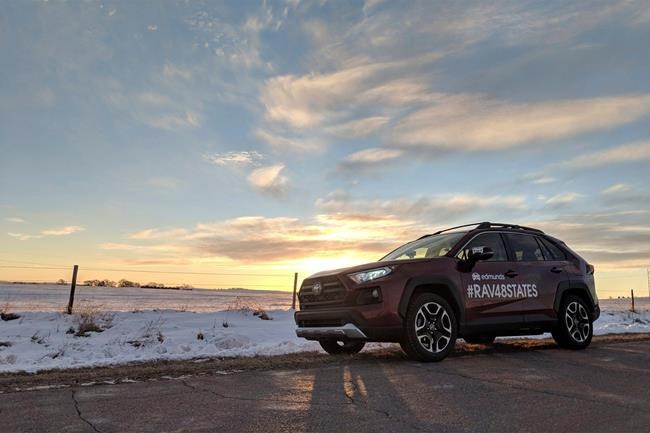
This December 2018 photo provided by Edmunds shows the 2019 Toyota RAV4 in Nebraska, on the fifth day of a marathon test drive from Kittery, Maine, to Needles, California, touching all 48 contiguous states. The trip taught our editors the particular value of four car features: torque-vectoring all-wheel drive, winter tires, high-quality headlights and built-in navigation. (Edmunds via AP)

Such coverage is not a given in every corner of our country, especially if you use back roads away from the interstates, as we often did. But it’s more common than that: There are several “no service” areas less than 50 miles from downtown Los Angeles. There are workarounds, such as pre-saving routes or initiating guidance when you have service. But only a vehicle’s built-in navigation lets you see maps and establish guidance when there’s no data-level cell service.

EDMUNDS SAYS:

Even if you don’t drive 7,100 miles in a week, safe travel in tough conditions and unfamiliar terrain is a lot easier and more enjoyable if you have the right vehicle and equipment to suit the trip.

___

This story was provided to The Associated Press by the automotive website Edmunds. Dan Edmunds (no relation) is the director of vehicle testing at Edmunds: Twitter @Edmunds_Test

Related links:

Edmunds Article: 2019 Toyota RAV4 Ultimate Review https://edmu.in/2Egqo4r

Edmunds Video: 2019 Toyota RAV4 Ultimate Review https://bit.ly/2RFPCRG

Report Error Submit a Tip

More Stories

Big Loser’s latest a winning mix of country, folk

Ben Waldman 5 minute read Preview

Big Loser’s latest a winning mix of country, folk

Ben Waldman 5 minute read Yesterday at 6:00 AM CDT

The yellow trucker hat for sale on Facebook Marketplace said “Selkirk Lumber,” so Adam Wayne Brown knew he had to hammer home a deal.

Like the other millennial members of Winnipeg folk-country band Big Loser, the bassist has an affinity for the nostalgic, taking every opportunity — through music, through lyrics and through wardrobe — to recall the unique circumstances of growing up in a changing Interlake.

“I remember the matte yellow trucks driving around — the lumber trucks — and so I’ve had this strange memory of something disappearing from my youth and then persisting,” says Brown, who, like the band’s frontman Alex Paradoski, moved to Winnipeg more than a decade ago.

“I have a photo of the Lockport Bridge in my dining room,” chimes in Paradoski, whose first job as a teenager was bunning wieners and chopping fries at Skinner’s, a drive-in mainstay since 1929 along Highway 44.

Read
Yesterday at 6:00 AM CDT

Don’t be a big loser — check out Real Love Summer Fest ReunionBig Loser takes the stage at 8:20 p.m. tonight as part of the Real Love Summer Fest Reunion, a one-day event put on by the indie promotion company, which ran the festival in the Interlake area for a decade until last summer’s final edition near Teulon.

Bookers Gil Carroll and Adam Soloway have programmed a full day of music at Blue Note Park (220 Main St.), the outdoor venue adjacent to Times Change(d) High and Lonesome Club.

First up at 4 p.m. is folk-rock songwriter tofusmell, followed at 5 p.m. with a rare performance by indie-songwriting darlings Animal Teeth, a group with several summer fest bills under its belt. Up-and-coming pop-rockers Synthetic Friend take the stage at 6, followed at 7 by the fun electronic dance pop of French Class.

After playing with his full band at last month’s Winnipeg Folk Festival, Amos the Kid will perform a solo set at 8 p.m. Sans band, the performer shows off his affable roots as a Gord Downie acolyte with catchy earworms to match.

Could renewed interest in strategically critical rare earth elements finally make sub-sector profitable?

Joel Schlesinger 6 minute read Preview

Could renewed interest in strategically critical rare earth elements finally make sub-sector profitable?

Joel Schlesinger 6 minute read Yesterday at 3:00 AM CDT

Rare earth elements are among the most critical of mined resources for modern economies.

They’re essential in manufacturing specialized magnets used in a host of technologies from wind turbines and electric vehicles to hard drives, smartphones, television screens, and fibre optics. Most notably, however, rare earth minerals are increasingly vital to the defence industry.

These 17 elements — closely related chemically and usually found all together in mineral deposits — have indeed been growing in geopolitical importance as the United States, Canada and other Western nations recognize their dependence on production from China.

It is the world’s largest producer and processor of rare earths, including the most in-demand elements neodymium and praseodymium used to manufacture very light and powerful magnets for an array of technologies, including the most advanced weapons of modern warfare.

Read
Yesterday at 3:00 AM CDT

A Life's Story: Woman fought for better outcomes for others amid cancer fight

Janine LeGal 7 minute read Preview

A Life's Story: Woman fought for better outcomes for others amid cancer fight

Janine LeGal 7 minute read Yesterday at 3:00 AM CDT

Catherine Mary Burke was strong and motivated in ways many of us could never imagine.

She was known for fighting the good fight, and she fought as hard as she could for as long as she could. But something set her apart. Even when it was too late for her, she insisted cancer survival rates had to be better for other women. And they are today because of her fierce determination.

Burke died on Nov. 29, 2025, at age 67 after courageously facing breast cancer for more than a decade.

“Cathy was born happy,” said her husband, Patrick Burke. “She was a glass-half-full person. What a gift this attitude was to me and the boys. She never once said ‘Why me?’ or complained. She was just so happy to be alive.

Read
Yesterday at 3:00 AM CDT

Corroded Arlington overpass yields way for new hope of spanning urban chasm

Melissa Martin 6 minute read Preview

Corroded Arlington overpass yields way for new hope of spanning urban chasm

Melissa Martin 6 minute read Yesterday at 2:00 AM CDT

It’s an interesting quirk of timing, perhaps, that the end of two of Winnipeg’s most unlovely features are coming into view in the same few weeks. The rail lines that split the city in half, and the bridge that was built to tie it back together. The original problem, and the solution.

And in the confluence of those two ends, we have an opportunity to dream of what a better Winnipeg can be.

At a news conference on Wednesday, former federal transport minister Lloyd Axworthy laid out a vision for a rail line bypass that would remove more than 120 railway crossings from Winnipeg, route them through Crown and Manitoba Hydro corridor land south of the city, and reclaim 250 acres in the urban core for greenspace and development.

The next step is to focus on how to make it happen. Nothing of this scope comes easy. This new bypass plan emerged from a two-year feasibility study that Premier Wab Kinew had tasked Axworthy with back in 2024. Now, Axworthy will helm a new 90-day feasibility study zooming in on that route specifically.

Read
Yesterday at 2:00 AM CDT

WRHA directs three care homes to accommodate surge of hospital patients

Malak Abas 5 minute read Preview

WRHA directs three care homes to accommodate surge of hospital patients

Malak Abas 5 minute read Friday, Aug. 14, 2026

The Winnipeg Regional Health Authority has directed three long-term care centres to make space for hospital patients, citing “exceptionally high demand for care across the health-care system.”

Read
Friday, Aug. 14, 2026