Transgender cancer screening rates lower than those for other patients: study
Advertisement
Read this article for free:
or
Already have an account? Log in here »
To continue reading, please subscribe:

Digital Subscription
One year of digital access for only $205*
- Enjoy unlimited reading on winnipegfreepress.com
- Read the E-Edition, our digital replica newspaper
- Access News Break, our award-winning app
- Play interactive puzzles
*First annual payment billed as $205.00 + GST for one year. This annual subscription will automatically renew at $233.00 + GST every 52 weeks (10% off the regular annual price of $259.35). Offer available to new and qualified returning subscribers only. Cancel any time.
To continue reading, please subscribe:
Add Free Press access to your Brandon Sun subscription for only an additional
$1 for the first 4 weeks*
- Enjoy unlimited reading on winnipegfreepress.com
- Read the E-Edition, our digital replica newspaper
- Access News Break, our award-winning app
- Play interactive puzzles
*Your next Brandon Sun subscription payment will increase by $1.00 and you will be charged $17.95 plus GST for four weeks. After four weeks, your payment will increase to $24.95 plus GST every four weeks.
Read unlimited articles for free today:
or
Already have an account? Log in here »
Hey there, time traveller!
This article was published 23/01/2019 (2763 days ago), so information in it may no longer be current.
TORONTO – Transgender patients are less likely to be screened for cancers specific to their physical gender at birth, suggest researchers, saying practitioners need to address the health-care disparity affecting this often marginalized population.
In a study by St. Michael’s Hospital in Toronto, researchers assessed screening rates for cervical, breast, and colorectal cancer among 120 transgender patients eligible for the routine testing and compared them with rates among non-transgender patients seen by the family health team.
“We found that people who were trans had lower screening rates in our practice,” said Dr. Tara Kiran, a family doctor and the study’s principal investigator.
Transgender patients were about 70 per cent less likely to be screened for breast cancer, 60 per cent less likely to get tested for cervical cancer, and 50 per cent less likely to be screened for colorectal cancer — even after accounting for such other factors as age and the number of visits to their doctors.
The study arose as the result of an effort by the family health team begun in 2014 to improve cancer screening rates for all its patients, in part by reaching out with recall notices when testing was overdue.
“We did improve care overall and cancer screening rates for people on average, but there were some groups of individuals that were being left behind by our efforts,” Kiran said in an interview.
“If we hadn’t thought to look at this particular patient population, we would have been happy with our results,” she said. “This study stemmed from a realization that our system had the potential to miss patients whose gender had changed on their health card but who still required screening.”
Patients who have transitioned from female to male and still require screening for breast and cervical cancer are often missed when provincial agencies such as Cancer Care Ontario send reminders that regular mammograms or Pap smears are due.
“I think conversely sometimes we were inappropriately having people on lists because they had transitioned from male to female and now had ‘female’ on their gender marker, but actually didn’t have a cervix,” said Kiran.
For trans patients requiring regular mammograms, the study found just one-third were screened, compared to two-thirds of non-transgender, or cisgender, patients. For cervical cancer, 56 per cent of trans patients had Pap tests compared to 72 per cent of non-trans patients.
When it came to colorectal cancer screening, which is recommended for all patients, the uptake was 55 per cent for gender-transitioned patients versus 70 per cent for cis patients.
“I think the finding for us was surprising around colorectal cancer screening, as it’s not related to a sex organ,” said Kiran.
Among the 120 transgender patients included in the study, published Wednesday in the journal Canadian Family Physician, 76 per cent were physically female at birth but self-identified as male.
“If you are transitioned from female to male — but you still have a cervix, you haven’t had a hysterectomy — having a Pap test is an important part of screening for cervical cancer,” said Kiran. “But it also can really be gender dysphoric.
“If you can imagine, you are now identifying as a male but you are being asked to come in to do a procedure that’s really done for women. And so you’re being reminded of the fact there’s anatomy there that doesn’t relate to you being a man.
“So this can be quite upsetting for folks, understandably. That I suspect is a big reason why we found these low rates.”
In fact, interviews with patients following the study found that such a sentiment could run very deep, to the point where some transgender men said they would rather potentially get cancer than undergo a Pap test.
“That’s how strongly they felt,” she said.
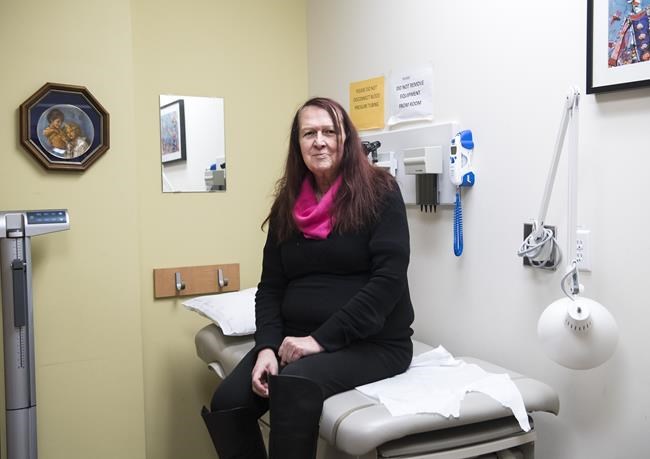
Cat MacDonald of Ajax, Ont., near Toronto, was born male but came to the realization at about age five that inside she was really girl. She didn’t do anything about it until the 1990s, when she began transitioning to female, which included taking a testosterone blocker and starting on lifelong doses of estrogen.
Taking the female hormone means MacDonald needs regular mammograms, as estrogen can lead to breast tissue growth that is potentially subject to malignancy. But at the same time, she needs regular testing for prostate cancer.
“There are still certain kinds of cancer that are more common in males that have to be screened for,” she said. “I’m fortunate that my health-care giver is very well-versed in trans medicine. She is aware of these and screens for it.”
It’s critical that health providers be better trained to provide sensitive, quality care to transgender patients, said MacDonald, 74. “So doctors have to become aware that this is specialized care.”
Still, she said many trans people are not willing to openly admit they’ve transitioned because they want to be seen as the gender they identify with.
“But not telling your doctor you were born the other gender can jeopardize your health, be it (for) cancer screening or other health problems that are specific to a gender,” MacDonald said.
“Hello — you worry about your health. You need to worry about this.”
— Follow @SherylUbelacker on Twitter.