Cleaning routine shows promise in curbing superbug infection

Advertisement

Advertise with us

Think of it as decontaminating yourself. Hospitalized patients who harbour certain superbugs can cut their risk of developing full-blown infections if they swab medicated goo in their nose and use special soap and mouthwash for six months after going home, a study found.

Read this article for free:

or

Already have an account? Log in here »

To continue reading, please subscribe:

Subscribe and receive a limited-edition Free Press branded hat or tote.

Digital Subscription

One year of digital access for only $205*

  • Enjoy unlimited reading on winnipegfreepress.com
  • Read the E-Edition, our digital replica newspaper
  • Access News Break, our award-winning app
  • Play interactive puzzles

*First annual payment billed as $205.00 + GST for one year. This annual subscription will automatically renew at $233.00 + GST every 52 weeks (10% off the regular annual price of $259.35). Offer available to new and qualified returning subscribers only. Cancel any time.

To continue reading, please subscribe:

Add Free Press access to your Brandon Sun subscription for only an additional

$1 for the first 4 weeks*

  • Enjoy unlimited reading on winnipegfreepress.com
  • Read the E-Edition, our digital replica newspaper
  • Access News Break, our award-winning app
  • Play interactive puzzles
Start now

*Your next Brandon Sun subscription payment will increase by $1.00 and you will be charged $17.95 plus GST for four weeks. After four weeks, your payment will increase to $24.95 plus GST every four weeks.

Hey there, time traveller!
This article was published 13/02/2019 (2730 days ago), so information in it may no longer be current.

Think of it as decontaminating yourself. Hospitalized patients who harbour certain superbugs can cut their risk of developing full-blown infections if they swab medicated goo in their nose and use special soap and mouthwash for six months after going home, a study found.

It’s a low-tech approach to a big problem: About 5 per cent of patients have MRSA — antibiotic-resistant Staph bacteria — lurking on their skin or in their noses, putting them at high risk of developing an infection while recovering from an illness or an operation. These can affect the skin, heart, brain, lungs, bones and joints, and most of them land people back in the hospital.

The hygiene steps that researchers tested trimmed that risk by nearly one third.
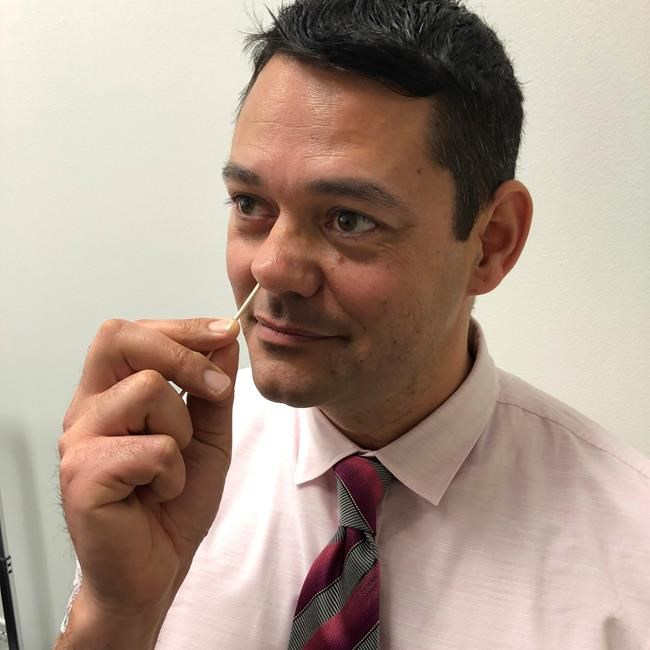
In this Monday, Feb. 11, 2019 photo provided by Dr. Susan Huang of the University of California, Irvine School of Medicine, researcher Raheeb Saavedra demonstrates how to use a medicated ointment for a study on preventing superbug infections. Hospitalized patients who harbor superbugs can cut their risk of developing full-blown infections if they swab medicated goo in their nose and use special soap and mouthwash for six months after going home, a study published on Wednesday, Feb. 13, 2019 finds. (Susan Huang via AP)

“It’s a very simple solution. You don’t have to swallow a medicine, you just have to clean the outside of your body for a little while longer,” said Dr. Susan Huang of the University of California Irvine School of Medicine. She led the federally funded study, published Wednesday by the New England Journal of Medicine.

A lot has been done to curb infections in hospitals and attention is shifting to what happens after patients leave. Nine states — California, Washington, Nevada, Minnesota, Illinois, South Carolina, Pennsylvania, Maine and New Jersey — require that hospitals test the most vulnerable patients, such as those in intensive care, for MRSA. Many other places do it voluntarily.

The study involved more than 2,000 patients at hospitals in southern California who were found to carry MRSA, or methicillin-resistant Staphylococcus aureus bacteria. All were given information on ways to avoid infection, and half also got special products — mouthwash, liquid soap containing an antiseptic and an antibiotic ointment to swab in the nose. They were told to use these Monday through Friday, every other week for six months.

A year later, 6 per cent of those in the deep-clean group had developed a MRSA infection versus 9 per cent of the others. They also had fewer infections from other germs. Doctors estimated that 25 to 30 people would need to be treated to prevent one case.

There were no serious side effects; 44 people had dry or irritated skin, and most continued using the products despite that.

Heather Avizius was one. The 41-year-old nanny has had MRSA infections in the past and entered the study after severe complications of Crohn’s disease landed her in St. Jude Medical Center in Fullerton, California, eight years ago.

“I took the regimen very, very seriously” and has not had MRSA since, she said. “I felt cleaner and safer” and less worried about spreading germs to her children, she said.

Nearly half dropped out of the study early or couldn’t be found for follow-up.

“Many people may think ‘I feel fine, I don’t really need to do this,'” said Dr. John Jernigan of the U.S. Centers for Disease Control and Prevention. But “the risk doesn’t end once you go home.”

Federal grants paid for the products. They would cost $150 to $200 for six months otherwise, Huang said. The antiseptic soap was a 4 per cent chlorhexidine solution sold in many drugstores.

Other soaps, even ones labeled antibacterial, “may not have the active ingredients to remove MRSA,” said Dr. Robert Weinstein, another study leader and an infections specialist at Cook County Health and Rush University Medical Center in Chicago.

It’s worth it for patients to do whatever they can to prevent an MRSA infection, he said.

“You left the hospital, you don’t want to go back.”

___

Marilynn Marchione can be followed at http://twitter.com/MMarchioneAP

___

The Associated Press Health & Science Department receives support from the Howard Hughes Medical Institute’s Department of Science Education. The AP is solely responsible for all content.

Report Error Submit a Tip

More Stories

Cleaning routine shows promise in curbing superbug infection

Marilynn Marchione, The Associated Press 4 minute read Preview

Cleaning routine shows promise in curbing superbug infection

Marilynn Marchione, The Associated Press 4 minute read Wednesday, Feb. 13, 2019

Think of it as decontaminating yourself. Hospitalized patients who harbour certain superbugs can cut their risk of developing full-blown infections if they swab medicated goo in their nose and use special soap and mouthwash for six months after going home, a study found.

It's a low-tech approach to a big problem: About 5 per cent of patients have MRSA — antibiotic-resistant Staph bacteria — lurking on their skin or in their noses, putting them at high risk of developing an infection while recovering from an illness or an operation. These can affect the skin, heart, brain, lungs, bones and joints, and most of them land people back in the hospital.

The hygiene steps that researchers tested trimmed that risk by nearly one third.

"It's a very simple solution. You don't have to swallow a medicine, you just have to clean the outside of your body for a little while longer," said Dr. Susan Huang of the University of California Irvine School of Medicine. She led the federally funded study, published Wednesday by the New England Journal of Medicine.

Read
Wednesday, Feb. 13, 2019

Once hailed as sign of strong bond, U.S. consulate in Winnipeg to close

Tyler Searle 6 minute read Preview

Once hailed as sign of strong bond, U.S. consulate in Winnipeg to close

Tyler Searle 6 minute read Yesterday at 6:21 PM CDT

There was much fanfare when the U.S. government re-established a permanent presence in Winnipeg in April 2001 as it unveiled its consulate and hailed it as a major achievement between two friendly nations.

“It is testimony not only to the importance the U.S. government attaches to our bilateral relationship with Canada but also to the increasing prominence of Winnipeg, Manitoba and the western region of the country in bilateral and multilateral affairs,” said U.S. Ambassador to Canada Gordon Giffin at a ceremony with then-premier Gary Doer.

Fast-forward to this week when it was learned the office at Portage and Main is set to close, meaning the U.S. will lose its primary advocate for American business and trade interests in Manitoba.

Dwight MacAulay was chief of protocol for the Manitoba government in 2001, calling it a time of celebration and strength between the countries.

Read
Yesterday at 6:21 PM CDT

Sea Bears say Allen recovering from nightclub assault

Joshua Frey-Sam 6 minute read Preview

Sea Bears say Allen recovering from nightclub assault

Joshua Frey-Sam 6 minute read Yesterday at 6:03 PM CDT

The Winnipeg Sea Bears are preparing for the Canadian Elite Basketball League playoffs without the services of its Most Valuable Player.

The club announced on Tuesday that star guard Teddy Allen has been ruled out for Thursday’s Western Conference semifinal against the Saskatoon Mamba at Canada Life Centre (7:30 p.m.) as he recovers from “significant health injuries” suffered after being assaulted by security staff at a downtown nightclub on Sunday.

“We continue to co-operate with the Winnipeg Police Service on its investigation and have referred them individuals and information based on what has been provided to us from those on the scene,” a statement from the club read.

“What we’ve seen and heard to date leads us to believe that Teddy was the victim of an assault at the hands of security at a downtown nightclub.”

Read
Yesterday at 6:03 PM CDT

Goldeyes pitcher Boyd making most out of his visit to Winnipeg

Taylor Allen 5 minute read Preview

Goldeyes pitcher Boyd making most out of his visit to Winnipeg

Taylor Allen 5 minute read Yesterday at 10:36 PM CDT

Not that long ago it seemed very unlikely that Luke Boyd was going to turn into one of the American Association’s best pitchers.

He began the 2025 campaign with the Cleburne Railroaders but was released two weeks into the year after getting torched for nine runs in less than seven innings of work.

The Baylor University product was unsure if he would have a future in pro ball after that, but then, his old pal Logan Watkins — the manager of the Winnipeg Goldeyes — threw him a lifeline.

Watkins managed Boyd in Cleburne in 2023 before taking the job in Winnipeg.

Read
Yesterday at 10:36 PM CDT

Concordia doctor denies responsibility for Calgary man’s permanent disability

Erik Pindera 4 minute read Preview

Concordia doctor denies responsibility for Calgary man’s permanent disability

Erik Pindera 4 minute read Yesterday at 3:52 PM CDT

A Concordia Hospital doctor accused in a negligence lawsuit after a Calgary man was left permanently disabled when he was given a massive overdose of a powerful sedative has denied she ordered he be given the drug.

Zachary Hoogerdyk’s father, Edward Hoogerdyk, and the Alberta government filed their statement of claim earlier this year in Court of King’s Bench naming the Winnipeg Regional Health Authority, provincial health agency Shared Health, Concordia Hospital, Dr. Anna Ziomek and two other hospital staff as defendants.

Hoogerdyk, who was 23 at the time, went to Concordia’s urgent-care centre with flu-like symptoms and worsening breathing difficulties on March 25, 2024 while he was in Winnipeg on business and to visit family, the lawsuit says.

The claim alleges Ziomek diagnosed Hoogerdyk with low levels of oxygen in his blood and a strain of the flu, before ordering him to be intubated.

Read
Yesterday at 3:52 PM CDT

Airport traffic surges despite fewer U.S. flights

Gabrielle Piché 4 minute read Preview

Airport traffic surges despite fewer U.S. flights

Gabrielle Piché 4 minute read Yesterday at 5:42 PM CDT

The Winnipeg airport has recorded an uptick in traffic this summer, despite the loss of notable U.S. flights.

Read
Yesterday at 5:42 PM CDT