Across Baghdad, a moment of respite and guarded hope

Advertisement

Advertise with us

Baghdad's main commercial district has seen more bombings than its residents can count. Death visited almost daily during times of war — most horrifically, a 2015 suicide bombing that ripped through two shopping malls, killing over 300 people.

Read this article for free:


or

Already have an account? Log in here »

To continue reading, please subscribe:

Subscribe and receive a limited-edition Free Press branded hat or tote.

Digital Subscription

One year of digital access for only $205*

  • Enjoy unlimited reading on winnipegfreepress.com
  • Read the E-Edition, our digital replica newspaper
  • Access News Break, our award-winning app
  • Play interactive puzzles

*First annual payment billed as $205.00 + GST for one year. This annual subscription will automatically renew at $233.00 + GST every 52 weeks (10% off the regular annual price of $259.35). Offer available to new and qualified returning subscribers only. Cancel any time.

To continue reading, please subscribe:

Add Free Press access to your Brandon Sun subscription for only an additional

$1 for the first 4 weeks*

  • Enjoy unlimited reading on winnipegfreepress.com
  • Read the E-Edition, our digital replica newspaper
  • Access News Break, our award-winning app
  • Play interactive puzzles
Start now

*Your next Brandon Sun subscription payment will increase by $1.00 and you will be charged $17.95 plus GST for four weeks. After four weeks, your payment will increase to $24.95 plus GST every four weeks.

Hey there, time traveller!
This article was published 11/03/2019 (2762 days ago), so information in it may no longer be current.

Baghdad’s main commercial district has seen more bombings than its residents can count. Death visited almost daily during times of war — most horrifically, a 2015 suicide bombing that ripped through two shopping malls, killing over 300 people.

But over the past year or so, the residents of Karrada have felt more normal than they have in decades. Streets lined with food stalls are crowded with shoppers, coffee shops and restaurants are packed until late, and the grey cement blast walls that protected against bombings are being removed.

“I used to go to school and come back home, nothing more,” said Rusul Mohsen, a 33-year-old middle school teacher, seated recently at a store front sipping coffee. “If I went to a restaurant, I would ask to sit in a corner the farthest away from any windows, fearing a car bomb explosion might shatter the glass.”
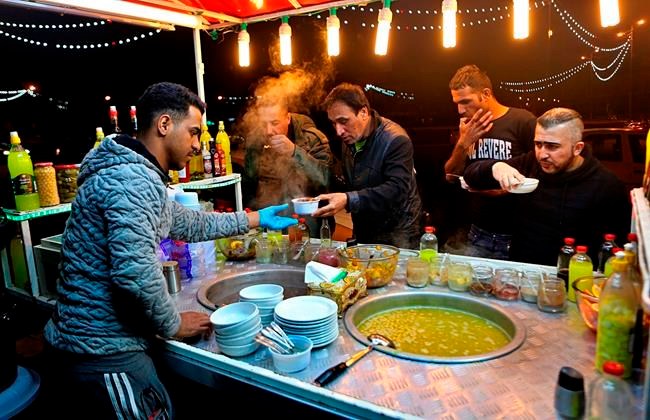
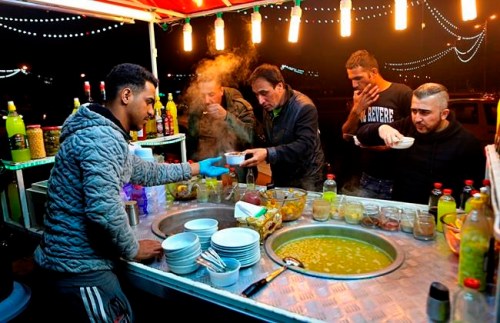
ADVANCE FOR PUBLICATION ON MONDAY, MAR. 11, AND THEREAFTER - In this Wednesday, Feb. 13, 2019 photo, a chickpeas vendor serves customers in Tahrir Square in Baghdad, Iraq. For the first time in 15 years, Iraq is not at war. The defeat of the Islamic State group after a ruinous four-year war has given the population a moment of respite, and across the capital Baghdad there is a guarded sense of hope. The city's infamous blast walls are coming down, restaurants, amusement parks and malls are brimming with families and shoppers who don't have to worry where the next car bomb will explode. But massive hurdles lie ahead, and many worry the calm is only temporary before a slide back into the violence that has dominated Iraq for the past four decades. (AP Photo/Khalid Mohammed)

For the first time in 15 years there is no major war or insurgency in Iraq, and the defeat of the Islamic State group in late 2017 after a ruinous four-year war has given the population a moment of respite. Despite the enormous challenges ahead, there is a guarded sense of hope across the capital.

Car bomb explosions that became the norm after the U.S.-led invasion in 2003, making the Iraqi capital’s name synonymous with war, have ceased — at least for now. Thousands of concrete barriers that snaked through the city as protection from suicide car bombers have been towed away in trucks, easing traffic.

Army spokesman Brig. Gen. Yahya Rasool said thousands of barriers have been towed away to a plot of land on the outskirts of the city, saying they may be used in the future around Baghdad to protect against infiltration.

Parts of the heavily fortified Green Zone on the west bank of the Tigris River have reopened to the public, including public access to the landmark “Victory Arch” — a 40-meter (131-feet) tall arch of two swords held by bronze casts of former dictator Saddam Hussein’s hands to commemorate the Iran-Iraq war. On Monday, Prime Minister Adel Abdul Mahdi eased restrictions on the Green Zone further, announcing the highly secure area would stay open to the public for an hour and a half longer in the day.

The U.S. established the Green Zone in 2003 to secure its embassy and Iraqi government institutions. But the zone became a symbol of the country’s inequality, fueling the perception among Iraqis that their government is out of touch.

On the other side of the river, Baghdad’s famous Rasheed Street, the capital’s oldest street and cultural centre known for its crumbling, old Iraqi houses, has also reopened for cars and pedestrians after a 15-year closure due to security risks.

A new Central Bank headquarters, a towering waterfront building on the banks of the Tigris designed by the late Iraq-born architect Zaha Hadid, is currently under construction, expected to be completed next year.

“Baghdad feels better than it has since 2003,” remarked a veteran Western diplomat in Baghdad.

Even so, the country faces massive challenges.
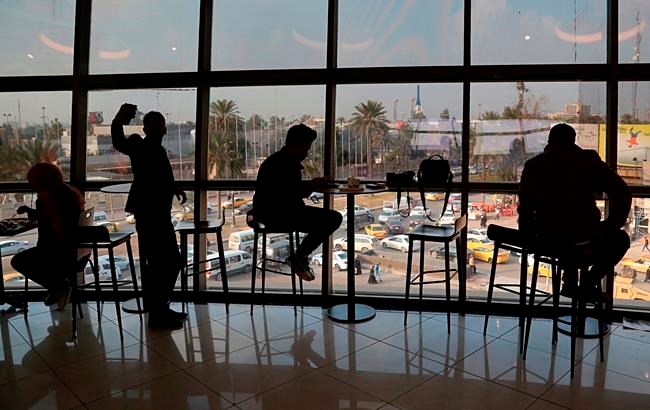
ADVANCE FOR PUBLICATION ON MONDAY, MAR. 11, AND THEREAFTER - In this Feb. 10, 2019 photo, people eat in a restaurant at a shopping mall in Baghdad, Iraq. For the first time in years, Iraq is not at war. The defeat of the Islamic State group in late 2017 after a ruinous four-year conflict has given the population a moment of respite, and across the capital Baghdad there is a guarded sense of hope. (AP Photo/Khalid Mohammed)

The Islamic State group, which is about to lose its last shred of territory in neighbouring Syria, is creeping back in Iraq, stepping up insurgent-style attacks in areas outside Baghdad and the country’s north. Tens of thousands of people remain displaced and much of the country is in ruins. The country is plagued by corruption, and in the oil-rich but parched south, violent riots have repeatedly broken out against living conditions.

Baghdad, an ancient metropolis of 8 million people that was once the Arab world’s cultural centre, is barely functional, its infrastructure crumbling. Armed militias who fought IS alongside the Iraqi armed forces roam the streets in what many see as the country’s latest menace, amid reports of kidnappings for ransom and general lawlessness. Unemployment, poverty and disenfranchised youth are widespread.

“There is a big gap between people’s aspirations and the government ability to deliver,” the Western diplomat said, speaking on condition of anonymity so he could speak freely.

Still, many hope that after years of bloodshed, Iraq is starting to turn a corner.

In Karrada, the Hadi Center where a 2015 suicide bombing trapped people in a burning inferno for hours, killing around 300 people, is full of shoppers and youngsters fill the food court. The adjacent Laith Center had to be razed and rebuilt from scratch. It’s now almost completed.

Assem Gharib, owner of a pastries and ice cream shop, said for years he used to pay someone to supervise the street outside his shop and keep cars from parking in front.

“I used to be frightened whenever a car approached, imagining it to be a suicide bomber or a car bomb. Now it’s the opposite, we are happy when a car parks in front of the shop,” he said.

That kind of confidence eluded most Iraqis for the past 15 years. The country has been at war, one way or another, for more than a generation, starting with the eight-year Iraq-Iran war that ended in 1988, followed by Iraq’s invasion of Kuwait in 1990 and the subsequent military intervention by the United States.
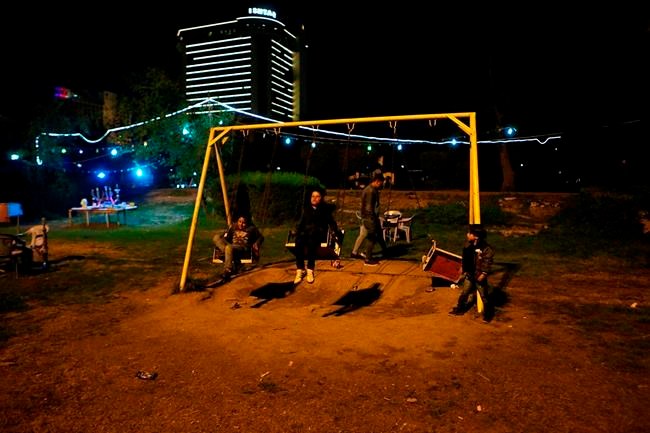
ADVANCE FOR PUBLICATION ON MONDAY, MAR. 11, AND THEREAFTER - In this Feb. 13, 2019 photo, children play at a park in Baghdad, Iraq. For the first time in years, Iraq is not at war. The defeat of the Islamic State group in late 2017 after a ruinous four-year conflict has given the population a moment of respite, and across the capital Baghdad there is a guarded sense of hope. (AP Photo/Khalid Mohammed)

The worst bloodletting came with the U.S.-led invasion of Iraq in 2003, which triggered an al-Qaida driven insurgency and sectarian violence that washed over the country, killing tens of thousands of Iraqis. Bombings reached up to 10 a day.

The violence culminated with the Islamic State group, an al-Qaida offshoot, seizing Iraqi cities and declaring a self-styled Islamic caliphate over large parts of Iraq and Syria. That triggered a displacement crisis unprecedented in Iraq’s history. Millions fled their homes in the face of the militants’ rapid advance. Others fled as Iraqi forces, backed by the U.S. and Iran, battled back, ultimately reclaiming the last town in late 2017.

Few dare to hope the current lull in fighting will last and many worry fear the growing power of the Shiite militias, known collectively as the Popular Mobilization Forces.

Bashar Ali, a 33-year-old shop owner on Karrada street, said he fears the return of IS fighters from Syria and the lawlessness outside the city, including kidnappings and killings.

“Baghdad is like my home, I feel safe in my own home, but when I go outside I don’t feel this way,” he said.
Report Error Submit a Tip

More Stories

Gillingham talks trash, pledges big bin boost

Joyanne Pursaga 4 minute read Preview

Gillingham talks trash, pledges big bin boost

Joyanne Pursaga 4 minute read 2:01 AM CDT

Scott Gillingham says he would add hundreds of locked garbage bins downtown to prevent unsightly trash piles if re-elected as mayor.

Gillingham led a program that added about 120 locked garbage bins along Portage Avenue and Main Street last fall, after trash was repeatedly strewn around the area. If he wins a second term, he plans to add at least 200 more of the receptacles.

A look at how one locked Main Street recycle/garbage bin in front of city hall fared offers an example of the bins’ success so far, he said.

“Every day, you would see the lids up, and people had been rifling through it, or someone left the lid up and the wind picked up the garbage and (spread) it everywhere. It’s much more difficult now. Once the garbage is in, the garbage stays in,” said Gillingham.

Read
2:01 AM CDT

Letters, Oct. 1

7 minute read Preview

Letters, Oct. 1

7 minute read Updated: Yesterday at 7:45 AM CDT

Did anyone else see the irony when Premier Wab Kinew announced at the Selkirk Mental Health Centre that Manitoba would adopt permanent Daylight Time (DT) and had hired 17 new psychiatrists this year?

Read
Updated: Yesterday at 7:45 AM CDT

There’s fast and then there’s this

Kelly Taylor 5 minute read Preview

There’s fast and then there’s this

Kelly Taylor 5 minute read 2:00 AM CDT

The advice was not unexpected but it was surprising considering it applied to a vehicle weighing almost 6,000 pounds.

“Before you let off the brake, put your head against the headrest,” the instructor said.

We — myself and a handful of Porsche customers gathered at Red River Exhibition Park — were about to experience launch control on the 2027 Porsche Cayenne Turbo Electric.

Launch control works like this: you put the vehicle in Drive, hold the brake as hard as you can with your left foot and quickly depress the accelerator pedal as far as it goes and hold it.

Read
2:00 AM CDT

Man who killed two Indigenous women, was accused of killing third, back in prison less than year after statutory release

Erik Pindera 5 minute read Preview

Man who killed two Indigenous women, was accused of killing third, back in prison less than year after statutory release

Erik Pindera 5 minute read Yesterday at 4:06 PM CDT

A Winnipeg man convicted of killing two First Nations women more than a decade ago — with charges stayed in a third slaying — has been sent back to prison less than a year after he left under conditions.

Parole Board of Canada officials revoked 67-year-old Shawn Lamb’s statutory release after a hearing last week.

“Your actions are not beyond your control, yet you continue to wilfully make poor decisions that place the public at risk,” board member Arun Kundu-Thomsen wrote in a decision released this week.

Lamb gained statutory release — a legislated conditional release most federal inmates automatically qualify for after serving two-thirds of their sentence — in November last year and lived in several Ontario facilities for federal offenders.

Read
Yesterday at 4:06 PM CDT

Port of Churchill signs agreement with Dutch port

Aaron Epp 2 minute read Preview

Port of Churchill signs agreement with Dutch port

Aaron Epp 2 minute read Tuesday, Sep. 29, 2026

Arctic Gateway Group, operator of the Port of Churchill, has signed an agreement with the Port of Rotterdam in the Netherlands to attract business and strengthen supply chains linking Western Canada and Europe.

The agreement enables the two ports to work together to develop new trade in critical minerals and energy products, connect Canadian producers with European buyers, and identify opportunities to improve the supply chain from Western Canadian resource projects through Churchill and into European markets.

The Port of Rotterdam is Europe’s largest port and home to more than 3,000 businesses across its industrial complex, serving as a major gateway for critical raw materials and energy.

Meanwhile, the Port of Churchill has been identified as a transformative national strategy for Canada and is emerging as a northern trade corridor connecting Western Canada’s resources to global markets.

Read
Tuesday, Sep. 29, 2026

Across Baghdad, a moment of respite and guarded hope

Qassim Abdul-Zahra, The Associated Press 7 minute read Preview

Across Baghdad, a moment of respite and guarded hope

Qassim Abdul-Zahra, The Associated Press 7 minute read Monday, Mar. 11, 2019

Baghdad's main commercial district has seen more bombings than its residents can count. Death visited almost daily during times of war — most horrifically, a 2015 suicide bombing that ripped through two shopping malls, killing over 300 people.

But over the past year or so, the residents of Karrada have felt more normal than they have in decades. Streets lined with food stalls are crowded with shoppers, coffee shops and restaurants are packed until late, and the grey cement blast walls that protected against bombings are being removed.

"I used to go to school and come back home, nothing more," said Rusul Mohsen, a 33-year-old middle school teacher, seated recently at a store front sipping coffee. "If I went to a restaurant, I would ask to sit in a corner the farthest away from any windows, fearing a car bomb explosion might shatter the glass."

For the first time in 15 years there is no major war or insurgency in Iraq, and the defeat of the Islamic State group in late 2017 after a ruinous four-year war has given the population a moment of respite. Despite the enormous challenges ahead, there is a guarded sense of hope across the capital.

Read
Monday, Mar. 11, 2019