States weigh bans on shackling jailed moms during childbirth

Advertisement

Advertise with us

SALT LAKE CITY - Michelle Aldana gave birth to her first child chained to a hospital bed.

Read this article for free:


or

Already have an account? Log in here »

To continue reading, please subscribe:

Subscribe and receive a limited-edition Free Press branded hat or tote.

Digital Subscription

One year of digital access for only $205*

  • Enjoy unlimited reading on winnipegfreepress.com
  • Read the E-Edition, our digital replica newspaper
  • Access News Break, our award-winning app
  • Play interactive puzzles

*First annual payment billed as $205.00 + GST for one year. This annual subscription will automatically renew at $233.00 + GST every 52 weeks (10% off the regular annual price of $259.35). Offer available to new and qualified returning subscribers only. Cancel any time.

To continue reading, please subscribe:

Add Free Press access to your Brandon Sun subscription for only an additional

$1 for the first 4 weeks*

  • Enjoy unlimited reading on winnipegfreepress.com
  • Read the E-Edition, our digital replica newspaper
  • Access News Break, our award-winning app
  • Play interactive puzzles
Start now

*Your next Brandon Sun subscription payment will increase by $1.00 and you will be charged $17.95 plus GST for four weeks. After four weeks, your payment will increase to $24.95 plus GST every four weeks.

Hey there, time traveller!
This article was published 13/03/2019 (2758 days ago), so information in it may no longer be current.

SALT LAKE CITY – Michelle Aldana gave birth to her first child chained to a hospital bed.

Then serving time at the Utah state prison on a drug charge, she says she laboured through the difficult 2001 birth for nearly 30 hours, her ankles bleeding as the shackles on both her legs and one arm dug in. “I felt like a farm animal,” she says.

The practice of keeping inmates shackled during childbirth was once common around the United States, but that’s gradually been changing after women began speaking out, with 22 states passing laws against it over the past two decades.
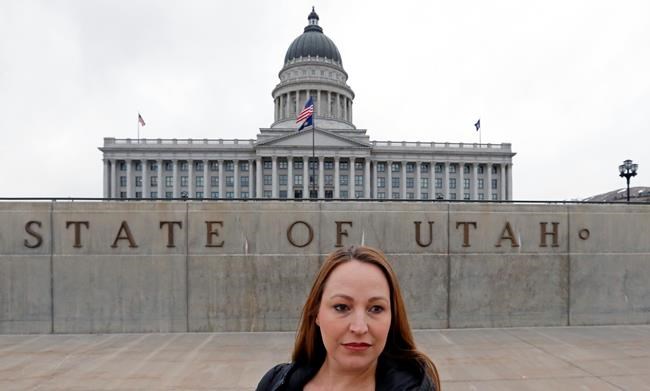
In this Feb. 27, 2019, photo, Michelle Aldana is shown at the Utah State Capitol in Salt Lake City. Utah is one of at least four states considering bans this year on the shackling of incarcerated women during childbirth. The Utah measure has passed the state House and is being considered by the Senate. The measure is a relief for mothers like Aldana, who was shackled when she gave birth while incarcerated on a drug charge in 2001. (AP Photo/Rick Bowmer)

Utah and at least three other states are considering joining them this year, after the federal government recently banned the practice with a sweeping criminal justice reform law. Many other states have policies against shackling, but advocates say that without a law it’s harder to stop a practice they condemn as dangerous and inhumane.

Women are America’s fast-growing segment of prisoners. The American Civil Liberties Union estimates about 12,000 pregnant women are incarcerated in U.S. jails or prisons each year.

“For me, it’s just a fundamental issue of dignity,” said Democratic state Rep. Stephanie Pitcher, who is sponsoring the Utah measure. “A woman deserves dignity in childbirth.”

Though the state prison changed its official policy to prohibit shackling in 2015, Pitcher has heard from a number of Utah doctors who have treated incarcerated women having babies in shackles, some as recently as this year. Her bill, which would apply to both the prison and local jails, passed the state House and is being considered by the Senate.

The practice is an outgrowth of policies requiring all prisoners to be restrained during medical treatment for safety, said Amy Fettig, deputy director of the National Prison Project at the ACLU.

But childbirth is different, she said. Preventing a woman from moving during labour increases the risk of potentially life-threatening health risks inherent in childbirth, like blood clots. It also makes it harder to move her if there is an emergency, or feed the baby after it’s born.

Meanwhile, the physical conditions of labour make escape attempts unlikely, and there are no documented cases of a woman getting away while having a child, Fettig said.

Still, some have raised safety concerns. In Utah, Republican Rep. Eric Hutchins has pointed out that violent incidents happen often in state prisons, and hospitals have far less built-in security.

He ultimately voted in favour of the bill, which does allow some shackling during transportation and the use of soft restraints if an inmate is documented to be dangerous. Prison officials are also in support, and say their policy change means women like Aldana are treated differently today.

In this Feb. 22, 2019, photo, State Democratic Rep. Stephanie Pitcher speaks on the house floor at the Utah State Capitol, in Salt Lake City. Utah is one of at least four states considering bans this year on the shackling of incarcerated women during childbirth. The Utah measure has passed the state House and is being considered by the Senate. Pitcher argues the chains are both unnecessary during labor and exacerbate health risks. (AP Photo/Rick Bowmer)

Most other states without laws against shackling do have policies in place, but without strict controls, the practice is hard to stamp out, said Lauryn King, a public-policy Ph.D. student at The George Washington University who completed a state-by-state analysis of laws on the topic.

“What are the odds that without specific training, your average corrections officer knows every policy?” she said. In New York, for example, a report found the practice continued even after a law was passed.

In Wisconsin, a woman said in a lawsuit she was shackled with a chain so short that she couldn’t reach the stirrups during labour in February 2014. Tennessee and Arkansas have faced similar lawsuits and are weighing bans on the practice this year, along with South Carolina.

In Utah, Aldana was bloody and sore after her tough labour, which also left her with a broken pelvis from the pressure of the baby. She was released a month after her son was born, and in the years since she’s recovered and become a substance abuse counsellor. Now pregnant with her third child, she still suffers with anxiety about childbirth but said a law against shackling would be a relief.

“I just don’t think any woman, when they’re that vulnerable, should ever be treated that way,” she said. “It’s just wrong.”
Report Error Submit a Tip

More Stories

Canada resorting to its tried and true playbook

Niigaan Sinclair 5 minute read Preview

Canada resorting to its tried and true playbook

Niigaan Sinclair 5 minute read Yesterday at 6:00 AM CDT

In 1846, Britain faced an emergency influenced by the Irish famine, so leaders repealed the country’s “Corn Laws” and restrictions on imported food and grain, transitioning to a system of free trade.

This created a crisis in the then Province of Canada, which had relied on British “preferential” status to prop up its agricultural and resource industries.

As a result, Canada looked south for new markets and eventually negotiated a free trade agreement with the United States.

This required land to be acquired and converted for industrial use quickly, so Canada quickly dispatched Commissioner William Robinson to negotiate with Indigenous communities along Lake Huron and Lake Superior for land.

Read
Yesterday at 6:00 AM CDT

Port of Churchill signs agreement with Dutch port

Aaron Epp 2 minute read Preview

Port of Churchill signs agreement with Dutch port

Aaron Epp 2 minute read 4:40 PM CDT

Arctic Gateway Group, operator of the Port of Churchill, has signed an agreement with the Port of Rotterdam in the Netherlands to attract business and strengthen supply chains linking Western Canada and Europe.

The agreement enables the two ports to work together to develop new trade in critical minerals and energy products, connect Canadian producers with European buyers, and identify opportunities to improve the supply chain from Western Canadian resource projects through Churchill and into European markets.

The Port of Rotterdam is Europe’s largest port and home to more than 3,000 businesses across its industrial complex, serving as a major gateway for critical raw materials and energy.

Meanwhile, the Port of Churchill has been identified as a transformative national strategy for Canada and is emerging as a northern trade corridor connecting Western Canada’s resources to global markets.

Read
4:40 PM CDT

Retiree sues neighbour over alleged dog attack

Scott Billeck 2 minute read 2:00 AM CDT

A Winnipeg man is suing his neighbour over an alleged dog attack he says occurred while he was helping him with a lawnmower.

Arthur Cabel, a retiree who lives on Selkirk Avenue, is seeking unspecified damages from neighbour Saisamone Saegone, according to a statement of claim filed in the Manitoba Court of King’s Bench last week.

Cabel claims he went to Saegone’s home in the afternoon on Sept. 23, 2024, to help him with his lawnmower.

According to the lawsuit, Saegone’s large dog, initially in a fenced backyard, escaped, approaching Cabel and “mauling, attacking and biting him.”

In a smart-device world, some families keep phone jacked into the wall

Sheldon Birnie 8 minute read Preview

In a smart-device world, some families keep phone jacked into the wall

Sheldon Birnie 8 minute read 4:20 PM CDT

When the phone rings in Kristin Shiach and Jordan Sobkowicz’s Riverview home, their three daughters race to see who can be the first to answer.

“It depends who is closest,” says 13-year-old Emily. “If I’m sitting in my room, I can get to it quickest.”

“That’s because it’s always in your room,” Anna, 10, replies. “You never put it back!”

“Usually, when the phone rings,” explains Sobkowicz, “someone yells really loudly —”

Read
4:20 PM CDT

Billions of dollars spent on health, but scattershot financial reporting leaves decision-makers, Manitobans in the dark, auditor general says

Nicole Buffie 3 minute read Preview

Billions of dollars spent on health, but scattershot financial reporting leaves decision-makers, Manitobans in the dark, auditor general says

Nicole Buffie 3 minute read 5:20 PM CDT

Manitoba’s auditor general says significant gaps in health-sector financial reporting make it difficult to understand how billions of dollars in public funds are spent.

Auditor General Tyson Shtykalo is calling for clearer, more transparent reporting in his latest report, titled Observations on Health Sector Financial Reporting and Accountability in Manitoba.

“Manitoba spends nearly $10 billion annually on health care, but current financial reporting does not provide a clear picture of how that money is spent, what services cost, or the financial pressures facing the system,” Shtykalo said in a news release.

While some financial information is available, the reports do not provide a “complete, consistent, or easily understood” picture of how health-care funds are spent, the report said.

Read
5:20 PM CDT

Teacher barred for ‘repeated boundary-crossing conduct’

Maggie Macintosh 3 minute read Yesterday at 11:01 PM CDT

A disciplinary panel has ordered the cancellation of a Chinese-Canadian teacher’s certificate because of her “repeated boundary-crossing with a student” during her tenure at an international school with local ties.

Janice Wen Ying Ma is permanently barred from teaching on Manitoba soil or at a Manitoba-accredited institution as of Sept. 14.

The new ruling concludes that Ma engaged in inappropriate physical interaction and “emotionally intimate online messages” with a girl who attended Clifford International School in Guangzhou, China in 2024-25.

“This conduct represents a fundamental departure from the standards expected of a teacher,” the panel, chaired by public representative Gordon Schumacher, wrote in its 22-page decision.