The way you speak now was shaped by what your ancestors ate

Advertisement

Advertise with us

WASHINGTON - The way most of us speak today is shaped in part by how long ago our ancestors gave up chewing tough, raw meat.

Read this article for free:


or

Already have an account? Log in here »

To continue reading, please subscribe:

Subscribe and receive a limited-edition Free Press branded hat or tote.

Digital Subscription

One year of digital access for only $205*

  • Enjoy unlimited reading on winnipegfreepress.com
  • Read the E-Edition, our digital replica newspaper
  • Access News Break, our award-winning app
  • Play interactive puzzles

*First annual payment billed as $205.00 + GST for one year. This annual subscription will automatically renew at $233.00 + GST every 52 weeks (10% off the regular annual price of $259.35). Offer available to new and qualified returning subscribers only. Cancel any time.

To continue reading, please subscribe:

Add Free Press access to your Brandon Sun subscription for only an additional

$1 for the first 4 weeks*

  • Enjoy unlimited reading on winnipegfreepress.com
  • Read the E-Edition, our digital replica newspaper
  • Access News Break, our award-winning app
  • Play interactive puzzles
Start now

*Your next Brandon Sun subscription payment will increase by $1.00 and you will be charged $17.95 plus GST for four weeks. After four weeks, your payment will increase to $24.95 plus GST every four weeks.

Hey there, time traveller!
This article was published 14/03/2019 (2756 days ago), so information in it may no longer be current.

WASHINGTON – The way most of us speak today is shaped in part by how long ago our ancestors gave up chewing tough, raw meat.

It’s widely known that languages evolve as societies develop and change, but the sounds we utter are also shaped, literally, by the placement of our jaw — and that is influenced by how we chew our food, researchers report Thursday in the journal Science.

Language study often focuses on cultural factors, “but our work shows that language is also a biological phenomenon — you can’t fully separate culture and biology,” said Balthasar Bickel, a linguist at the University of Zurich and co-author of the new study.
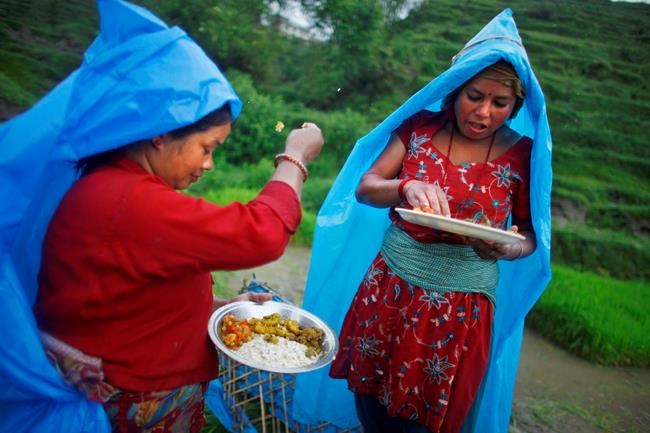
FILE - In this June 30, 2014 file photo, a farmer, left, ritualistically offers a small portion of food to god before eating her lunch while working at a rice field in Chunnikhel, Katmandu, Nepal. Languages evolve as societies develop and change, but the sounds we utter are also shaped, literally, by the placement of our jaw – and that is influenced by how we chew our food, researchers say in a report released Thursday, March 14, 2019, in the journal Science. (AP Photo/Niranjan Shrestha)

The researchers analyzed Stone Age and modern skulls and created simulations of how different jaw placements allow our mouths to make different sounds. They analyzed a database of roughly 2,000 languages — more than a quarter of languages in existence today — to identify which sounds were more and less frequently used, and where.

Languages spoken by groups with hunter-gatherer societies in their more recent past are far less likely to use consonants used by longtime farming societies, the study found.

“Our anatomy actually changed the types of sounds being incorporated into languages,” Noreen von Cramon-Taubadel, an evolutionary anthropologist at the University of Buffalo who was not involved in the study, wrote in an email.

Before societies cultivated crops and learned to cook food, early humans chewed tough raw meat — which was hard work on our jaws and teeth. Stone Age adult skulls don’t look like modern skulls. These older skulls have upper and lower teeth closing directly on top of each other — whereas today most people have some degree of overbite, with the front teeth extending in front of bottom teeth when the mouth is closed.

“If you are raised on softer foods, you don’t have the same kind of wear and tear on your bite that your ancestors had, so you keep an overbite,” said Bickel.

Eating softer foods not only sets the jaw in a different fashion, but also changes which sounds are easily pronounced. In particular, it becomes much easier to say “f” and “v,” which linguists call “labiodental” sounds.

(Try it. Put your upper and lower incisors — or “front teeth” — directly on top of each other and try say “favour.” It’s difficult.)

The researchers looked closely at 52 languages from what is called the Indo-European language group — including dialects spoken from Iceland to India — and charted how the “f” and “v” sounds appeared in a rising number of languages over time. As more societies developed agriculture and traded in raw meat for softer fare — whether it’s cooked meat and potatoes, or rice and stewed vegetables — these sounds became more common, the researchers found.

“New sounds get introduced into languages, and then are more widely adopted,” said Steven Moran, also a linguist at the University of Zurich and co-author of the paper.

The notion that agriculture shaped language was first suggested decades ago by American linguist Charles Hockett, but he did not attempt to prove it.

Elan Dresher, a linguist at the University of Toronto who was not involved in the study, commended testing Hockett’s theory, but said the research could be fine-tuned by looking at historical reconstructions of languages, rather than using language databases to make comparisons.

___

The Associated Press Health and Science Department receives support from the Howard Hughes Medical Institute’s Department of Science Education. The AP is solely responsible for all content.


Report Error Submit a Tip

More Stories

Khan cites infighting, quits as Tory leader

Carol Sanders 5 minute read Preview

Khan cites infighting, quits as Tory leader

Carol Sanders 5 minute read Updated: 6:30 AM CDT

Manitoba’s Leader of the Opposition is stepping down.

Progressive Conservative Leader Obby Khan announced late Monday afternoon he is quitting caucus and will sit in the legislature as an independent MLA, effective today.

He cited internal party fighting for his decision.

The former Winnipeg Blue Bombers offensive lineman survived a caucus confidence vote Friday. He said there were 13 votes for him to remain and six against, with one person absent.

Read
Updated: 6:30 AM CDT

Horoscope

Georgia Nicols 4 minute read Preview

Horoscope

Georgia Nicols 4 minute read 2:00 AM CDT

Moon alert: Avoid shopping (except food and gas) and important decisions until 1 p.m. After that, there are no restrictions to shopping or important decisions. The moon is in Gemini.

Aries (March 21-April 19)

A busy, chatty day. Your communication skills are excellent. Wait until the moon alert is over to commit to any important decisions or ideas. Tap into your creative talents. It’s also a lovely day to schmooze and enjoy sports and kids’ activities.

Taurus (April 20-May 20)

Read
2:00 AM CDT

Is another goalie on Jets’ wish list?

Ken Wiebe 7 minute read Preview

Is another goalie on Jets’ wish list?

Ken Wiebe 7 minute read Sunday, Sep. 27, 2026

Kevin Cheveldayoff and company are down to the short strokes.

With the opening-day roster due on Monday afternoon, the Winnipeg Jets took steps on the weekend to get down to the final number.

As it stood on Sunday, the Jets were down to 24 healthy players in training camp after centre Danny Zhilkin and defenceman Henry Thrun were placed on waivers.

With a maximum of 23 spots available, the only things left to determine are whether the Jets are interested in claiming a more experienced goalie to serve as the backup to Stuart Skinner and if centre Brayden Yager will break camp with the big club.

Read
Sunday, Sep. 27, 2026

Province to acquire campground near former residential school

Morgan Modjeski 3 minute read Preview

Province to acquire campground near former residential school

Morgan Modjeski 3 minute read 6:00 AM CDT

A burial site for dozens of children who died while attending the Brandon Indian Residential School will be acquired by the province, the Free Press has learned.

Premier Wab Kinew will announce the province’s plan to protect Turtle Crossing Campground at a news conference in Brandon Wednesday to mark National Day for Truth and Reconciliation. The move is in partnership with the City of Brandon.

The graves of at least 56 children are located at the campground, the Sioux Valley Dakota Nation has said, pointing to a geophysical study conducted by an archaeology firm in 2018.

There have been longstanding concerns from Indigenous leaders and community members that people were camping on the resting place of children victimized by colonialism.

Read
6:00 AM CDT

Retiree sues neighbour over alleged dog attack

Scott Billeck 2 minute read 2:00 AM CDT

A Winnipeg man is suing his neighbour over an alleged dog attack he says occurred while he was helping him with a lawnmower.

Arthur Cabel, a retiree who lives on Selkirk Avenue, is seeking unspecified damages from neighbour Saisamone Saegone, according to a statement of claim filed in the Manitoba Court of King’s Bench last week.

Cabel claims he went to Saegone’s home in the afternoon on Sept. 23, 2024, to help him with his lawnmower.

According to the lawsuit, Saegone’s large dog, initially in a fenced backyard, escaped, approaching Cabel and “mauling, attacking and biting him.”

Jets pick up netminder as relatively new 23-man roster announced

Mike McIntyre 7 minute read Preview

Jets pick up netminder as relatively new 23-man roster announced

Mike McIntyre 7 minute read Updated: Yesterday at 9:25 PM CDT

Let’s get the caveats out of the way: Nothing is set in stone, nor written in permanent ink, and what you see right now could change in the blink of an eye.

With that being said, allow us to introduce you to the 2026-27 Winnipeg Jets — where change is very much in the air.

The 23-man roster submitted to the NHL offices by Monday’s 4 p.m. deadline includes seven players who were not on the team at this time last year. In fact, there could be as many as 10 new faces in the opening-night lineup on Friday against Boston when you factor in three regulars didn’t start the 2025-26 campaign due to injury.

That’s a lot of turnover, which isn’t surprising for a team that finished 26th overall in the standings and was — to most fans and pundits — too old and too slow.

Read
Updated: Yesterday at 9:25 PM CDT