

Province to acquire campground near former residential school

Advertisement
Read this article for free:
or
Already have an account? Log in here »
To continue reading, please subscribe:

Digital Subscription
One year of digital access for only $205*
- Enjoy unlimited reading on winnipegfreepress.com
- Read the E-Edition, our digital replica newspaper
- Access News Break, our award-winning app
- Play interactive puzzles
*First annual payment billed as $205.00 + GST for one year. This annual subscription will automatically renew at $233.00 + GST every 52 weeks (10% off the regular annual price of $259.35). Offer available to new and qualified returning subscribers only. Cancel any time.
To continue reading, please subscribe:
Add Free Press access to your Brandon Sun subscription for only an additional
$1 for the first 4 weeks*
- Enjoy unlimited reading on winnipegfreepress.com
- Read the E-Edition, our digital replica newspaper
- Access News Break, our award-winning app
- Play interactive puzzles
*Your next Brandon Sun subscription payment will increase by $1.00 and you will be charged $17.95 plus GST for four weeks. After four weeks, your payment will increase to $24.95 plus GST every four weeks.
Read unlimited articles for free today:
or
Already have an account? Log in here »
A burial site for dozens of children who died while attending the Brandon Indian Residential School will be acquired by the province, the Free Press has learned.
Premier Wab Kinew will announce the province’s plan to protect Turtle Crossing Campground at a news conference in Brandon Wednesday to mark National Day for Truth and Reconciliation. The move is in partnership with the City of Brandon.
The graves of at least 56 children are located at the campground, the Sioux Valley Dakota Nation has said, pointing to a geophysical study conducted by an archaeology firm in 2018.
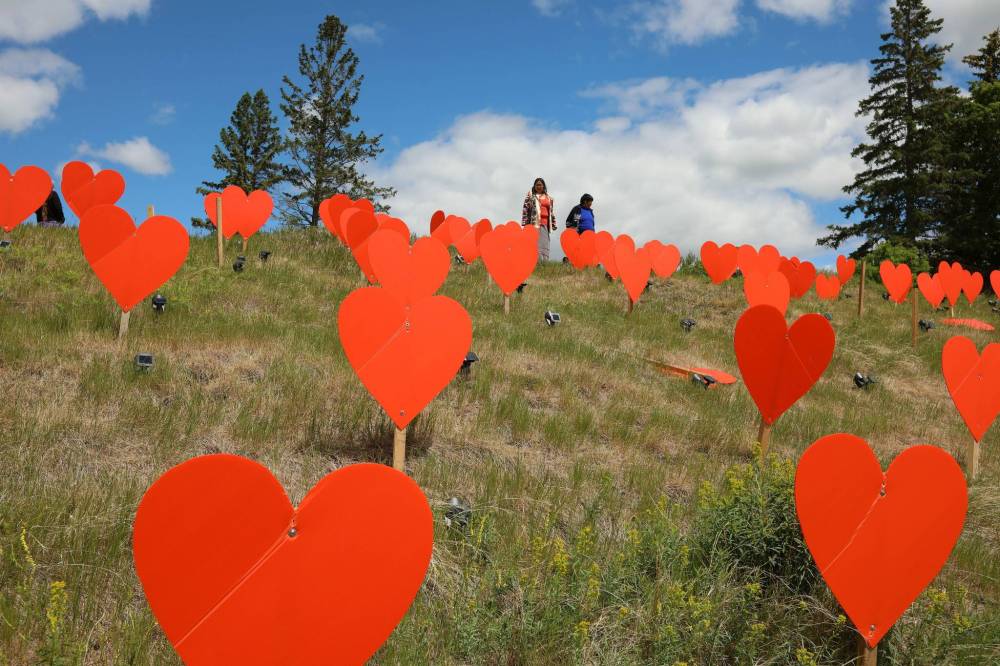
Tim Smith / Brandon Sun
Orange hearts memorialize the children who died at the Brandon Indian Residential School.
There have been longstanding concerns from Indigenous leaders and community members that people were camping on the resting place of children victimized by colonialism.
The school, which was located about five kilometres northwest of Brandon, operated from 1895 to 1972. It used a grave site near the Assiniboine River until 1912, with grave markers removed in 1921 so the area could be transformed into a park.
The City of Brandon sold the park privately in 2001, and in 2007, it was acquired by Mark Kovatch and his wife, Joan.
In the years following, the campground’s owners and the City of Brandon said work was ongoing to locate potential graves, an effort spearheaded by Sioux Valley Dakota Nation, but many were unhappy with the progress and access at the site.
“What really needs to happen is the City of Brandon needs to undo what it did,” said Jennifer Moore Rattray in 2021, noting her great aunt and great uncle were buried in unmarked graves at the site. “It needs to correct a wrong and it needs to purchase back the piece of land that is currently the cemetery.”
Sioux Valley Dakota Nation Chief Jennifer Bone, along with Chief Hubert Watt of God’s Lake First Nation and Manitoba Keewatinowi Okimakanak Grand Chief Garrison Settee, called for the site to be protected under the Heritage Resources Act in 2023.
Bone told the Brandon Sun in 2023 that no progress had been made to access the campground and search for the graves of children who were forced to attend the school.
“What really needs to happen is the City of Brandon needs to undo what it did”
“We haven’t had any access at all this year,” Bone said at the time.
Some of the children were buried in the Turtle Crossing Campground and at a cemetery further up the hill from where the school used to be, said a geophysical scientist who has worked on the project.
“The archival evidence has revealed, at this time, 113 names of children who perished at the Brandon residential school,” Christopher Mancuso told the Brandon Sun earlier this year.
The remaining children are documented as deceased but their burial grounds are unknown, he said.
The announcement is part of the Manitoba government’s ongoing commitment to reconciliation.
Survivors and affected First Nations will determine future steps for the site.
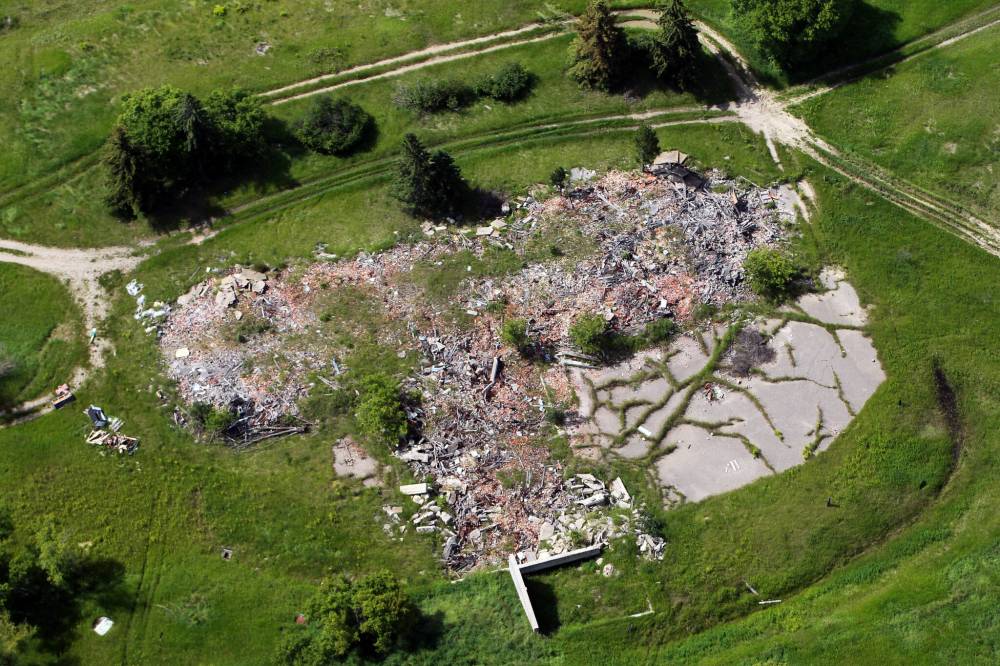
Tim Smith / Brandon Sun
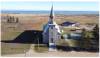
The site of the former Brandon Indian Residential School along Grand Valley Road is seen from the air in July, 2014.
A monument is set to be unveiled Wednesday at the site, listing the names of students who attended the former Brandon Indian Residential School. Bone said 2,700 names were identified through archival research and community engagement.
morgan.modjeski@freepress.mb.ca

Morgan Modjeski
Reporter
Signal
Morgan Modjeski is a news reporter and multimedia producer for the Free Press. Read more about Morgan.
Every piece of reporting Morgan produces is reviewed by an editing team before it is posted online or published in print — part of the Free Press‘s tradition, since 1872, of producing reliable independent journalism. Read more about Free Press’s history and mandate, and learn how our newsroom operates.
Our newsroom depends on a growing audience of readers to power our journalism. If you are not a paid reader, please consider becoming a subscriber.
Our newsroom depends on its audience of readers to power our journalism. Thank you for your support.
Morgan Modjeski
Reporter
Signal
Morgan Modjeski is a news reporter and multimedia producer for the Free Press. Read more about Morgan.
Every piece of reporting Morgan produces is reviewed by an editing team before it is posted online or published in print — part of the Free Press‘s tradition, since 1872, of producing reliable independent journalism. Read more about Free Press’s history and mandate, and learn how our newsroom operates.
Our newsroom depends on a growing audience of readers to power our journalism. If you are not a paid reader, please consider becoming a subscriber.
Our newsroom depends on its audience of readers to power our journalism. Thank you for your support.
Related Articles
Survivors gather at former residential school site near Brandon


Advertisement Advertise With Us
Advertisement Advertise With Us