7 tax changes investors should watch for as they file
Advertisement
Read this article for free:
or
Already have an account? Log in here »
To continue reading, please subscribe:

Digital Subscription
One year of digital access for only $205*
- Enjoy unlimited reading on winnipegfreepress.com
- Read the E-Edition, our digital replica newspaper
- Access News Break, our award-winning app
- Play interactive puzzles
*First annual payment billed as $205.00 + GST for one year. This annual subscription will automatically renew at $233.00 + GST every 52 weeks (10% off the regular annual price of $259.35). Offer available to new and qualified returning subscribers only. Cancel any time.
To continue reading, please subscribe:
Add Free Press access to your Brandon Sun subscription for only an additional
$1 for the first 4 weeks*
- Enjoy unlimited reading on winnipegfreepress.com
- Read the E-Edition, our digital replica newspaper
- Access News Break, our award-winning app
- Play interactive puzzles
*Your next Brandon Sun subscription payment will increase by $1.00 and you will be charged $17.95 plus GST for four weeks. After four weeks, your payment will increase to $24.95 plus GST every four weeks.
Read unlimited articles for free today:
or
Already have an account? Log in here »
Hey there, time traveller!
This article was published 15/03/2019 (2730 days ago), so information in it may no longer be current.
Americans will face a slew of new rules during the first tax-filing season with the Tax Cuts and Jobs Act of 2017 in effect.
Here’s what changed for investors:
1. NO DEDUCTION FOR INVESTMENT EXPENSES
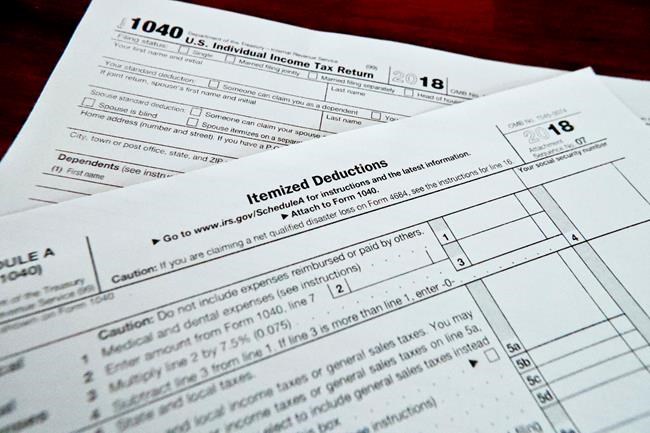
For taxpayers who itemize, the 2 per cent miscellaneous itemized deduction was a handy catchall bucket for expenses such as investment fees and expenses and tax-preparation fees. It wasn’t easy to qualify for this deduction — your expenses had to top 2 per cent of your adjusted gross income before you could claim them — but it was a nice option to have.
2. LOWER TAX RATES ON SHORT-TERM CAPITAL GAINS
Here’s some good news: The new tax law trimmed income tax rates . That means short-term capital gains — that’s money you make when you sell certain investments that you’ve held for less than a year — now also enjoy a slightly lower rate.
“If you’ve got short-term gains — those are taxed as ordinary income — they get the benefit of lower rates now, so there’s a bit of a break there,” says Tim Steffen, director of advanced planning at financial-services firm Baird, in Milwaukee.
3. THE NEW 20 Per cent PASS-THROUGH INCOME DEDUCTION
If you’re a real estate investor — say, you purchase houses and rent them out, or some other such activity — there’s a chance the new 20 per cent deduction on pass-through income will apply to you.
The rules are complex, but generally, to qualify for this deduction as a real estate investor, the IRS wants you to be operating a business. The IRS has announced some “safe harbour” rules to help clarify the types of activities that will allow real estate businesses to qualify for the deduction.
For example, you need to maintain separate books and records for this activity, and you or someone you hire must spend at least 250 hours a year managing your rentals, says Mark Luscombe, principal analyst with Wolters Kluwer Tax & Accounting in Riverwoods, Illinois.
But even if you don’t meet the safe harbour rules, you still might qualify. As noted, it’s complicated, so hire a tax pro if you think you might be eligible to claim this deduction.
Luscombe adds that investors in real estate investment trusts may enjoy the new deduction with respect to certain qualified dividends they receive from those REITs.
4. NO MORE ROTH RECHARACTERIZATIONS
Before the Tax Cuts and Jobs Act, converting a traditional IRA to a Roth IRA came with an out: By the tax-filing deadline — when you would have to pay income tax on the money you converted — you could reverse, or “recharacterize,” your decision.
In some cases, people were doing this if their investments in the account tanked between the time of the conversion and the tax-filing deadline. But now, no matter the reason, it’s no longer possible.
5. THE KIDDIE TAX IS A LITTLE DIFFERENT NOW
The way children’s unearned income (generally interest, dividends and investment gains) is taxed has changed. Previously, kids paid taxes at their parents’ rate on any unearned income over $2,100. Under the new rules, the rates for estates and trusts apply on unearned income over $2,100.
For the 2018 tax year, children pay 10 per cent on net unearned income up to $2,550; 24 per cent on any excess up to $9,150; 35 per cent on any further excess up to $12,500; and 37 per cent on any excess above $12,500. And for long-term capital gains and qualified dividends, the rates for estate and trusts apply: 0 per cent up to $2,600, 15 per cent from $2,600 to $12,700, and 20 per cent on the excess above $12,700. (A 3.8 per cent tax on net investment income may apply as well.)
6. IT’S EASIER TO PAY BACK 401(K) LOANS
Under the old rules, if you lost your job while you had a 401(k) loan outstanding, that loan became due within 60 days — and if you didn’t meet that deadline you risked owing taxes and a 10 per cent penalty on that money.
The new tax rules give you until the tax-filing deadline (up to mid-October if you file an extension) to pay back your loan and avoid the taxes and 10 per cent penalty.
7. YOU CAN SEND MORE TO YOUR RETIREMENT ACCOUNT
This has nothing to do with the new tax law and everything to do with the IRS’s annual inflation adjustments: Starting in 2019, you can contribute up to $6,000 ($7,000 if you’re 50 or older) to a traditional IRA or Roth IRA.
And don’t forget that you still have time to save on your 2018 taxes by putting money into a traditional IRA before April 15. Assuming you’re eligible to deduct your contributions, the amount you contribute will reduce your taxable income — and thus, your tax bill.
The maximum IRA contribution in 2018 was $5,500 ($6,500 if you’re 50 or older). Keep in mind that’s the max you can put in all of your traditional and Roth IRAs combined. And be sure to specify which tax year you want your contribution to go toward — 2018 or 2019.
____________________________________________
This article originally appeared on the personal finance website NerdWallet. Andrea Coombes is a writer at NerdWallet. Email: acoombes@nerdwallet.com. Twitter: @andreacoombes.
RELATED LINKS:
NerdWallet: The 2018-2019 federal income tax brackets and new tax rates http://bit.ly/nerdwallet-lists-federal-income-tax-brackets
NerdWallet: Does my business get the new pass-through deduction? http://bit.ly/nerdwallet-explains-pass-through-tax-deduction
NerdWallet: How to set up a backdoor Roth IRA http://bit.ly/nerdwallet-backdoor-roth-IRA-guide