Native Americans say movement to end ‘redface’ is slow

Advertisement

Advertise with us

FLAGSTAFF, Ariz. - John Little can hardly go a week without a reminder that he and other Native Americans often are viewed as relics of the past: the Indian maiden on the butter container at the grocery store, the kids' teepees sold at popular retailers and the sports fans with their faces painted doing tomahawk chops at games.

Read this article for free:

or

Already have an account? Log in here »

To continue reading, please subscribe:

Subscribe and receive a limited-edition Free Press branded hat or tote.

Digital Subscription

One year of digital access for only $205*

  • Enjoy unlimited reading on winnipegfreepress.com
  • Read the E-Edition, our digital replica newspaper
  • Access News Break, our award-winning app
  • Play interactive puzzles

*First annual payment billed as $205.00 + GST for one year. This annual subscription will automatically renew at $233.00 + GST every 52 weeks (10% off the regular annual price of $259.35). Offer available to new and qualified returning subscribers only. Cancel any time.

To continue reading, please subscribe:

Add Free Press access to your Brandon Sun subscription for only an additional

$1 for the first 4 weeks*

  • Enjoy unlimited reading on winnipegfreepress.com
  • Read the E-Edition, our digital replica newspaper
  • Access News Break, our award-winning app
  • Play interactive puzzles
Start now

*Your next Brandon Sun subscription payment will increase by $1.00 and you will be charged $17.95 plus GST for four weeks. After four weeks, your payment will increase to $24.95 plus GST every four weeks.

Hey there, time traveller!
This article was published 17/03/2019 (2698 days ago), so information in it may no longer be current.

FLAGSTAFF, Ariz. – John Little can hardly go a week without a reminder that he and other Native Americans often are viewed as relics of the past: the Indian maiden on the butter container at the grocery store, the kids’ teepees sold at popular retailers and the sports fans with their faces painted doing tomahawk chops at games.

But he doesn’t hear widespread outrage over these images that many Native Americans find offensive, even as the country has spent most of the year coming to grips with blackface and racist imagery following the revelation of a racist photo on the Virginia governor’s college yearbook page. Since then, new examples have surfaced regularly, most recently a TV host who painted her face brown in a parody of Oscar-nominated Mexican actress Yalitza Aparicio.

“These are everyday realities for Native people,” said Little, a Standing Rock Sioux tribal member.
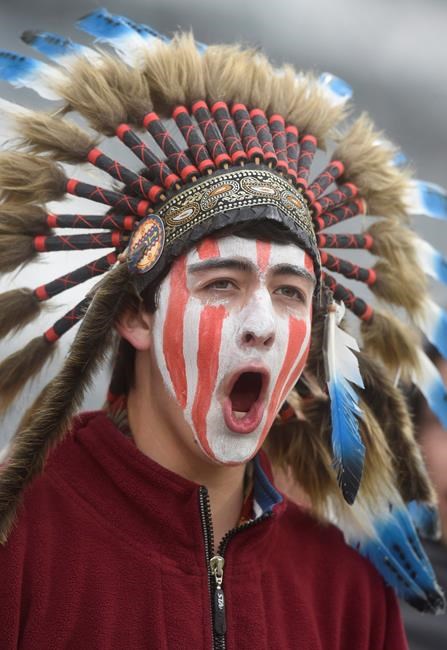
FILE - In this May 20, 2015, file photo, a Cheyenne Mountain High School student wears a headdress and face paint as he cheers for his school -- which uses
FILE - In this May 20, 2015, file photo, a Cheyenne Mountain High School student wears a headdress and face paint as he cheers for his school -- which uses "Indians" as its team mascot -- in the 4A State Soccer Championship game at Dick's Sporting Goods Park in Commerce City, Colo. The U.S. has spent most of 2019 coming to grips with blackface and racist imagery, including a racist photo on the Virginia governor’s college yearbook page. But Native Americans say they don't see significant pressure applied to those who perpetuate Native American stereotypes. (Mark Reis/The Gazette via AP, File)

Redface may get less attention because of ingrained misconceptions and feelings of entitlement to Native American culture and land, scholars say. Native Americans also are a relatively small group, making up less than 2 per cent of the U.S. population. Blacks, by comparison, make up around 13 per cent.

Convincing the masses that stereotyping Native Americans as savage, ignorant or humourless is insulting has been a slow movement, scholars say, and one they aren’t sure will gain steam.

Throughout America’s history, people have donned redface, worn fringe and feathers, and spoken in broken English as they “played” or portrayed Native Americans in theatre, film and everyday life. In one of the earliest examples, colonists dressed as Mohawk Indians dumped tea into the Boston harbour in 1773 in protest of British rule.

Early settlers wanted to take what they saw as the best values of Native Americans while simultaneously seizing the land and destroying tribal communities, scholars say.

Part of that was a desire to be seen as indigenous to the new land. Secret societies based on Native American symbols, customs and terminology formed and still exist, such as the Improved Order of Red Men and the Boy Scouts’ Order of the Arrow.

Waves of Jewish immigrants in the early 1900s sought to align themselves with Native Americans, whom they saw as fellow displaced people, dressing up as and singing songs about being Native American while belittling them to be socially accepted, said Peter Antelyes, an associate professor in English and Jewish studies at Vassar College.

Philip J. Deloria, a Harvard University history professor and author of “Playing Indian,” said Native Americans also were hypersexualized and depicted as cannibals. One famous political cartoon shows European nations lifting up the skirt of a Native American woman to reveal the newfound land, suggesting both were open to the desires of men, he said.

The Last of the Mohicans, published in 1826, furthered those depictions and stereotypes, as did Buffalo Bill’s Wild West shows, Deloria said.

Some actors later playing Native Americans made it their real-life image. Italian-American actor Iron Eyes Cody is well-known in Indian Country for a 1971 environmental ad in which he shed a single tear after paddling through a river littered with trash. He wore fringed buckskin and had a feather in his long, braided hair.

Most people think those images, largely based on 19th century Plains Indians, are who Native Americans were and still are, Deloria said. And some believe Natives went extinct.

“There’s a big, long, complicated history to this that’s really deep in American culture,” Deloria said. “It’s every bit as deep as blackface minstrelsy and slavery. It’s just out there, but we’ve kind of forgotten about it.”

Nowhere is redface more prominent than at sporting events featuring teams with Native American mascots like the Redskins, Braves and Indians, and around Halloween.
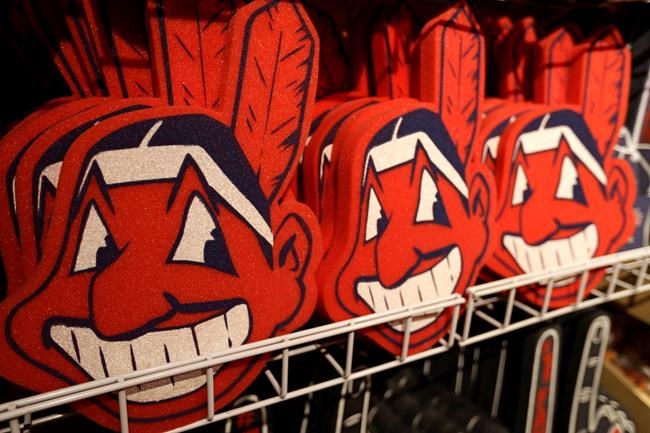
FILE - In this Jan. 29, 2018 file photo, foam images of the MLB baseball Cleveland Indians' mascot Chief Wahoo are displayed for sale at the Indians' team shop in Cleveland. The Chief Wahoo logo is being removed from the Cleveland Indians' uniform in the 2019 season, but the Club will still sell merchandise featuring the mascot in Northeast Ohio. The U.S. has spent most of 2019 coming to grips with blackface and racist imagery, but Native Americans say they don't see significant pressure applied to those who perpetuate Native American stereotypes. (AP Photo/Tony Dejak, File)

In the documentary “More Than a Word” about the Washington Redskins, fans say the team name honours Native Americans. Stadiums today are dotted with fans who paint their faces, perform their versions of a Native American dance or war cry, and wear toy or replica headdresses that are mass-produced.

It’s insulting to many Native Americans because headdresses historically were a symbol of honour and respect, earned by tribal chiefs and warriors, they say. Modern-day veterans and leaders sometimes are gifted them in ceremonies and honoured with the right to wear them.

“It’s easy to do the comparison: If this was blackface, it wouldn’t be tolerable,” said Little, who co-directed the documentary. “But that also discredits it because you are comparing issues in two separate races and two distinct people.”

Redface for many Native Americans isn’t limited to face paint. It also includes clothing and speech.

Celebrities have donned fake headdresses and feathers and hosted cowboys and Indians parties without many repercussions, beyond being called on to apologize. Non-Native actors portray Native Americans in movies more often than Native Americans do. And some politicians routinely cast doubt on tribes’ ability to control their own land.

“It’s hard for me to say people don’t know it’s wrong,” said Kyle Mays, an assistant professor of African American and American Indian studies at the University of California-Los Angeles, who is black and Saginaw Anishinaabe. “They might not know Native people, (but) they know it’s wrong and it’s just OK to do because there are not any consequences for it.”

Nicholet Deschine Parkhurst, who is Lakota and Navajo, has been trying to take companies to task for misappropriating Native American culture and to highlight indigenous people in a more contemporary way.

“When you’re viewed in that way, as only existing in the past, as the ‘frozen Indian’ found in museums … it makes it harder for voices of leaders in our communities to actually be heard, and it’s easier for people to ignore us,” she said.
Report Error Submit a Tip

More Stories

Today’s horoscope

Georgia Nicols 4 minute read Preview

Today’s horoscope

Georgia Nicols 4 minute read 2:00 AM CDT

MOON ALERT: There are no restrictions to shopping or important decisions. The moon is in Taurus.

ARIES (March 21-April 19)

Resist the urge to get tangled up in financial disagreements with your kids, a friend, a group or a romantic partner. (Actually, anyone who wants to get in a fight with you.) You don’t need this. Focus on social outings. Keep things light.

TAURUS (April 20-May 20)

Read
2:00 AM CDT

Toronto’s alternative crisis response model deemed a success

Scott Billeck 4 minute read Preview

Toronto’s alternative crisis response model deemed a success

Scott Billeck 4 minute read Yesterday at 2:01 AM CDT

A Toronto emergency response program that helped inspire Winnipeg’s proposed alternative crisis response model has already expanded city-wide, just four years after launching as a pilot project.

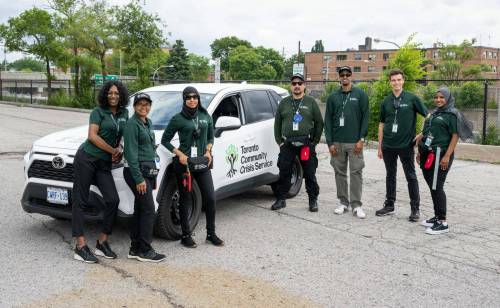
The Toronto Community Crisis Service, launched in 2022, has become the city’s fourth emergency service, providing a 24-7, community-based response to people experiencing mental health crises. The service has handled nearly 50,000 calls through 911 and 211, dispatched mobile crisis teams to more than 41,000 incidents, made more than 11,600 referrals to health and social services and resolved the majority of eligible 911 calls without police involvement.

Winnipeg Mayor Scott Gillingham last week proposed creating a similar “fourth crisis response pathway” that would allow 911 calls that aren’t violent or criminal in nature to be transferred to community-based crisis teams.

Under the proposal, which has support from both the Winnipeg Police Service and the Winnipeg Fire Paramedic Service, a centralized crisis dispatch and co-ordination hub would receive triaged calls and match them with citywide response teams, staffed in part through existing community organizations, including the Downtown Community Safety Partnership and The Link’s mobile crisis teams. The goal is to divert appropriate calls away from the WPS and WFPS.

Read
Yesterday at 2:01 AM CDT

Concordia doctor denies responsibility for Calgary man’s permanent disability

Erik Pindera 4 minute read Preview

Concordia doctor denies responsibility for Calgary man’s permanent disability

Erik Pindera 4 minute read Yesterday at 3:52 PM CDT

A Concordia Hospital doctor accused in a negligence lawsuit after a Calgary man was left permanently disabled when he was given a massive overdose of a powerful sedative has denied she ordered he be given the drug.

Zachary Hoogerdyk’s father, Edward Hoogerdyk, and the Alberta government filed their statement of claim earlier this year in Court of King’s Bench naming the Winnipeg Regional Health Authority, provincial health agency Shared Health, Concordia Hospital, Dr. Anna Ziomek and two other hospital staff as defendants.

Hoogerdyk, who was 23 at the time, went to Concordia’s urgent-care centre with flu-like symptoms and worsening breathing difficulties on March 25, 2024 while he was in Winnipeg on business and to visit family, the lawsuit says.

The claim alleges Ziomek diagnosed Hoogerdyk with low levels of oxygen in his blood and a strain of the flu, before ordering him to be intubated.

Read
Yesterday at 3:52 PM CDT

Team says Allen recovering from nightclub assault

Joshua Frey-Sam 5 minute read Preview

Team says Allen recovering from nightclub assault

Joshua Frey-Sam 5 minute read Yesterday at 6:03 PM CDT

The Winnipeg Sea Bears are preparing for the Canadian Elite Basketball League playoffs without the services of its Most Valuable Player.

The club announced on Tuesday that star guard Teddy Allen has been ruled out for Thursday’s Western Conference semifinal against the Saskatoon Mamba at Canada Life Centre (7:30 p.m.) as he recovers from “significant health injuries” suffered after being assaulted by security staff at a downtown nightclub on Sunday.

“We continue to co-operate with the Winnipeg Police Service on its investigation and have referred them individuals and information based on what has been provided to us from those on the scene,” a statement from the club read.

“What we’ve seen and heard to date leads us to believe that Teddy was the victim of an assault at the hands of security at a downtown nightclub.”

Read
Yesterday at 6:03 PM CDT

Homegrown grub: Resto turns to the Leaf for freshest ingredients

AV Kitching 4 minute read Preview

Homegrown grub: Resto turns to the Leaf for freshest ingredients

AV Kitching 4 minute read Yesterday at 3:39 PM CDT

The term “eat local” has taken on a whole new meaning at Gather Craft Kitchen and Bar, where the journey from plot to plate is measured in footsteps rather than miles.

Head chef Mike Licharson has expanded the restaurant’s focus on local sourcing by incorporating fruit and vegetables grown in The Leaf’s biomes and outdoor kitchen garden into his menu.

Bananas from the tropical biomes star in his banana-bread French toast and accompanying banana compote. Leeks, braised slowly and paired with Manitoba-grown beluga lentils, and Swiss chard — which takes the place of grape leaves in Licharson’s play on classic meze dolmades, a nod to the chef’s Greek-Ukrainian-Irish heritage — are both grown in the outdoor kitchen garden.

The park’s produce complements the restaurant’s other locally sourced ingredients, Licharson says.

Read
Yesterday at 3:39 PM CDT

Cyril Ramaphosa and South African law

Gwynne Dyer 5 minute read 2:01 AM CDT

It’s outrageous. You’re at your hobby farm in the country, just pottering around, so you stuff the $580,000 in your pocket under the sofa cushions temporarily, just to get it out of the way. Then you forget it when you are gathering things up to go back to the city. It could happen to anybody.

However, thieves break into your country house while you’re away and steal the money. You consider reporting it to the police, but you know they are struggling to keep up with the crime wave, so you decide to forget about it.

Even though it was foreign currency, you don’t report it to the tax authorities, either, because you never got to spend it. Or something like that.

But then events take a turn decidedly for the worse. A man called Arthur Fraser sends a dossier to the police reporting that you got the money and that it was not actually $580,000 but a whole $4 million. And since Mr. Fraser was the country’s former chief spy, they take him seriously and come to you looking for answers.