Want to help bees? Plant flowering herbs

Advertisement

Advertise with us

Herbs are among the most useful plants in nature. They can tantalize the taste buds, help cure what ails you, oil the body, perfume the air, and attract bees, butterflies and hummingbirds.

Read this article for free:


or

Already have an account? Log in here »

To continue reading, please subscribe:

Subscribe and receive a limited-edition Free Press branded hat or tote.

Digital Subscription

One year of digital access for only $205*

  • Enjoy unlimited reading on winnipegfreepress.com
  • Read the E-Edition, our digital replica newspaper
  • Access News Break, our award-winning app
  • Play interactive puzzles

*First annual payment billed as $205.00 + GST for one year. This annual subscription will automatically renew at $233.00 + GST every 52 weeks (10% off the regular annual price of $259.35). Offer available to new and qualified returning subscribers only. Cancel any time.

To continue reading, please subscribe:

Add Free Press access to your Brandon Sun subscription for only an additional

$1 for the first 4 weeks*

  • Enjoy unlimited reading on winnipegfreepress.com
  • Read the E-Edition, our digital replica newspaper
  • Access News Break, our award-winning app
  • Play interactive puzzles
Start now

*Your next Brandon Sun subscription payment will increase by $1.00 and you will be charged $17.95 plus GST for four weeks. After four weeks, your payment will increase to $24.95 plus GST every four weeks.

Hey there, time traveller!
This article was published 19/03/2019 (2706 days ago), so information in it may no longer be current.

Herbs are among the most useful plants in nature. They can tantalize the taste buds, help cure what ails you, oil the body, perfume the air, and attract bees, butterflies and hummingbirds.

“People are getting more into herbs, with herb sales definitely on the rise,” said David Trinklein, an Extension horticulturist with the University of Missouri. “They’re using fresh herbs from the garden for culinary purposes, but another important reason is to help pollinators.”

Many gardeners are trying to help declining pollinator populations by providing them with the plants they need to thrive.
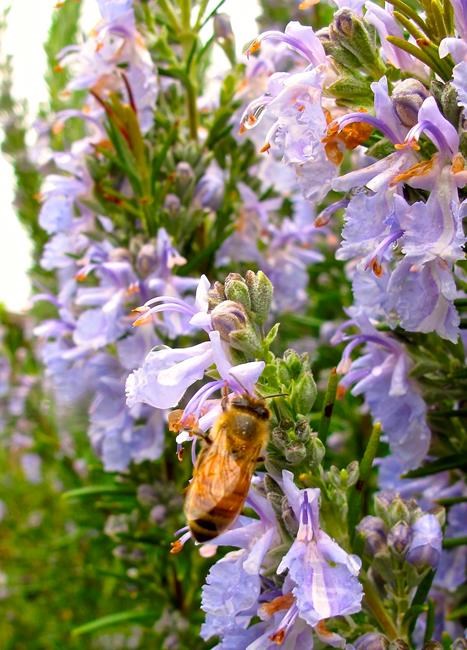
This April 19, 2013 photo shows a honeybee on Rosemary blooms in a garden near Langley, Wash. Some herbs, like fennel and dill, also serve as host plants for butterfly caterpillars. (Dean Fosdick via AP)

Herbs appeal to a great variety of bee species, said Francis Drummond, a professor of insect ecology and insect pest management at the University of Maine.

“It is mostly the abundant nectar that brings the bees in,” he said. “Some of the more attractive herbs to bees are thyme, comfrey, borage, oregano, bee’s friend, lemon balm, rosemary, hyssop, sage, lavender and chives.”

Most flowering herbs are attractive to pollinators, but some, like cilantro and basil, tend to lose other qualities when they blossom or bolt, said Ed Spevak, curator of invertebrates at the St. Louis Zoo. “So use the leaves earlier (for your own purposes) but then allow the plant to flower to support pollinators,” he said.

Some herbs, like cilantro, fennel and dill, produce very small blossoms that attract very small bees, Spevak said. “Fennel and dill also serve as host plants for black swallowtail caterpillars,” he said.

Bees find flowers by way of their colour, not their scent, said David Salman, founder and chief horticulturist for High Country Gardens. “Particularly honeybees, although some native bees will feed on them as well,” he said. “But herbs primarily have Old World origins, so their primary interest is (for) honeybees which also were imported here.

“In general, annual herbs tend to be more important for butterflies, primarily swallowtails,” Salman said.

Pollinators as a whole are necessary for a huge amount of the world’s food production, but the European honeybee is a critical species, Trinklein said.

“They’re the king of the pollinators,” he said. “They are morphologically designed to be pollinators, while other species are more accidental pollinators. They’re also greater in number and activity level than other species of pollinators.”

Bees need to collect syrup and pollen from early spring through late fall to support a healthy hive, Trinklein said. That means gardeners should plant a variety of flowers and herbs to prolong the bloom season.

Many beekeepers maintain that the herbs used for attracting pollinators should be natives, but Trinklein disagrees.
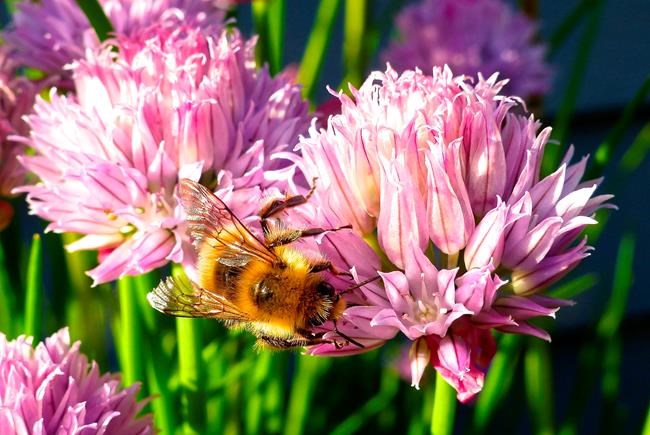
This May 20, 2015 photo shows Containerized chive blossoms in a yard near Langley, Wash., which attract a variety of bee species. Gardeners are opting for more herbs in their yards for culinary use but also to attract pollinators. (Dean Fosdick via AP)

“I don’t think a bee minds if an herb is native or non-native,” he said. “Lavender and anything in the catnip family are particularly attractive to bees.”

Gardeners seeking to support pollinators might consider planting scent gardens made up entirely of herbs. They would provide pleasing fragrances around the home as well as nutrition for the bees, he said.

“However, it is advisable to avoid (wearing) strong-smelling perfumes, hairsprays or other fragrances which might attract to the gardener confused bees seeking out nectar,” Trinklein said.

___

Online:

For more about growing pollinator friendly herbs, see this fact sheet from University of Illinois Extension: https://web.extension.illinois.edu/cfiv/downloads/56964.pdf

You can contact Dean Fosdick at deanfosdick@netscape.net

Report Error Submit a Tip

More Stories

Rise of social media reflects rise of self-promotion — to the detriment of genuine storytelling

Reviewed by Matt Henderson 5 minute read Preview

Rise of social media reflects rise of self-promotion — to the detriment of genuine storytelling

Reviewed by Matt Henderson 5 minute read 3:00 AM CDT

A conversation is overheard between two people; one congratulates the other on their success, evident through countless posts on LinkedIn, but the other confesses the prolific aggrandizement is due to slumping success.

A young man on an airplane spends three hours poring over selfies taken on a vacation, zooming in on his biceps and using AI to retouch photos before posting on Instagram.

Anonymous and cowardly trolls on Reddit attempt to end another person’s career.

All this “storytelling” was observed in one day by this reviewer.

Read
3:00 AM CDT

City Lego seller continues to build up its business

Gabrielle Piché 5 minute read Preview

City Lego seller continues to build up its business

Gabrielle Piché 5 minute read Updated: Yesterday at 8:54 AM CDT

Brick by brick, a Winnipeg Lego seller is building its third expansion — in less than two years.

Read
Updated: Yesterday at 8:54 AM CDT

Meetings accomplish something that an email never could while respecting people’s time, building relationships

Tory McNally 7 minute read Preview

Meetings accomplish something that an email never could while respecting people’s time, building relationships

Tory McNally 7 minute read 3:00 AM CDT

There are few workplace experiences that unite employees quite like complaining about meetings. Ask almost anyone what frustrates them at work, and somewhere on the list will be the meeting that could have been an email. We’ve all been there. Thirty minutes scheduled for a simple update somehow turns into an hour. Half the attendees don’t need to be there. Someone shares their screen for ten minutes trying to find the right document. The meeting ends with everyone wondering what was actually decided.

It’s no surprise that organizations are looking for ways to reduce meeting fatigue. Every hour spent in a meeting is an hour that isn’t spent serving customers, solving problems, writing reports, or completing projects. As calendars become increasingly crowded, employees often find themselves working longer days simply to catch up on the work they couldn’t accomplish because they were in meetings.

The obvious solution seems simple: hold fewer meetings. In many cases, that’s exactly the right answer. Routine updates, policy reminders, project status reports, and information that doesn’t require discussion can often be shared through email and chat platforms. Not every piece of information deserves everyone’s calendar.

But eliminating meetings altogether would create a different problem, especially as more organizations embrace hybrid and remote work.

Read
3:00 AM CDT

Proposed Transcona development — which could add 20,000 people — gets thumbs down from residents

Joyanne Pursaga 5 minute read Preview

Proposed Transcona development — which could add 20,000 people — gets thumbs down from residents

Joyanne Pursaga 5 minute read Yesterday at 6:15 PM CDT

Dozens of Winnipeggers fear plans to make way for up to 20,000 more people to live in south Transcona would dramatically alter their neighbourhood and tie hefty fees for new services to their property titles.

If city council adopts the proposed South Transcona secondary plan, all future development applications would need to conform to its goals. The affected area is located south of Dugald Road, north of St. Boniface Road, east of Plessis Road and west of Murdock Road.

Homeowner Virginia Page Jähne fears the plan could add a massive tab to the title of her 4.3-acre property to cover services required for the development.

“My main concern is that they are wanting to put $1.4 million onto my title to pay for this. Now, they say that I will not have to pay it unless I subdivide. But if a person comes by and wants to buy from me … and they see that $1.4 million … what’s the first thing (they’re) going to do?” said Page Jähne, in an interview.

Read
Yesterday at 6:15 PM CDT

A Life's Story: Woman fought for better outcomes for others amid cancer fight

Janine LeGal 7 minute read Preview

A Life's Story: Woman fought for better outcomes for others amid cancer fight

Janine LeGal 7 minute read 3:00 AM CDT

Catherine Mary Burke was strong and motivated in ways many of us could never imagine.

She was known for fighting the good fight, and she fought as hard as she could for as long as she could. But something set her apart. Even when it was too late for her, she insisted cancer survival rates had to be better for other women. And they are today because of her fierce determination.

Burke died on Nov. 29, 2025, at age 67 after courageously facing breast cancer for more than a decade.

“Cathy was born happy,” said her husband, Patrick Burke. “She was a glass-half-full person. What a gift this attitude was to me and the boys. She never once said ‘Why me?’ or complained. She was just so happy to be alive.

Read
3:00 AM CDT

Could renewed interest in strategically critical rare earth elements finally make sub-sector profitable?

Joel Schlesinger 6 minute read Preview

Could renewed interest in strategically critical rare earth elements finally make sub-sector profitable?

Joel Schlesinger 6 minute read 3:00 AM CDT

Rare earth elements are among the most critical of mined resources for modern economies.

They’re essential in manufacturing specialized magnets used in a host of technologies from wind turbines and electric vehicles to hard drives, smartphones, television screens, and fibre optics. Most notably, however, rare earth minerals are increasingly vital to the defence industry.

These 17 elements — closely related chemically and usually found all together in mineral deposits — have indeed been growing in geopolitical importance as the United States, Canada and other Western nations recognize their dependence on production from China.

It is the world’s largest producer and processor of rare earths, including the most in-demand elements neodymium and praseodymium used to manufacture very light and powerful magnets for an array of technologies, including the most advanced weapons of modern warfare.

Read
3:00 AM CDT