Study: Safe to transplant hepatitis C-infected hearts, lungs

Advertisement

Advertise with us

WASHINGTON - Doctors can safely transplant hepatitis C-infected lungs and hearts into people desperate for a new organ, say researchers who may have found a way to protect those patients from getting the risky virus.

Read this article for free:


or

Already have an account? Log in here »

To continue reading, please subscribe:

Subscribe and receive a limited-edition Free Press branded hat or tote.

Digital Subscription

One year of digital access for only $205*

  • Enjoy unlimited reading on winnipegfreepress.com
  • Read the E-Edition, our digital replica newspaper
  • Access News Break, our award-winning app
  • Play interactive puzzles

*First annual payment billed as $205.00 + GST for one year. This annual subscription will automatically renew at $233.00 + GST every 52 weeks (10% off the regular annual price of $259.35). Offer available to new and qualified returning subscribers only. Cancel any time.

To continue reading, please subscribe:

Add Free Press access to your Brandon Sun subscription for only an additional

$1 for the first 4 weeks*

  • Enjoy unlimited reading on winnipegfreepress.com
  • Read the E-Edition, our digital replica newspaper
  • Access News Break, our award-winning app
  • Play interactive puzzles
Start now

*Your next Brandon Sun subscription payment will increase by $1.00 and you will be charged $17.95 plus GST for four weeks. After four weeks, your payment will increase to $24.95 plus GST every four weeks.

Hey there, time traveller!
This article was published 03/04/2019 (2685 days ago), so information in it may no longer be current.

WASHINGTON – Doctors can safely transplant hepatitis C-infected lungs and hearts into people desperate for a new organ, say researchers who may have found a way to protect those patients from getting the risky virus.

The experiment, reported Wednesday, is the latest attempt to put a dent in the nation’s long transplant waiting list by using organs that otherwise would be wasted, often ones from victims of the opioid epidemic.

The new twist: Instead of trying to cure hepatitis C after it took hold in transplant recipients, researchers at Boston’s Brigham and Women’s Hospital say a faster, cheaper treatment seems to prevent infection in the first place.
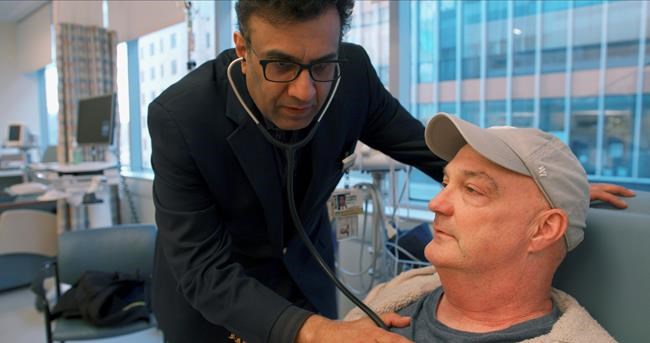
In this February 2019 photo provided by Brigham and Women's Hospital, Dr. Mandeep Mehra, executive director of Brigham’s Center for Advanced Heart Disease, checks on patient James Sullivon at the hospital in Boston. Sullivon, who received a hepatitis C-positive heart transplant, was given antiviral medicine shortly after the procedure in hopes of blocking hepatitis C infection rather than having to treat it. (Adam Knee/Brigham and Women's Hospital via AP)

“This is about not discarding organs that are medically suitable,” said Dr. Ann Woolley, a Brigham infectious disease specialist who co-authored the study in the New England Journal of Medicine.

Transplanting organs that could infect someone with a liver-damaging virus sounds drastic, but the organ shortage has more hospitals giving it a try. More than 113,000 people are on the national waiting list for a transplant; just 36,529 people got one last year. For heart or lung transplants, about 1,000 people a year die waiting.

“I knew that time was getting shorter for me,” said Rexford Kelley, 71, of Searsport, Maine. So he sought out the Brigham study in hopes that accepting a lung infected with hepatitis C would mean a speedier transplant. “I’m thankful I got the lung,” said the retired state trooper, who now breathes easy enough to get back on the golf course.

Until recently, doctors tended to transplant hepatitis C-infected organs only into patients who already had that virus.

But in 2016, spurred by powerful new drugs that promised to cure hepatitis C, surgeons began experimenting with so-called mismatched transplants — giving infected kidneys to hepatitis-free recipients. If those patients showed signs of infection, they got three months of medicine to beat it back. Last year, small studies at the University of Pennsylvania and Johns Hopkins University showed not only were patients cured of their hepatitis, the new kidney worked fine.

It was time to test more scarce transplants of lungs or hearts. Among the questions: Would hepatitis C make it harder to transplant those more fragile organs? And because the hepatitis medicine costs tens of thousands of dollars, could patients fare as well with a shorter — and cheaper — course of treatment?

In February, Penn researchers reported the standard three-month treatment cured 10 recipients of a hepatitis C-infected heart. One eventually died of organ rejection but the others were faring well.

Brigham researchers took a different approach. Within hours of either a heart or lung transplant, participants started taking medicine for a month in hopes of blocking hepatitis C infection rather than having to treat it.

The study detailed how about half of the 69 transplant recipients so far are faring. Six months after transplant, none showed signs of hepatitis C and their organs were functioning well. One died eight months after transplant from a bacterial infection unrelated to the hepatitis but 15 are doing well a year later.

Woolley said researchers might test even shorter treatment, noting the virus was undetectable at two weeks.

It might work “because maybe the virus hasn’t had the chance to establish itself,” said Dr. Peter Reese, a Penn kidney specialist who helped pioneer hepatitis C mismatch transplants but wasn’t involved in the latest research. But, “if the short course doesn’t work, it’s incumbent to be up front with patients about what they would do.”
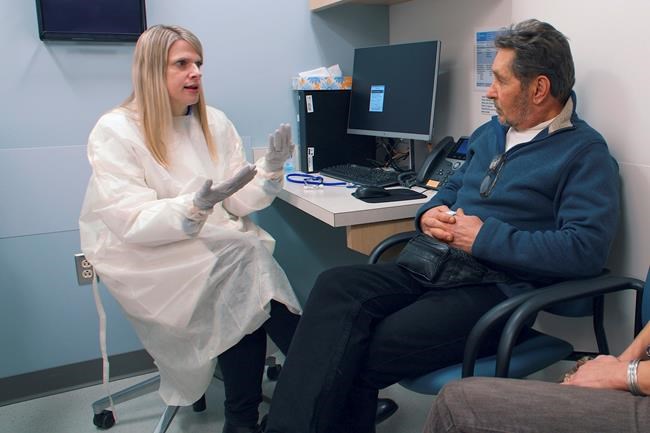
In this February 2019 photo provided by Brigham and Women's Hospital, Dr. Ann Woolley, an infectious disease specialist, speaks with patient Mark Natichinoi at the hospital in Boston. Natichinoi, who received a hepatitis C-positive lung transplant, was given antiviral medicine shortly after the procedure in hopes of blocking hepatitis C infection rather than having to treat it. (Adam Knee/Brigham and Women's Hospital via AP)

Larger and longer studies are key for all hepatitis C-infected transplants, Reese added.

Many hospitals aren’t waiting for more evidence. Last year, there were 1,274 hepatitis C-infected transplants in people without the virus compared to several hundred the year before, according to the United Network for Organ Sharing, which oversees the nation’s transplant system.

“It’s not established that cure rates are 100 per cent,” cautioned UNOS chief medical officer Dr. David Klassen. “To believe they would be, would be a little naive.”

But one Penn heart recipient said patients should know this option could cut their waiting time. Tom Giangiulio Jr., 59, of Waterford Township, New Jersey, was steadily deteriorating after two years awaiting a transplant when doctors asked if he’d be their study’s first volunteer. He was transplanted in June 2017.

“My first thought was saving my life,” he recalled. “My next thought was, ‘I’m the front-runner here. What I’m doing could open up a tremendous number of hearts to other recipients.'”

___

The Associated Press Health & Science Department receives support from the Howard Hughes Medical Institute’s Department of Science Education. The AP is solely responsible for all content.


Report Error Submit a Tip

More Stories

$60M, six-storey Harbourview Terrace due to open in June 2028

Aaron Epp 4 minute read Preview

$60M, six-storey Harbourview Terrace due to open in June 2028

Aaron Epp 4 minute read Friday, Aug. 7, 2026

They donned high-vis vests and brandished shovels with gold-coloured blades Friday morning at the ceremonial groundbreaking for a multi-family residential development in northeast Winnipeg.

Concord Projects has started construction of Harbourview Terrace, the inaugural development by two-year-old real estate company Foxhill Properties. Located in North Kildonan at 1820 De Vries Ave., the $60-million, six-storey apartment building will contain 179 units.

Founder and president Frank Koch-Schulte, who runs the company with his wife Alisha, said Foxhill wants to develop and manage properties with integrity.

“This is kind of like my opportunity to try to do things our way, which I feel is a way that keeps tenants in mind,” Koch-Schulte said. “We live in this neighbourhood. We’re very much invested in seeing quality housing go here.”

Read
Friday, Aug. 7, 2026

Luxury and livability

Todd Lewys 5 minute read Preview

Luxury and livability

Todd Lewys 5 minute read Yesterday at 2:00 AM CDT

Those in the market for a new luxury home tend to be looking for two things.

First, the home must be unique — which is to say it possesses defining design characteristics that set it apart from other homes. Second, while the home must be different, it also must be livable.

Problem is, many home builders get too focused on fashion, which often makes for a visually arresting home that, sadly, isn’t as functional as it could be.

Fortunately, that’s not the case in Maric Homes’ stunning bungalow show home at 2 Woodland Lane in Headingley’s Forest Grove Estates.

Read
Yesterday at 2:00 AM CDT

Cinderella story continues, Sea Bears bounce Bandits in Conference Final

Joshua Frey-Sam 6 minute read Preview

Cinderella story continues, Sea Bears bounce Bandits in Conference Final

Joshua Frey-Sam 6 minute read Updated: Yesterday at 8:02 PM CDT

Just days ago, the Winnipeg Sea Bears were at rock bottom.

The losses had piled up, and the star talent had dwindled. The noise around the club grew, and the confidence from outside the building faded by the day.

Players and coaches alike conveyed the belief that persisted internally, but you wouldn’t fault some fans if those words fell on deaf ears.

Less than a week later, the undermanned and underestimated Sea Bears find themselves two wins away from the tippy top of the Canadian Elite Basketball League’s mountain after a second-straight convincing playoff victory, this time a 107-96 decision over the Vancouver Bandits in the Western Conference Final at the Langley Events Centre in British Columbia on Saturday.

Read
Updated: Yesterday at 8:02 PM CDT

Study: Safe to transplant hepatitis C-infected hearts, lungs

Lauran Neergaard, The Associated Press 5 minute read Preview

Study: Safe to transplant hepatitis C-infected hearts, lungs

Lauran Neergaard, The Associated Press 5 minute read Wednesday, Apr. 3, 2019

WASHINGTON - Doctors can safely transplant hepatitis C-infected lungs and hearts into people desperate for a new organ, say researchers who may have found a way to protect those patients from getting the risky virus.

The experiment, reported Wednesday, is the latest attempt to put a dent in the nation's long transplant waiting list by using organs that otherwise would be wasted, often ones from victims of the opioid epidemic.

The new twist: Instead of trying to cure hepatitis C after it took hold in transplant recipients, researchers at Boston's Brigham and Women's Hospital say a faster, cheaper treatment seems to prevent infection in the first place.

"This is about not discarding organs that are medically suitable," said Dr. Ann Woolley, a Brigham infectious disease specialist who co-authored the study in the New England Journal of Medicine.

Read
Wednesday, Apr. 3, 2019

Gilbert Plains Country Club closes for remainder of season due to flood damage

Ken Wiebe 6 minute read Preview

Gilbert Plains Country Club closes for remainder of season due to flood damage

Ken Wiebe 6 minute read Thursday, Aug. 6, 2026

Scott McCallum has made the trek to the Gilbert Plains Country Club clubhouse countless times.

But this was the first time the golf professional and general manager of the course required hip waders to get to his office.

Walking hand in hand with his wife Lindsay, McCallum didn’t need much time to see the devastation caused by the flash flooding in the Parkland region in late June.

“We’re on a river and it’s a beautiful golf course, but anytime you’re on a body of water you know that you’re taking a chance of events like this happening,” McCallum said in a telephone interview. “To this magnitude, we’ve never seen anything like it before. So, this is new to us.

Read
Thursday, Aug. 6, 2026

Vibrant Norwood apartment garden a labour of love to honour green thumb’s late partner

David Sanderson 7 minute read Preview

Vibrant Norwood apartment garden a labour of love to honour green thumb’s late partner

David Sanderson 7 minute read Yesterday at 6:00 AM CDT

St. Vital resident Rob Duncan can’t pinpoint when he first noticed an award-winning garden blanketing the grounds of a two-storey St. Mary’s Road apartment block, near Coniston Street.

Perhaps he was on his way home from work and caught a glimpse of it out of the corner of his eye. Or maybe he was running errands in the Norwood Flats area and paused to admire the array of annuals, perennials and potted plants that extends from the block’s doorway to the front curb.

What Duncan does know for certain is that after spying the urban oasis, twice fêted in Take Pride Winnipeg’s annual Winnipeg in Bloom competition, he couldn’t unsee it.

“First of all, the pink building really stands out,” Duncan says, referring to the brightly painted California Apartments complex at 268 St. Mary’s Rd. “But then you have the pergola, the rock garden, the flowers and trees… a sea of colour on a very busy street.”

Read
Yesterday at 6:00 AM CDT